Could It Be Fraud? – Consider Civil Jury Instructions To Evaluate

There are different criteria for different types of fraud and fraudulent intent or conduct. Thus, for example, I have pasted below some of the California Civil Jury Instructions (“CACI”) relating to allegations of fraud, including CACI Nos. 1900-1908. You might not be aware that there are types of fraud in which intentional lying in the statement or representation is not a required element.

CACI No. 1900 pertains to intentional misrepresentation; however CACI Nos. 1901-1908, respectively, relate to concealment, false promise, negligent misrepresentation, opinions of statements of fact, definition of important fact/promise, misrepresentations made to persons other than the plaintiff, reliance, and reasonable reliance.

There are also other types and definitions or elements of fraud or fraudulent intent or conduct that might be applied depending on the specific facts of the case – such as, for example, scienter under the federal securities laws, or the Model Civil Jury Instructions for the District Courts of the Ninth Circuit, etc.

Briefly, on a related but different topic that is relevant and that will become more relevant – consider someone using AI to produce materials. Apparently, or at least I have read, that in its current development AI produced materials are or might be reliable but only to a certain extent, and they can contain entirely erroneous or unsupported materials or statements.

However, for the purpose of this post I have pasted below only CACI Nos. 1900-1908, as those instructions will provide you with a good introduction to this topic. The following are CACI Nos. 1900-1908, in which you can fill in the blanks for possible different types of fraud and fraudulent intent or conduct.

1900. Intentional Misrepresentation

[Name of plaintiff] claims that [name of defendant] made a false representation that harmed [him/her/nonbinary pronoun/it]. To establish this claim, [name of plaintiff] must prove all of the following:

1. That [name of defendant] represented to [name of plaintiff] that a fact was true;

2. That [name of defendant]’s representation was false;

3. That [name of defendant] knew that the representation was false when [he/she/nonbinary pronoun] made it, or that [he/she/nonbinary pronoun] made the representation recklessly and without regard for its truth;

4. That [name of defendant] intended that [name of plaintiff] rely on the representation;

5. That [name of plaintiff] reasonably relied on [name of defendant]’s representation;

6. That [name of plaintiff] was harmed; and

7. That [name of plaintiff]’s reliance on [name of defendant]’s representation was a substantial factor in causing [his/her/nonbinary pronoun/its] harm.

New September 2003; Revised December 2012, December 2013

1901. Concealment

[Name of plaintiff] claims that [he/she/nonbinary pronoun] was harmed because [name of defendant] concealed certain information. To establish this claim, [name of plaintiff] must prove all of the following:

[1. (a) That [name of defendant] and [name of plaintiff] were [insert type of fiduciary relationship, e.g., “business partners”]; and

[1. (b) That [name of defendant] intentionally failed to disclose certain facts to [name of plaintiff];]

[or]

[1. That [name of defendant] disclosed some facts to [name of plaintiff] but intentionally failed to disclose [other/another] fact[s], making the disclosure deceptive;]

[or]

[1. That [name of defendant] intentionally failed to disclose certain facts that were known only to [him/her/nonbinary pronoun/it] and that [name of plaintiff] could not have discovered;]

[or]

[1. That [name of defendant] prevented [name of plaintiff] from discovering certain facts;]

2. That [name of plaintiff] did not know of the concealed fact[s];

3. That [name of defendant] intended to deceive [name of plaintiff] by concealing the fact[s];

4. That had the omitted information been disclosed, [name of plaintiff] reasonably would have behaved differently;

5. That [name of plaintiff] was harmed; and

6. That [name of defendant]’s concealment was a substantial factor in causing [name of plaintiff]’s harm.

New September 2003; Revised October 2004, December 2012, June 2014, June 2015

1902. False Promise

[Name of plaintiff] claims [he/she/nonbinary pronoun] was harmed because [name of defendant] made a false promise. To establish this claim, [name of plaintiff] must prove all of the following:

1. That [name of defendant] made a promise to [name of plaintiff];

2. That [name of defendant] did not intend to perform this promise when [he/she/nonbinary pronoun] made it;

3. That [name of defendant] intended that [name of plaintiff] rely on this promise;

4. That [name of plaintiff] reasonably relied on [name of defendant]’s promise;

5. That [name of defendant] did not perform the promised act;

6. That [name of plaintiff] was harmed; and

7. That [name of plaintiff]’s reliance on [name of defendant]’s promise was a substantial factor in causing [his/her/nonbinary pronoun/its] harm.

New September 2003; Revised December 2012, December 2013

1903. Negligent Misrepresentation

[Name of plaintiff] claims [he/she/nonbinary pronoun/it] was harmed because [name of defendant] negligently misrepresented a fact. To establish this claim, [name of plaintiff] must prove all of the following:

1. That [name of defendant] represented to [name of plaintiff] that a fact was true;

2. That [name of defendant]’s representation was not true;

3. That [although [name of defendant] may have honestly believed that the representation was true,] [[name of defendant]/he/she/nonbinary pronoun] had no reasonable grounds for believing the representation was true when [he/she/nonbinary pronoun] made it;

4. That [name of defendant] intended that [name of plaintiff] rely on this representation;

5. That [name of plaintiff] reasonably relied on [name of defendant]’s representation;

6. That [name of plaintiff] was harmed; and

7. That [name of plaintiff]’s reliance on [name of defendant]’s representation was a substantial factor in causing [his/her/nonbinary pronoun/its] harm.

New September 2003; Revised December 2009, December 2013

1904. Opinions as Statements of Fact

Ordinarily, an opinion is not considered a representation of fact. An opinion is a person’s belief that a fact exists, a statement regarding a future event, or a judgment about quality, value, authenticity, or similar matters. However, [name of defendant]’s opinion is considered a representation of fact if [name of plaintiff] proves that:

[[Name of defendant] claimed to have special knowledge about the subject matter that [name of plaintiff] did not have;] [or]

[[Name of defendant] made a representation, not as a casual expression of belief, but in a way that declared the matter to be true;] [or]

[[Name of defendant] had a relationship of trust and confidence with [name of plaintiff];] [or]

[[Name of defendant] had some other special reason to expect that [name of plaintiff] would rely on the defendant’s opinion.]

New September 2003; Revised April 2004, May 2020

1905. Definition of Important Fact/Promise Revoked December 2013 See CACI No. 1908, Reasonable Reliance (below).

1906. Misrepresentations Made to Persons Other Than the Plaintiff

[Name of defendant] is responsible for a representation that was not made directly to [name of plaintiff] if [he/she/nonbinary pronoun/it] made the representation [to a group of persons including [name of plaintiff]] [or] [to another person, intending or reasonably expecting that it would be repeated to [name of plaintiff]].

New September 2003

1907. Reliance

[Name of plaintiff] relied on [name of defendant]’s [misrepresentation/concealment/false promise] if:

1. The [misrepresentation/concealment/false promise] substantially influenced [him/her/nonbinary pronoun/it] to [insert brief description of the action, e.g., “buy the house”]; and

2. [He/She/Nonbinary pronoun/It] would probably not have [e.g., bought the house] without the [misrepresentation/concealment/false promise].

It is not necessary for a [misrepresentation/concealment/false promise] to be the only reason for [name of plaintiff]’s conduct.

New September 2003; Revised December 2013

1908. Reasonable Reliance

In determining whether [name of plaintiff]’s reliance on the [misrepresentation/concealment/false promise] was reasonable, [he/she/ nonbinary pronoun/it] must first prove that the matter was material. A matter is material if a reasonable person would find it important in deciding what to do.

If you decide that the matter is material, you must then decide whether it was reasonable for [name of plaintiff] to rely on the [misrepresentation/ concealment/false promise]. In making this decision, take into consideration [name of plaintiff]’s intelligence, knowledge, education, and experience.

However, it is not reasonable for anyone to rely on a [misrepresentation/ concealment/false promise] that is preposterous. It also is not reasonable for anyone to rely on a [misrepresentation/concealment/false promise] if facts that are within [his/her/nonbinary pronoun] observation show that it is obviously false.

New September 2003; Revised October 2004, December 2013, May 2020

* * * * *

Regards, and best to you,

David Tate, Esq.

Thank you for reading. Please do pass this blog and blog post and information to other people who would be interested as it is only through collaboration and sharing that great things and success are more quickly achieved.

David Tate, Esq. (and inactive CPA)

  • Business litigation and disputes – business, breach of contract/commercial, co-owners, shareholders, investors, founders, workplace and employment, environmental, D&O, governance, boards and committees.
  • Trust, estate and probate court litigation and disputes – trust, estate, probate, elder and dependent abuse, conservatorship, POA, real property, mental health and care, mental capacity, undue influence, conflicts of interest, and contentious administrations.
  • Governance, boards, audit and governance committees, investigations, auditing, ESG, etc.
  • Mediator and facilitating dispute resolution:
    • Trust, estate, probate, conservatorship, elder and dependent abuse, etc.
    • Business, breach of contract/commercial, owner, shareholder, investor, etc.
    • D&O, board, audit and governance committee, accountant and CPA related.
    • Other: workplace and employment, environmental, trade secret.

Remember, every case and situation is different. It is important to obtain and evaluate all of the evidence that is available, and to apply that evidence to the applicable standards and laws. You do need to consult with an attorney and other professionals about your particular situation. This post is not a solicitation for legal or other services inside of or outside of California, and, of course, this post only is a summary of information that changes from time to time, and does not apply to any particular situation or to your specific situation. So . . . you cannot rely on this post for your situation or as legal or other professional advice or representation, or as or for my opinions and views on the subject matter.

Also note – sometimes I include links to or comments about materials from other organizations or people – if I do so, it is because I believe that the materials are worthwhile reading or viewing; however, that doesn’t mean that I don’t or might not have a different view about some or even all of the subject matter or materials, or that I necessarily agree with, or agree with everything about or relating to, that organization or person, or those materials or the subject matter.

Please also subscribe to this blog and my other blog (see below), and connect with me on LinkedIn and Twitter.

My two blogs are:

http://tateattorney.com – business, D&O, audit committee, governance, compliance, etc. – previously at http://auditcommitteeupdate.com

Trust, estate, conservatorship, elder and elder abuse, etc. litigation and contentious administrations http://californiaestatetrust.com

David Tate, Esq. (and inactive California CPA) – practicing only as an attorney in California.
An officer’s oversight duty – In Re McDonald’s Corporation Stockholder Derivative Litigation – Court of Chancery of the State of Delaware

I have pasted below select wording from the Opinion in In Re McDonald’s Corporation Stockholder Derivative Litigation in which the Court held that a corporate officer has an oversight duty (the entire Opinion is 65 pages). In Re McDonald’s Corporation Stockholder Derivative Litigation, Court of Chancery of the State of Delaware, C.A. No. 2021-0324-JTL (January 25, 2023). The Opinion has already resulted in an amount of discussion, and will continue to do so; however, it is my view that the Opinion expresses a view that has been coming step-by-step for a considerable time. This is a developing area of law – the holding in In Re McDonald’s Corporation Stockholder Derivative Litigation will be variously followed, disagreed with, differentiated, or expanded upon in future cases, and in other jurisdictions.

The following is select wording from the Opinion in In Re McDonald’s Corporation Stockholder Derivative Litigation – I have provided you with specific wording so that you can read for yourself – and officers of corporations, whether incorporated in Delaware, or in California, or in some other jurisdiction, should kept this Opinion in mind in addition to the business judgment rule, risk management, compliance and compliance programs, entity controls, Dept. of Justice compliance program guidance, specific areas of liability for which officers have already been held personally liable (e.g., environmental contamination, and food safety), and the like. Below the following quoted language I have also provided a complete pdf of the Opinion in In Re McDonald’s Corporation Stockholder Derivative Litigation.

Generally, following the approach in In Re McDonald’s Corporation Stockholder Derivative Litigation, (1) evaluate whether you have the requisite corporate officer status or standing; and if you do, (2) have you evaluated and considered your area(s) of responsibility and control; (3) have you made an effort or has an effort been made to consider, design, implement and monitor risk management and entity controls and compliance programs in those areas as believed relevant and necessary; and/or (4) are there relevant red flags of which you are aware (or perhaps about which someone in hindsight might argue that you should have been aware)? Obviously such an approach also raises other important issues and questions at law.

The following is quoted from In Re McDonald’s Corporation Stockholder Derivative Litigation * * * * *

            6. The Scope Of An Officer’s Oversight Duty

            For the reasons previously discussed, officers owe duties of oversight comparable to those of directors. But that does not mean that the situational application of those duties will be the same. “Although the fiduciary duty of a Delaware director is unremitting, the exact course of conduct that must be charted to properly discharge that responsibility will change in the specific context of the action the director is taking with regard to either the corporation or its shareholders.” Malone v. Brincat, 722 A.2d 5, 10 (Del. 1998). The same is true for officers, who regularly operate in different contexts than directors.

            Most notably, directors are charged with plenary authority over the business and affairs of the corporation. See 8 Del. C. § 141(a). That means that “the buck stops with the Board.” In re Del Monte Foods Co. S’holders Litig., 25 A.3d 813, 835 (Del. Ch. 2011). It also means that the board has oversight duties regarding the corporation as a whole.

            Although the CEO and Chief Compliance Officer likely will have company-wide oversight portfolios, other officers generally have a more constrained area of authority. With a constrained area of responsibility comes a constrained version of the duty that supports an Information-Systems Claim.12 For example, the Chief Financial Officer is responsible for financial oversight and for making a good faith effort to establish reasonable information systems to cover that area. The Chief Legal Officer is responsible for legal oversight and for making a good faith effort to establish reasonable information systems to cover that area. The executive officer in charge of sales and marketing is not responsible for the financial or legal reporting systems. And of course, the board can tailor the officers’ obligations and responsibilities.

            For similar reasons, officers generally only will be responsible for addressing or reporting red flags within their areas of responsibility, although one can imagine possible exceptions. If a red flag is sufficiently prominent, for example, then any officer might have a duty to report upward about it. An officer who receives credible information indicating that the corporation is violating the law cannot turn a blind eye and dismiss the issue as “not in my area.”

            Another important question is the standard of liability for officers. As with directors, officers only will be liable for violations of the duty of oversight if a plaintiff can prove that they acted in bad faith and hence disloyally.

            As scholars have chronicled, Delaware’s oversight jurisprudence has evolved from the original Caremark decision, where the oversight duty could sound in both loyalty or care, to a strictly loyalty-based regime. 13 The corporation in Caremark had an exculpatory provision that eliminated director liability for breaches of the duty of care. After noting that the failure to ensure that a corporation information and reporting system existed could, “under some circumstances . . . render a director liable for losses caused by non-compliance with applicable legal standards,” Chancellor Allen observed in a footnote that “questions of waiver of liability under certificate provisions authorized by 8 Del. C. § 102(b)(7) may also be faced.” Caremark, 698 A.2d at 970 & n.27. That comment only makes sense if, in the absence of an exculpatory provision, a breach of the duty of care could support an otherwise actionable claim. Other references in the decision also acknowledged that a breach of the duty of care could lead to a failure of oversight.14

            In another portion of the opinion, however, Chancellor Allen expressed his view that a pure breach of the duty of care, absent conduct that rose to the level of bad faith, should not support a monetary damages award:

Indeed, one wonders on what moral basis might shareholders attack a good faith business decision of a director as “unreasonable” or “irrational”. Where a director in fact exercises a good faith effort to be informed and to exercise appropriate judgment, he or she should be deemed to satisfy fully the duty of attention. If the shareholders thought themselves entitled to some other quality of judgment than such a director produces in the good faith exercise of the powers of office, then the shareholders should have elected other directors. 15

It is possible to read this passage as indicating that a breach of the duty of care should never support liability, whether as an oversight claim or otherwise.

            Writing as a member of this court, Chief Justice Strine took up this aspect of Caremark and held that director liability for oversight claims always requires a showing of bad faith. See Guttman v. Huang, 823 A.2d 492, 506 (Del. Ch. 2003). In Stone, the Delaware Supreme Court adopted the Guttman formulation and stated that a breach of the duty of loyalty, such as acting in bad faith, was a “necessary condition to liability.” Stone, 911 A.2d at 364; see Banbridge, supra, at 595. After Stone, then-Vice Chancellor Strine acknowledged that Caremark duties carried overtones of care, but explained that “to hold directors liable for a failure in monitoring, the directors have to have acted with a state of mind consistent with a conscious decision to breach their duty of care.” Desimone v. Barrows, 924 A.2d 908, 935 (Del. Ch. 2007). After becoming the Chief Justice, he authored a Delaware Supreme Court decision that made a similar statement: “If Caremark means anything, it is that a corporate board must make a good faith effort to exercise its duty of care. A failure to make that effort constitutes a breach of the duty of loyalty.” Marchand v. Barnhill, 212 A.3d 805, 824 (Del. 2019).

            There is room to debate whether the same loyalty-based framework that governs directors should apply to officers, or whether officers could be held liable for a failure of oversight caused by a breach of the duty of care.16 To state a care-based claim, a plaintiff would have to plead and later prove that the oversight failure resulted from gross negligence. For purposes of Delaware entity law, a showing of gross negligence requires conduct akin to recklessness.17

            The arguments about the oversight regime that should apply to officers parallel the arguments about whether an officer’s duty of care should resemble the director regime and require a showing of gross negligence, or whether it should track the agency regime and require only simple negligence. Scholars engaged in extensive debate on that topic.18

            The arguments in favor of a less protective standard for officers generally start from the observation that, while directors are part-time monitors who may meet a handful of times per year, officers are full-time employees who are deeply involved in corporate decision-making on a daily basis. Compared to directors, officers have greater knowledge about and responsibility for the areas under their control. They also receive significantly higher levels of compensation for doing their jobs. The arguments in favor of a more protective standard for officers generally rely on the same justifications that support the business judgment rule, including the risk of hindsight bias in judicial decision-making, the relative incompetence of judges in assessing business decisions, the disproportionate level of liability that an individual could face from harm to a large enterprise, the bluntness of liability as a tool for shaping behavior, and a concern that the threat of liability will cause good people to decline to serve. See, e.g., Petrin, supra, at 460–73. Chancellor Allen highlighted some of those arguments in Caremark, when he observed that “a demanding test of liability in the oversight context is probably beneficial to corporate shareholders as a class, as it is in the board decision context, since it makes board service by qualified persons more likely, while continuing to act as a stimulus to good faith performance of duty by such directors.” 698 A.2d at 971.

            When faced with this type of policy decision, Delaware courts generally view the latter set of considerations as more persuasive and opt for a more protective standard. For example, a comparatively recent series of decisions have adopted the director model for analyzing officers’ duty of care.19 Similar policy rationales about protecting directors and officers against unjustified lawsuits, and the importance of encouraging capable people to serve, drive Delaware’s broad construction of advancement and indemnification rights.20

            A recent event with potential implications for officers’ oversight duties is the statutory amendment authorizing limited exculpation for officers. Historically, officers have not been entitled to exculpation, rendering them subject to liability for the duty of care. See Gantler, 965 A.2d at 709 n.37. Effective August 1, 2022, the General Assembly amended Section 102(b)(7) of the DGCL to authorize corporations to exculpate officers for care-based liability for direct claims by stockholders. Del. S.B. 273, 151st Gen. Assem., 83 Del. Laws ch. 377 (2022). The amendment did not authorize exculpation for “any action by or in the right of the corporation.” Id.

            The bifurcated approach taken by the amendment might imply a legislative intent to preserve care-based liability for officers for derivative claims, including for breaches of the duty of oversight. But that is not the only inference. Claims for breaches of fiduciary duty generally focus on actions or decisions that a fiduciary has taken affirmatively. Although Delaware authorities regularly equate action and conscious inaction,21 humans intuitively distinguish between the two and associate greater culpability with an affirmative act rather than a conscious decision not to act.22 The amendment to Section 102(b)(7) can be read as preserving care-based liability for officers when they act in a grossly negligent (i.e., reckless) manner. It need not be read to suggest an intent to override the loyalty-based premise of oversight liability for officers and preserve care-based liability in that area.

            This decision concludes that oversight liability for officers requires a showing of bad faith. The officer must consciously fail to make a good faith effort to establish information systems, or the officer must consciously ignore red flags.

End of quoted wording from the Opinion in In Re McDonald’s Corporation Stockholder Derivative Litigation * * * * *

The following is a pdf of the complete Opinion in In Re McDonald’s Corporation Stockholder Derivative Litigation.

* * * * *

Regards, and best to you,

David Tate, Esq.

Thank you for reading. Please do pass this blog and blog post and information to other people who would be interested as it is only through collaboration and sharing that great things and success are more quickly achieved.

David Tate, Esq. (and inactive CPA)

  • Business litigation and disputes – business, breach of contract/commercial, co-owners, shareholders, investors, founders, workplace and employment, environmental, D&O, governance, boards and committees.
  • Trust, estate and probate court litigation and disputes – trust, estate, probate, elder and dependent abuse, conservatorship, POA, real property, mental health and care, mental capacity, undue influence, conflicts of interest, and contentious administrations.
  • Governance, boards, audit and governance committees, investigations, auditing, ESG, etc.
  • Mediator and facilitating dispute resolution:
    • Trust, estate, probate, conservatorship, elder and dependent abuse, etc.
    • Business, breach of contract/commercial, owner, shareholder, investor, etc.
    • D&O, board, audit and governance committee, accountant and CPA related.
    • Other: workplace and employment, environmental, trade secret.

Remember, every case and situation is different. It is important to obtain and evaluate all of the evidence that is available, and to apply that evidence to the applicable standards and laws. You do need to consult with an attorney and other professionals about your particular situation. This post is not a solicitation for legal or other services inside of or outside of California, and, of course, this post only is a summary of information that changes from time to time, and does not apply to any particular situation or to your specific situation. So . . . you cannot rely on this post for your situation or as legal or other professional advice or representation, or as or for my opinions and views on the subject matter.

Also note – sometimes I include links to or comments about materials from other organizations or people – if I do so, it is because I believe that the materials are worthwhile reading or viewing; however, that doesn’t mean that I don’t or might not have a different view about some or even all of the subject matter or materials, or that I necessarily agree with, or agree with everything about or relating to, that organization or person, or those materials or the subject matter.

Please also subscribe to this blog and my other blog (see below), and connect with me on LinkedIn and Twitter.

My two blogs are:

http://tateattorney.com – business, D&O, audit committee, governance, compliance, etc. – previously at http://auditcommitteeupdate.com

Trust, estate, conservatorship, elder and elder abuse, etc. litigation and contentious administrations http://californiaestatetrust.com

David Tate, Esq. (and inactive California CPA) – practicing only as an attorney in California.

Understanding the basics of employee personnel files – forwarding from Weintraub Tobin

I have provided below a link to a video (YouTube) from California law firm Weintraub Tobin discussing personnel files – this is a good discussion for every employer to know and to be mindful of, or simply to review, and also can relate to workplace and employer/employee compliance, risk and liability management, privacy, and perhaps even some aspects of ESG.

It should not be necessary for me to add; however, the video and discussion apply only to California people, situations and entities, and only to California law. Please also see my limitations and disclaimer below – and, I am not associated with Weintraub but am merely forwarding their video.

* * * * * * *

Regards, and best to you,

David Tate, Esq.

Thank you for reading. Please do pass this blog and blog post and information to other people who would be interested as it is only through collaboration and sharing that great things and success are more quickly achieved.

David Tate, Esq. (and inactive CPA)

  • Business litigation and disputes – business, breach of contract/commercial, co-owners, shareholders, investors, founders, workplace and employment, environmental, D&O, governance, boards and committees.
  • Trust, estate and probate court litigation and disputes – trust, estate, probate, elder and dependent abuse, conservatorship, POA, real property, mental health and care, mental capacity, undue influence, conflicts of interest, and contentious administrations.
  • Governance, boards, audit and governance committees, investigations, auditing, ESG, etc.
  • Mediator and facilitating dispute resolution:
    • Trust, estate, probate, conservatorship, elder and dependent abuse, etc.
    • Business, breach of contract/commercial, owner, shareholder, investor, etc.
    • D&O, board, audit and governance committee, accountant and CPA related.
    • Other: workplace and employment, environmental, trade secret.

Remember, every case and situation is different. It is important to obtain and evaluate all of the evidence that is available, and to apply that evidence to the applicable standards and laws. You do need to consult with an attorney and other professionals about your particular situation. This post is not a solicitation for legal or other services inside of or outside of California, and, of course, this post only is a summary of information that changes from time to time, and does not apply to any particular situation or to your specific situation. So . . . you cannot rely on this post for your situation or as legal or other professional advice or representation, or as or for my opinions and views on the subject matter.

Also note – sometimes I include links to or comments about materials from other organizations or people – if I do so, it is because I believe that the materials are worthwhile reading or viewing; however, that doesn’t mean that I don’t or might not have a different view about some or even all of the subject matter or materials, or that I necessarily agree with, or agree with everything about or relating to, that organization or person, or those materials or the subject matter.

Please also subscribe to this blog and my other blog (see below), and connect with me on LinkedIn and Twitter.

My two blogs are:

http://tateattorney.com – business, D&O, audit committee, governance, compliance, etc. – previously at http://auditcommitteeupdate.com

Trust, estate, conservatorship, elder and elder abuse, etc. litigation and contentious administrations http://californiaestatetrust.com

David Tate, Esq. (and inactive California CPA) – practicing only as an attorney in California.
David Tate, Esq. – mediator and dispute resolution services

Dear Connections and Others: 

I am making this post to discuss my services as a mediator. I provide reasonably priced mediator and dispute resolution services, in addition to my litigation practice. Toward the end of 2022 I started to expand my mediator practice to about 20% of my practice. I provide services in California only.

My services as mediator have primarily been in the following litigation: trust, estate, elder abuse, conservatorship, POA, accounting, contentious administration, real property, breach of contract, commercial, and internal business, co-owner, board/director/committee, shareholder, founder, investor, and workplace cases and disputes. I also have experience in other areas. 

Please feel free to contact me informally to discuss mediation and dispute resolution opportunities generally or a specific case or situation where a mediator is required or could simply be helpful. I like helping people get to settlement, answers, resolution and moving forward.    

My current rates are the following (although I have flexibility in some cases): 

Remote/zoom mediations: current standard mediator rate: $300 per hour plus a $200 setup fee, to be apportioned between the parties. 

In person mediations: current standard mediator rate: $300 per hour plus a $200 setup fee, to be apportioned between the parties – plus a per party room cost of approximately $60 per hour (or less if possible).   

You will find some of my mediator discussions on my blogs in addition to other posts (see blog addresses below).

     Recent blog posts on http://californiaestatetrust.com: mediation tips video, Gordon v. Ervin Cohen & Jessup LLP. 

     Recent blog posts on http://tateattorney.com: SV Bank, internal audit, California mental health. 

Thank you. Again, please also feel free to contact me informally. Email: dave@tateattorney.com

Thank you for reading. Please do pass this blog and blog post and information to other people who would be interested as it is only through collaboration and sharing that great things and success are more quickly achieved.

* * * * * * *

Best to you, David Tate, Esq. – Email: dave@tateattorney.com

David Tate, Esq. (and inactive CPA)

  • Business litigation and disputes – business, breach of contract/commercial, co-owners, shareholders, investors, founders, workplace and employment, environmental, D&O, governance, boards and committees.
  • Trust, estate and probate court litigation and disputes – trust, estate, probate, elder and dependent abuse, conservatorship, POA, real property, mental health and care, mental capacity, undue influence, conflicts of interest, and contentious administrations.
  • Governance, boards, audit and governance committees, investigations, auditing, ESG, etc.
  • Mediator and facilitating dispute resolution:
    • Trust, estate, probate, conservatorship, elder and dependent abuse, etc.
    • Business, breach of contract/commercial, owner, shareholder, investor, etc.
    • D&O, board, audit and governance committee, accountant and CPA related.
    • Other: workplace and employment, environmental, trade secret.

Remember, every case and situation is different. It is important to obtain and evaluate all of the evidence that is available, and to apply that evidence to the applicable standards and laws. You do need to consult with an attorney and other professionals about your particular situation. This post is not a solicitation for legal or other services inside of or outside of California, and, of course, this post only is a summary of information that changes from time to time, and does not apply to any particular situation or to your specific situation. So . . . you cannot rely on this post for your situation or as legal or other professional advice or representation, or as or for my opinions and views on the subject matter.

Also note – sometimes I include links to or comments about materials from other organizations or people – if I do so, it is because I believe that the materials are worthwhile reading or viewing; however, that doesn’t mean that I don’t or might not have a different view about some or even all of the subject matter or materials, or that I necessarily agree with, or agree with everything about or relating to, that organization or person, or those materials or the subject matter.

Please also subscribe to this blog and my other blog (see below), and connect with me on LinkedIn and Twitter.

My two blogs are:

http://tateattorney.com – business, D&O, audit committee, governance, compliance, etc. – previously at http://auditcommitteeupdate.com

Trust, estate, conservatorship, elder and elder abuse, etc. litigation and contentious administrations http://californiaestatetrust.com

David Tate, Esq. (and inactive California CPA) – practicing only as an attorney in California.
Silicon Valley Bank – what’s the plan and looking for answers, or looking for answers and what’s the plan . . . ?

Silicon Valley Bank – what’s the plan and looking for answers, or looking for answers and what’s the plan . . . ?

March 14, 2023, update: the Federal Reserve Board has announced that Vice Chair for Supervision Michael S. Barr is leading a review of the supervision and regulation of Silicon Valley Bank, with the review to be publicly released by May 1. Tate comments – that sounds like a fairly quick review – perhaps it will not be as in-depth.

In some ways this post is strangely similar to a recent December 8, 2022, post pertaining to FTX (Fallout from FTX (and continuing) https://tateattorney.com/2022/12/08/fallout-from-ftx-and-continuing/

Obviously the FTX and Silicon Valley Bank situations are different. Any yet, in both situations many financially sophisticated people, depositors, savers, and investors have lost or will lose money (some a lot of money), or have otherwise been caught up in the collapse. Below are some of my comments currently.

The chorus is the same: what’s the plan and looking for answers, or looking for answers and what’s the plan . . . . (and also how could this happen, and who is to blame, of course)?

Just because something unexpected or negative or bad happens does not by itself mean that someone is legally at fault or liable for wrongdoing or loss, or that there were related reliance, causation, damages, etc. We need more information to evaluate the issues – obviously there needs to be an in-depth investigation (or investigations) by qualified investigators, which presumably is (or are) already in progress. Civil lawsuits will be filed for money damages. Is there a possibility of criminal claims – it is too early to evaluate or to know.

Post-collapse actions, representations and statements also will be evaluated. In the FTX situation significant post-collapse interviews and public statements were made (ill-advisedly in my view) (and apparently without an attorney present, and perhaps without sufficient pre-interview or statement preparation, and possible agreed-upon procedures, questions, and assurances, and possible post-interview review, input and authorization procedures).

The people who are already caught up or who might become caught up in this wear many different hats and hold different positions.

It is also sounding like there might be or already is a need for governmental leadership to publicly provide reassurance (with specifics and evidence, not generalities) about the integrity, safety, trustworthiness, fairness, and governmental oversight and regulation of the banking system and institutions, investment system and institutions, and entity controls and processes.

As the comments and accusations start slinging, remember that being caught up in the situation does not by itself mean or establish legal fault or liability for wrongdoing or loss (i.e., authority, duty, breach, causation, liability, damages, mitigation, etc.) – possible hats and being caught up in the situation include the following people and possible others:

  • CEO (obviously);
  • CFO (obviously);
  • Other CxOs;
  • Board/directors, and possible committees (i.e., audit, governance, risk) (obviously);
  • People who are in SVB’s financial and banking risk function;
  • Possible people within SVB who directly or indirectly acted or did not act;
  • Possible people within SVB who made or who did not make representations;
  • Possible people who directly or indirectly took or obtained related money or assets;
  • Possible people who sold or liquidated SVB stock or other positions;
  • Possible other entities and people who became directly or indirectly involved;
  • External independent auditors – this is a complicated evaluation, for example: what services were retained and were performed, what standards and procedures applied and/or were or perhaps should have been performed, what “opinions” or other reports were provided, what was known, what was unknown, what perhaps should have been known, who was entitled to rely, causation, etc.;
  • General counsel – historically generally not; however, potential general counsel exposure has been expanding in certain circumstances, possibly such as for red flags, entity controls, and related diligence;
  • Internal auditors – historically generally not; however, internal audit/auditors were recently disciplined in the Wells Fargo Bank situation;     
  • Celebrity endorsers (if any) – see my prior post pertaining to FTX https://tateattorney.com/2022/11/23/ftx-cryptocurrency-celebrity-endorser-liability-exposure-in-the-news/;
  • Insurers;
  • Regulators (such as where were they and what were they doing or not doing in all of this);
  • Investor/investment entities and/or advisors or representatives;
  • Other banks and lenders, possible guarantors;
  • Investors (including the “investment small” people who are really at possible unrecoverable loss);
  • Customers, depositors, and savers (including the “financially small” people who are really at possible unrecoverable loss);
  • Possible third-party entities with which SVB contracted;
  • Professional licensing entities; and
  • More: possibly/probably more.

Thank you for reading. Please do pass this blog and blog post and information to other people who would be interested as it is only through collaboration and sharing that great things and success are more quickly achieved.

* * * * * * *

Best to you, David Tate, Esq.

David Tate, Esq. (and inactive CPA)

  • Business litigation and disputes – business, breach of contract/commercial, co-owners, shareholders, investors, founders, workplace and employment, environmental, D&O, governance, boards and committees.
  • Trust, estate and probate court litigation and disputes – trust, estate, probate, elder and dependent abuse, conservatorship, POA, real property, mental health and care, mental capacity, undue influence, conflicts of interest, and contentious administrations.
  • Governance, boards, audit and governance committees, investigations, auditing, ESG, etc.
  • Mediator and facilitating dispute resolution:
    • Trust, estate, probate, conservatorship, elder and dependent abuse, etc.
    • Business, breach of contract/commercial, owner, shareholder, investor, etc.
    • D&O, board, audit and governance committee, accountant and CPA related.
    • Other: workplace and employment, environmental, trade secret.

Remember, every case and situation is different. It is important to obtain and evaluate all of the evidence that is available, and to apply that evidence to the applicable standards and laws. You do need to consult with an attorney and other professionals about your particular situation. This post is not a solicitation for legal or other services inside of or outside of California, and, of course, this post only is a summary of information that changes from time to time, and does not apply to any particular situation or to your specific situation. So . . . you cannot rely on this post for your situation or as legal or other professional advice or representation, or as or for my opinions and views on the subject matter.

Also note – sometimes I include links to or comments about materials from other organizations or people – if I do so, it is because I believe that the materials are worthwhile reading or viewing; however, that doesn’t mean that I don’t or might not have a different view about some or even all of the subject matter or materials, or that I necessarily agree with, or agree with everything about or relating to, that organization or person, or those materials or the subject matter.

Please also subscribe to this blog and my other blog (see below), and connect with me on LinkedIn and Twitter.

My two blogs are:

http://tateattorney.com – business, D&O, audit committee, governance, compliance, etc. – previously at http://auditcommitteeupdate.com

Trust, estate, conservatorship, elder and elder abuse, etc. litigation and contentious administrations http://californiaestatetrust.com

David Tate, Esq. (and inactive California CPA) – practicing only as an attorney in California.
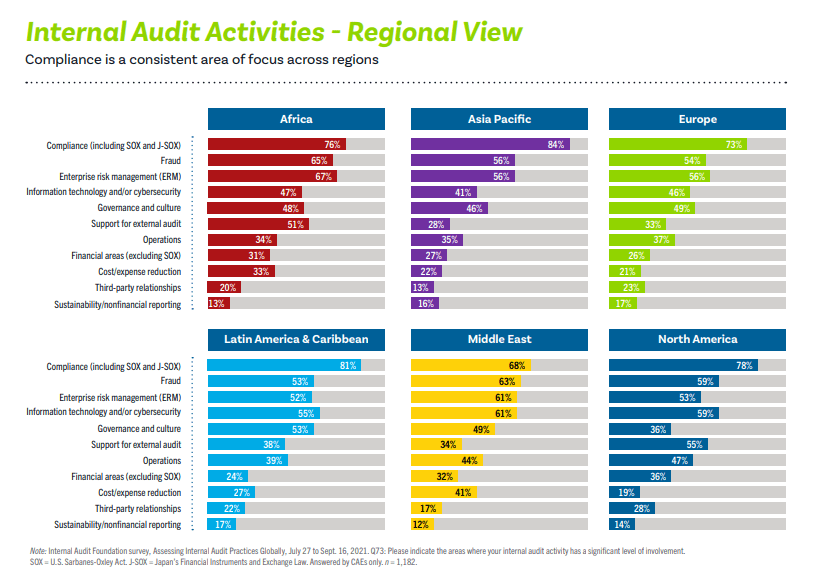
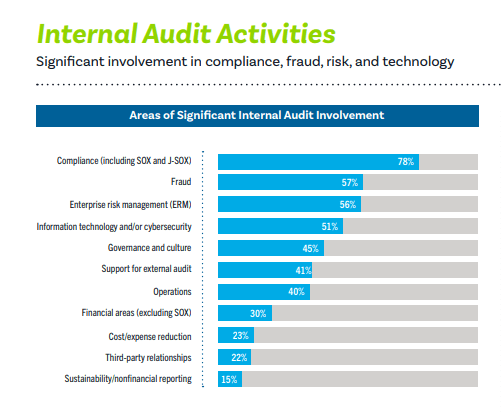
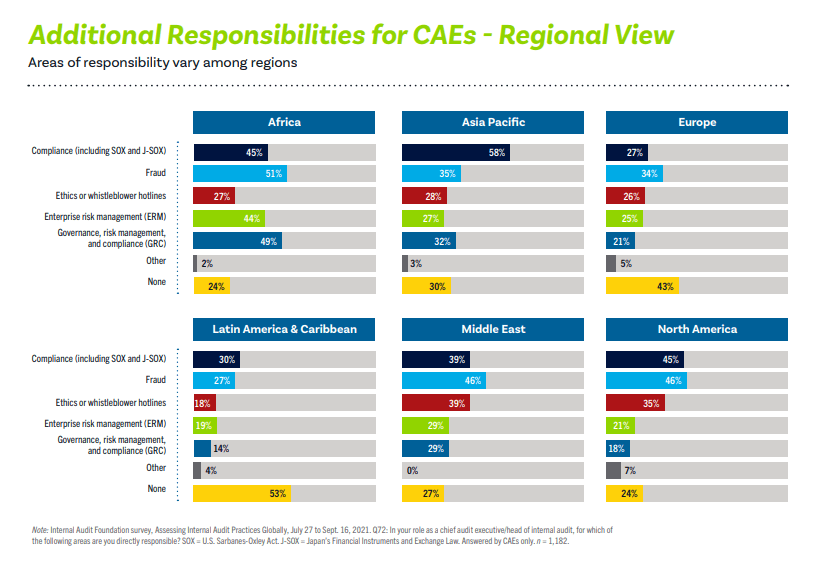
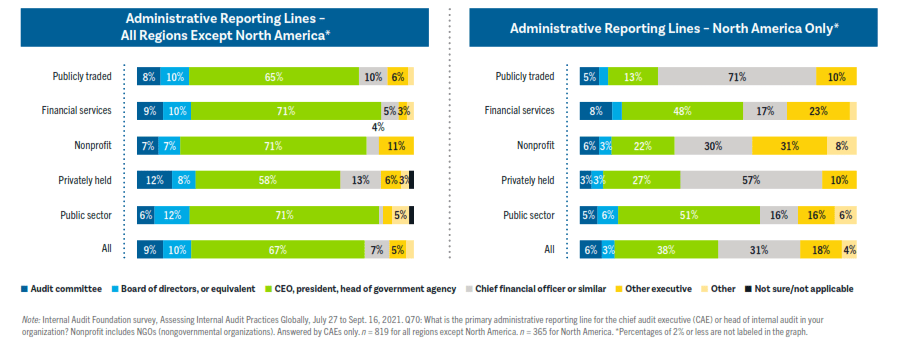
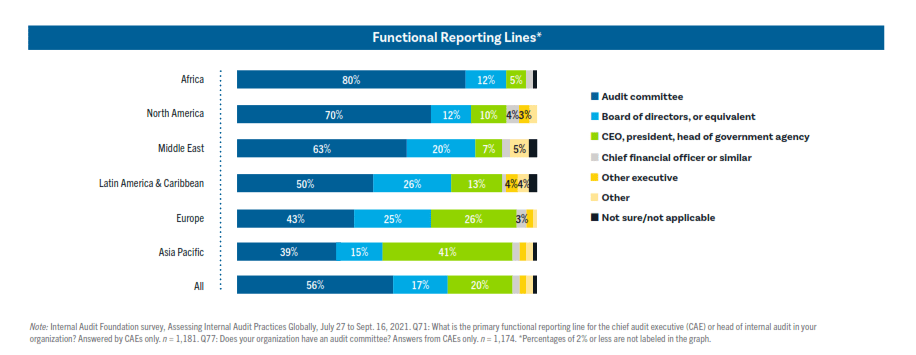
Interesting clips from the Internal Audit Foundation 2022 Premier Global Research – and this is a time of opportunity for internal audit to provide value and help to others

I have provided below clips from the Internal Audit Foundation 2022 Premier Global Research paper pertaining to how internal audit primarily functions and reports from an overview perspective. This is a time of opportunity for internal audit to provide help and value to boards and board committees including audit and governance committees, management, and internal operations. One key is to identify, educate and connect internal audit with the people and functions within the organization that could benefit from internal audit’s involvement, and to also identify the areas, issues, tasks, and problems in which internal audit can help. Typical areas, issues, tasks or problems include compliance, internal controls and monitoring, fraud, cybersecurity, governance, investigations, environmental, ESG, workplace, FCPA, legal and compliance issues, and any number of issues that might become known during the independent audit including the areas in which the outside independent auditor is required to communicate with the audit committee or those in charge of governance including, for example, about CAMs and the new NOCLAR requirements, and the list goes on. On March 1, 2023, new proposed internal audit professional standards will be circulated for a period of comment – I have not yet seen the proposed new standards; however, it is my understanding that the standards are being modernized and presented in a more unified, simplified manner.

Below are the clips from the Internal Audit Foundation 2022 Premier Global Research paper pertaining to how internal audit primarily functions and reports from an overview perspective – however, as we move through 2023 and thereafter I do expect that future surveys will show changes, increased utilization, and increasing opportunities.

Thank you for reading. Please do pass this blog and blog post and information to other people who would be interested as it is only through collaboration and sharing that great things and success are more quickly achieved.

* * * * * * *

Best to you,

David Tate, Esq. (and inactive CPA)

  • Business litigation and disputes – business, breach of contract/commercial, co-owners, shareholders, investors, founders, workplace and employment, environmental, D&O, governance, boards and committees.
  • Trust, estate and probate court litigation and disputes – trust, estate, probate, elder and dependent abuse, conservatorship, POA, real property, mental health and care, mental capacity, undue influence, conflicts of interest, and contentious administrations.
  • Governance, boards, audit and governance committees, investigations, auditing, ESG, etc.
  • Mediator and facilitating dispute resolution:
    • Trust, estate, probate, conservatorship, elder and dependent abuse, etc.
    • Business, breach of contract/commercial, owner, shareholder, investor, etc.
    • D&O, board, audit and governance committee, accountant and CPA related.
    • Other: workplace and employment, environmental, trade secret.

Remember, every case and situation is different. It is important to obtain and evaluate all of the evidence that is available, and to apply that evidence to the applicable standards and laws. You do need to consult with an attorney and other professionals about your particular situation. This post is not a solicitation for legal or other services inside of or outside of California, and, of course, this post only is a summary of information that changes from time to time, and does not apply to any particular situation or to your specific situation. So . . . you cannot rely on this post for your situation or as legal or other professional advice or representation, or as or for my opinions and views on the subject matter.

Also note – sometimes I include links to or comments about materials from other organizations or people – if I do so, it is because I believe that the materials are worthwhile reading or viewing; however, that doesn’t mean that I don’t or might not have a different view about some or even all of the subject matter or materials, or that I necessarily agree with, or agree with everything about or relating to, that organization or person, or those materials or the subject matter.

Please also subscribe to this blog and my other blog (see below), and connect with me on LinkedIn and Twitter.

My two blogs are:

http://tateattorney.com – business, D&O, audit committee, governance, compliance, etc. – previously at http://auditcommitteeupdate.com

Trust, estate, conservatorship, elder and elder abuse, etc. litigation and contentious administrations http://californiaestatetrust.com

David Tate, Esq. (and inactive California CPA) – practicing only as an attorney in California.
California Mental Health Services Oversight & Accountability Commission, draft Workplace Mental Health Report – a bit like the “S” and some of the “G” in ESG

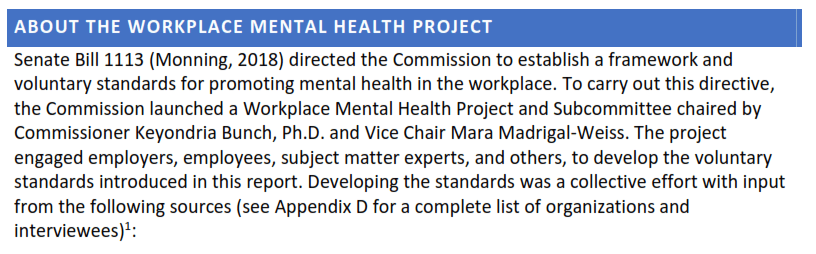
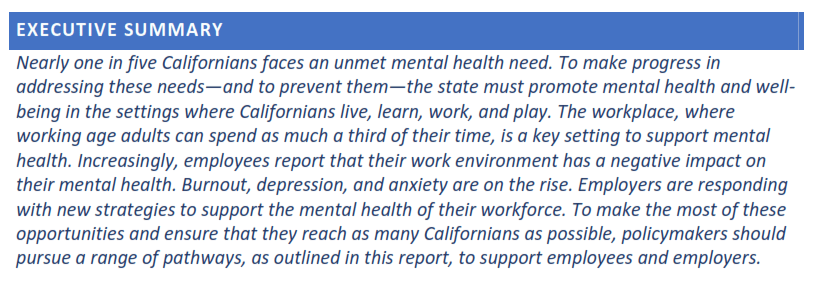
I have provided immediately below a link to and pdf copy of the recent California Mental Health Services Oversight & Accountability Commission draft Workplace Mental Health Report. Historically I have not spent much time discussing mental health and personality topics unless there was something to discuss that was law or mostly law related. However, you can see from recent posts on both of my blogs that for some of my discussions I have started discussing mental health and personality issues as it is not uncommon for those issues to at least indirectly relate to other issues that I do regularly discuss including law, litigation, conduct and possible liability, governance, risk management, and mediation/mediator services (and also discourse, debate, and dispute resolution). The following is a link to and pdf of the recent MHSOAC draft report: https://mhsoac.ca.gov/wp-content/uploads/WORKING-WELL_2022-12-20-18_22.pdf

The following is the short Executive Summary from the report:

The following is a very short history of the Commission from the report:

And the following is part of the longer summary of the project from the report:

Ultimately the report lists five standards which the report summarizes as follows (note, that the report does contain longer discussions about each standard):

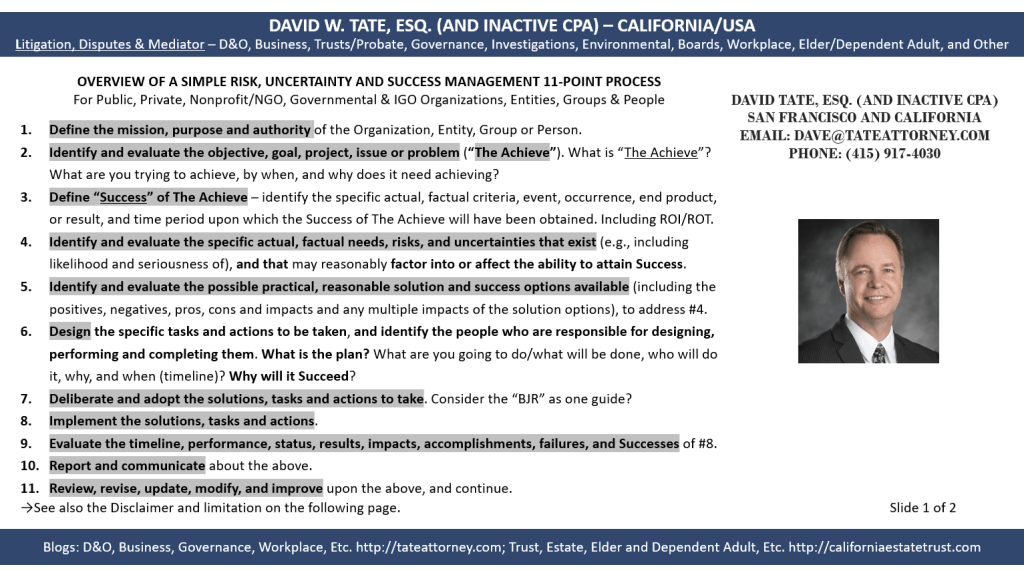
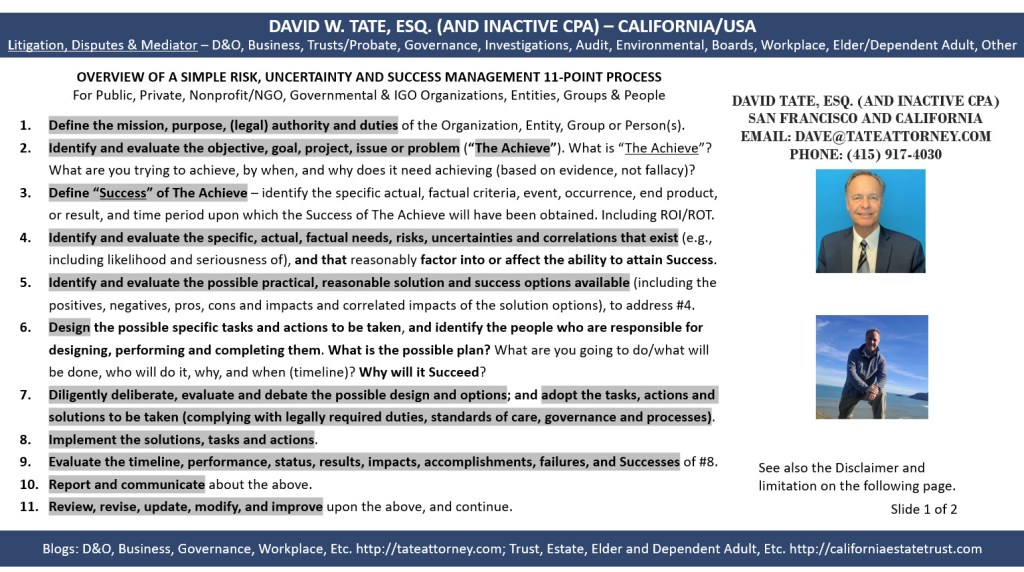
Mental health, personalities, relationships, interactions and discourse, including how people discuss, debate, disagree and argue, are some of the key issues in litigation, dispute resolution, mediation and settlement, and are also key issues and problems in the community at large. I encourage leaders and elected representatives to lead the way by using traditional debate and risk management approaches. These are huge topics – this blog post is merely a recognition. It is obvious that this Commission has spent a lot of time and effort on its draft report. As these topics are so numerous and important, I recommend that the Commission us its current work and first focus on 1, 2, or 3 primary issues and goals; define how the Commission would define “success” at this point-in-time; and identify the specific actions and tasks that will achieve that success. In other words, a specific, targeted risk management approach. Below I have added the most recent versions of my risk management process summary slide, governance definition slide, and pre-mediation questions to consider pdf.

For example, other than raising mental health issues, etc., a primary goal is to get a business to do something or to take a specific action or actions in response. Thus, what will achieve that goal, and what specific actions do you want a business to take? Also consider why a business would not want to do so – what impediments or hesitancy would a business have? The objective is to identify the specific issue, why it is an important issue, the goal, and what actions and tasks will lead to goal “success.”

On the other hand, if the objective or goal is to set standards that a business must implement or follow (all businesses of all sizes?), then perhaps the correct process is legislative. The draft report references “voluntary standards” and “standards.” “Standards” tend to raise issues of law, duty, and breach, etc. “Guidance,” “Best Practices” and similar words also can raise issues of law, duty, and breach, etc. Instead, for example, perhaps the report could contain its specific risk management approach discussion on an issue and goal, followed by a heading such as “References” or similar, followed by possible action ideas that a business might or might not decide to take.

I recommend on these and similar topics and issues that the California government first implement the ideas in governmental entity and governmental workplace settings, to see how they work and to evaluate changes and improvements that are needed.

Thank you for reading. Please do pass this blog and blog post and information to other people who would be interested as it is only through collaboration and sharing that great things and success are more quickly achieved.

* * * * * * *

Best to you,

David Tate, Esq. (and inactive CPA)

  • Business litigation and disputes – business, breach of contract/commercial, co-owners, shareholders, investors, founders, workplace and employment, environmental, D&O, governance, boards and committees.
  • Trust, estate and probate court litigation and disputes – trust, estate, probate, elder and dependent abuse, conservatorship, POA, real property, mental health and care, mental capacity, undue influence, conflicts of interest, and contentious administrations.
  • Governance, boards, audit and governance committees, investigations, auditing, ESG, etc.
  • Mediator and facilitating dispute resolution:
    • Trust, estate, probate, conservatorship, elder and dependent abuse, etc.
    • Business, breach of contract/commercial, owner, shareholder, investor, etc.
    • D&O, board, audit and governance committee, accountant and CPA related.
    • Other: workplace and employment, environmental, trade secret.

Remember, every case and situation is different. It is important to obtain and evaluate all of the evidence that is available, and to apply that evidence to the applicable standards and laws. You do need to consult with an attorney and other professionals about your particular situation. This post is not a solicitation for legal or other services inside of or outside of California, and, of course, this post only is a summary of information that changes from time to time, and does not apply to any particular situation or to your specific situation. So . . . you cannot rely on this post for your situation or as legal or other professional advice or representation, or as or for my opinions and views on the subject matter.

Also note – sometimes I include links to or comments about materials from other organizations or people – if I do so, it is because I believe that the materials are worthwhile reading or viewing; however, that doesn’t mean that I don’t or might not have a different view about some or even all of the subject matter or materials, or that I necessarily agree with, or agree with everything about or relating to, that organization or person, or those materials or the subject matter.

Please also subscribe to this blog and my other blog (see below), and connect with me on LinkedIn and Twitter.

My two blogs are:

http://tateattorney.com – business, D&O, audit committee, governance, compliance, etc. – previously at http://auditcommitteeupdate.com

Trust, estate, conservatorship, elder and elder abuse, etc. litigation and contentious administrations http://californiaestatetrust.com

David Tate, Esq. (and inactive California CPA) – practicing only as an attorney in California.
Hiking picture with the blue pacific in the background 01/21/2023

Thank you for reading. Please do pass this blog and blog post and information to other people who would be interested as it is only through collaboration and sharing that great things and success are more quickly achieved.

* * * * * * *

Best to you,

David Tate, Esq. (and inactive CPA)

  • Business litigation and disputes – business, breach of contract/commercial, co-owners, shareholders, investors, founders, workplace and employment, environmental, D&O, governance, boards and committees.
  • Trust, estate and probate court litigation and disputes – trust, estate, probate, elder and dependent abuse, conservatorship, POA, real property, mental health and care, mental capacity, undue influence, conflicts of interest, and contentious administrations.
  • Governance, boards, audit and governance committees, investigations, auditing, ESG, etc.
  • Mediator and facilitating dispute resolution:
    • Trust, estate, probate, conservatorship, elder and dependent abuse, etc.
    • Business, breach of contract/commercial, owner, shareholder, investor, etc.
    • D&O, board, audit and governance committee, accountant and CPA related.
    • Other: workplace and employment, environmental, trade secret.

Remember, every case and situation is different. It is important to obtain and evaluate all of the evidence that is available, and to apply that evidence to the applicable standards and laws. You do need to consult with an attorney and other professionals about your particular situation. This post is not a solicitation for legal or other services inside of or outside of California, and, of course, this post only is a summary of information that changes from time to time, and does not apply to any particular situation or to your specific situation. So . . . you cannot rely on this post for your situation or as legal or other professional advice or representation, or as or for my opinions and views on the subject matter.

Also note – sometimes I include links to or comments about materials from other organizations or people – if I do so, it is because I believe that the materials are worthwhile reading or viewing; however, that doesn’t mean that I don’t or might not have a different view about some or even all of the subject matter or materials, or that I necessarily agree with, or agree with everything about or relating to, that organization or person, or those materials or the subject matter.

Please also subscribe to this blog and my other blog (see below), and connect with me on LinkedIn and Twitter.

My two blogs are:

http://tateattorney.com – business, D&O, audit committee, governance, compliance, etc. – previously at http://auditcommitteeupdate.com

Trust, estate, conservatorship, elder and elder abuse, etc. litigation and contentious administrations http://californiaestatetrust.com

David Tate, Esq. (and inactive California CPA) – practicing only as an attorney in California.
David Tate, Esq. (inactive CPA) practice meet and greet slide

I have provided below a meet and greet slide for my practice. Pre-COVID I had a practice of doing regular meet and greets, and just reaching out, making connections and looking for mutual opportunities for growth. With the beginning of COVID I continued doing so, but less often, and also less often in part because of the tragic death of my sister Deb and how she/her remains and property have been controlled post-death by the man (Trotta) who Deb had finally decided to divorce. You can see a couple of prior posts relating to Deb’s tragedy and how I have now started integrating and using what I have learned and experienced to help other people (Deb’s case and getting her ashes and property are still ongoing) – and I will be posting more information.

The purpose of this post is to say I have also started returning to my previously more active meet and greets and connecting – and I will be expanding those efforts. More to follow.

Below is a meet and greet slide for my primary practice areas. And I am working to make my posts and materials more useful and personal for people who need help and for people and professionals who have experience and work or practice areas that are different than mine.

Thank you for reading. Please do pass this blog and blog post and information to other people who would be interested as it is only through collaboration and sharing that great things and success are more quickly achieved.

* * * * * * *

Best to you,

David Tate, Esq. (and inactive CPA)

  • Business litigation and disputes – business, breach of contract/commercial, co-owners, shareholders, investors, founders, workplace and employment, environmental, D&O, governance, boards and committees.
  • Trust, estate and probate court litigation and disputes – trust, estate, probate, elder and dependent abuse, conservatorship, POA, real property, mental health and care, mental capacity, undue influence, conflicts of interest, and contentious administrations.
  • Governance, boards, audit and governance committees, investigations, auditing, ESG, etc.
  • Mediator and facilitating dispute resolution:
    • Trust, estate, probate, conservatorship, elder and dependent abuse, etc.
    • Business, breach of contract/commercial, owner, shareholder, investor, etc.
    • D&O, board, audit and governance committee, accountant and CPA related.
    • Other: workplace and employment, environmental, trade secret.

Remember, every case and situation is different. It is important to obtain and evaluate all of the evidence that is available, and to apply that evidence to the applicable standards and laws. You do need to consult with an attorney and other professionals about your particular situation. This post is not a solicitation for legal or other services inside of or outside of California, and, of course, this post only is a summary of information that changes from time to time, and does not apply to any particular situation or to your specific situation. So . . . you cannot rely on this post for your situation or as legal or other professional advice or representation, or as or for my opinions and views on the subject matter.

Also note – sometimes I include links to or comments about materials from other organizations or people – if I do so, it is because I believe that the materials are worthwhile reading or viewing; however, that doesn’t mean that I don’t or might not have a different view about some or even all of the subject matter or materials, or that I necessarily agree with, or agree with everything about or relating to, that organization or person, or those materials or the subject matter.

Please also subscribe to this blog and my other blog (see below), and connect with me on LinkedIn and Twitter.

My two blogs are:

http://tateattorney.com – business, D&O, audit committee, governance, compliance, etc. – previously at http://auditcommitteeupdate.com

Trust, estate, conservatorship, elder and elder abuse, etc. litigation and contentious administrations http://californiaestatetrust.com

David Tate, Esq. (and inactive California CPA) – practicing only as an attorney in California.
Scenario – for discussion only, investigation discussion from a Form 8-K

For discussion purposes only, I have attached a redacted snapshot taken from part of a recent Form 8-K that was filed with the SEC. I have no personal information about or involvement in the situation. This post is only for discussion purposes. Unfortunately news or developments today tend to be assumed or characterized to be in the negative, and often so assumed immediately and long before the facts are investigated, evaluated and made available. It takes a while to do a full investigation and to then evaluate what is known, what is not yet known, and what might not ever be known, within the context of the law and the certainty and uncertainty that exists, etc. People are innocent and presumed to be innocent and not at fault unless and until proven otherwise by admissible evidence.

Whoever is doing an investigation must be sufficiently qualified and sufficiently independent of the situation, including consideration of possible relevant personal, family, social or other outside relationships. The qualifications and independence become more elevated if the alleged situation and subject matter at issue possibly evidence greater exposure or reach into higher levels of management and authority.

Item 8.01 states “the Board of Directors has established a committee to provide oversight of the Company’s investigation” but no additional information is provided in that regard. Obviously as this situation is alleged to involve board and CxO members, the members of the committee that has been established must be carefully vetted. And consideration must also be given to optics, and to possible other high ranking or high status or visibility people from whom information might be sought and obtained during the investigation, possibly including, depending on the situation, other high-level management and board members, general counsel, internal and outside audit, and people who are members of a compliance function that is relevant to the situation. Obviously the Company’s compliance, internal controls and risk management processes relative to the issues involved also should be reviewed and evaluated and improved if necessary. Although not a legal issue, in circumstances where it becomes appropriate, possible impact on relationships and trust going forward also should be considered and worked on if necessary.

Outside, separate attorney representation also will be engaged and retained by multiple people and entities involved. Of course, possible sources of payment, reimbursement, or indemnification for the expense of legal counsel also must be evaluated and pursued.

You may know from some of my other materials that I am also interested in audit committees and governance committees, audit and auditing, internal controls and processes, auditing function and auditor communications with management, those involved in governance, and audit committees, CAMs, NOCLAR pronouncements that are becoming effective, and similar topics and matters.

That is all that I have in this post – as I said, I do not have personal information about or involvement in this situation, and, frankly, I could not talk about it if I did.

The following is the name redacted Item 8.01 from the form 8-K:

Thank you for reading. Please do pass this blog and blog post and information to other people who would be interested as it is only through collaboration and sharing that great things and success are more quickly achieved.

* * * * * * *

Best to you,

David Tate, Esq. (and inactive CPA)

  • Business litigation and disputes – business, breach of contract/commercial, co-owners, shareholders, investors, founders, workplace and employment, environmental, D&O, governance, boards and committees.
  • Trust, estate and probate court litigation and disputes – trust, estate, probate, elder and dependent abuse, conservatorship, POA, real property, mental health and care, mental capacity, undue influence, conflicts of interest, and contentious administrations.
  • Governance, boards, audit and governance committees, investigations, auditing, ESG, etc.
  • Mediator and facilitating dispute resolution:
    • Trust, estate, probate, conservatorship, elder and dependent abuse, etc.
    • Business, breach of contract/commercial, owner, shareholder, investor, etc.
    • D&O, board, audit and governance committee, accountant and CPA related.
    • Other: workplace and employment, environmental, trade secret.

Remember, every case and situation is different. It is important to obtain and evaluate all of the evidence that is available, and to apply that evidence to the applicable standards and laws. You do need to consult with an attorney and other professionals about your particular situation. This post is not a solicitation for legal or other services inside of or outside of California, and, of course, this post only is a summary of information that changes from time to time, and does not apply to any particular situation or to your specific situation. So . . . you cannot rely on this post for your situation or as legal or other professional advice or representation, or as or for my opinions and views on the subject matter.

Also note – sometimes I include links to or comments about materials from other organizations or people – if I do so, it is because I believe that the materials are worthwhile reading or viewing; however, that doesn’t mean that I don’t or might not have a different view about some or even all of the subject matter or materials, or that I necessarily agree with, or agree with everything about or relating to, that organization or person, or those materials or the subject matter.

Please also subscribe to this blog and my other blog (see below), and connect with me on LinkedIn and Twitter.

My two blogs are:

http://tateattorney.com – business, D&O, audit committee, governance, compliance, etc. – previously at http://auditcommitteeupdate.com

Trust, estate, conservatorship, elder and elder abuse, etc. litigation and contentious administrations http://californiaestatetrust.com

David Tate, Esq. (and inactive California CPA) – practicing only as an attorney in California.