A Definition of the Term Governance – David W. Tate, Esq.

Greetings. Below I have inserted a snapshot of the first page and a pdf of my updated A Definition of the Term Governance. Please read and forward to other people who will find it useful.

David Tate, Esq.

Please reach out if you wish.

David Tate, Esq.

Please reach out on this topic or on other topics if you wish.

* * * *

Thank you for viewing and reading this discussion. Please do pass this blog and blog post and information to other people who would be interested as it is only through collaboration and sharing that great things and success are more quickly achieved. If you are interested in discussing anything that I have said in the discussion above or in either of my two blogs (see blog addresses below), or if you simply want to reach out or are seeking assistance, it is best to reach me by email at dave@tateattorney.com.

David Tate, Esq. (and inactive CPA)

Trust, estate, probate, power of attorney, fiduciary, beneficiary, conservatorship, and elder and dependent adult abuse litigation and contentious administrations, undue influence, fraud and deceit, physical and mental health and challenging and contentious personalities and relationships.

Trust, estate and probate administrations and litigation involving special assets such as business ownership interests and operating businesses, asset co-ownership disputes, contentious governance, intellectual property assets, art and collectible assets, ongoing future contractual rights, buyouts and sales, M&A disputes, businesses divorces, and accountings.

Businesses and third party disputes and litigation – contract, licensing, co-business, royalty and other arrangements, unfair business practices, fraud and deceit, lack of good faith and fair dealing, buyouts and sales, mergers, acquisitions, ventures, etc.

Business co-ownership and internal governance disputes and litigation, business divorces, buyouts and sales, merger and acquisition disputes, family, closely held and professional businesses, accountings, and audits, D&O, boards, audit committees and investigations. Legal authority, duties, rights, conflicts of interest, diligence, compliance, liability, BJR, legal risk management, and resolution.

Real property and co-ownership disputes and litigation.

Trials.

Mediator and dispute and litigation resolution services.

Legal risk and uncertainty management processes – authority, duties, rights, conflicts of interest, governance, diligence, compliance, liability, and resolution.

Other and additional disputes, litigation and issues that fall within the above areas – court and trial evidence, persuasion, debate and fallacies, using AI assistance, IP, meetings, defamation, risk management processes, workplace, new laws, regulations and government actions – impact/legality, law and legal matters in the news, etc.

Remember, every case and situation is different. It is important to obtain and evaluate all of the evidence that is available, and to apply that evidence to the applicable standards and laws. You do need to consult with an attorney and other professionals about your particular situation. This post is not a solicitation for legal or other services inside of or outside of California, and, of course, this post only is a summary of information that changes from time to time, and does not apply to any particular situation or to your specific situation. So . . . you cannot rely on this post for your situation or as legal or other professional advice or representation, or as or for my opinions and views on the subject matter.

Also note – sometimes I include links to or comments about materials from other organizations or people – if I do so, it is because I believe that the materials are worthwhile reading or viewing; however, that does not mean that I do not or that I might not have a different view about some or even all of the subject matter or materials, or that I necessarily agree with, or agree with everything about or relating to, that organization or person, or those materials or the subject matter.

Please also subscribe to this blog and my other blog (see below), and connect with me on LinkedIn and Twitter.

My blogs are:

http://tateattorney.com – business, D&O, audit committee, governance, compliance, etc. – previously at http://auditcommitteeupdate.com

Prior blog: Trust, estate, conservatorship, elder and elder abuse, etc. litigation and contentious administrations http://californiaestatetrust.com

David Tate, Esq. (and inactive California CPA) – practicing only as an attorney in California.

Overview of a Simple Risk, Uncertainty and Success Management 11-Point Process – David W. Tate, Esq.

Greetings. Below I have inserted a snapshot of the first page and a pdf of my updated Overview of a Simple Risk, Uncertainty and Success Management 11-Point Process. Please read and forward to other people who will find it useful.

David Tate, Esq.

Please reach out if you wish.

David Tate, Esq.

Please reach out on this topic or on other topics if you wish.

* * * *

Thank you for viewing and reading this discussion. Please do pass this blog and blog post and information to other people who would be interested as it is only through collaboration and sharing that great things and success are more quickly achieved. If you are interested in discussing anything that I have said in the discussion above or in either of my two blogs (see blog addresses below), or if you simply want to reach out or are seeking assistance, it is best to reach me by email at dave@tateattorney.com.

David Tate, Esq. (and inactive CPA)

Trust, estate, probate, power of attorney, fiduciary, beneficiary, conservatorship, and elder and dependent adult abuse litigation and contentious administrations, undue influence, fraud and deceit, physical and mental health and challenging and contentious personalities and relationships.

Trust, estate and probate administrations and litigation involving special assets such as business ownership interests and operating businesses, asset co-ownership disputes, contentious governance, intellectual property assets, art and collectible assets, ongoing future contractual rights, buyouts and sales, M&A disputes, businesses divorces, and accountings.

Businesses and third party disputes and litigation – contract, licensing, co-business, royalty and other arrangements, unfair business practices, fraud and deceit, lack of good faith and fair dealing, buyouts and sales, mergers, acquisitions, ventures, etc.

Business co-ownership and internal governance disputes and litigation, business divorces, buyouts and sales, merger and acquisition disputes, family, closely held and professional businesses, accountings, and audits, D&O, boards, audit committees and investigations. Legal authority, duties, rights, conflicts of interest, diligence, compliance, liability, BJR, legal risk management, and resolution.

Real property and co-ownership disputes and litigation.

Trials.

Mediator and dispute and litigation resolution services.

Legal risk and uncertainty management processes – authority, duties, rights, conflicts of interest, governance, diligence, compliance, liability, and resolution.

Other and additional disputes, litigation and issues that fall within the above areas – court and trial evidence, persuasion, debate and fallacies, using AI assistance, IP, meetings, defamation, risk management processes, workplace, new laws, regulations and government actions – impact/legality, law and legal matters in the news, etc.

Remember, every case and situation is different. It is important to obtain and evaluate all of the evidence that is available, and to apply that evidence to the applicable standards and laws. You do need to consult with an attorney and other professionals about your particular situation. This post is not a solicitation for legal or other services inside of or outside of California, and, of course, this post only is a summary of information that changes from time to time, and does not apply to any particular situation or to your specific situation. So . . . you cannot rely on this post for your situation or as legal or other professional advice or representation, or as or for my opinions and views on the subject matter.

Also note – sometimes I include links to or comments about materials from other organizations or people – if I do so, it is because I believe that the materials are worthwhile reading or viewing; however, that does not mean that I do not or that I might not have a different view about some or even all of the subject matter or materials, or that I necessarily agree with, or agree with everything about or relating to, that organization or person, or those materials or the subject matter.

Please also subscribe to this blog and my other blog (see below), and connect with me on LinkedIn and Twitter.

My blogs are:

http://tateattorney.com – business, D&O, audit committee, governance, compliance, etc. – previously at http://auditcommitteeupdate.com

Prior blog: Trust, estate, conservatorship, elder and elder abuse, etc. litigation and contentious administrations http://californiaestatetrust.com

David Tate, Esq. (and inactive California CPA) – practicing only as an attorney in California.
How Undue Influence Can Disrupt an Estate Plan: Was it Free Will or Foul Play?

Greetings. Below I have provided a snapshot of the first page of my new eBook discussing undue influence in an estate plan and how courts and the law view the evidence. Below the snapshot I have inserted a pdf of my eBook – please read and also forward the paper to other people who would be interested. Regards, David Tate, Esq.

David W. Tate, Esq.

Please reach out to me if you have an undue influence issue, or reach out on other topics.

* * * *

Thank you for viewing and reading this discussion. Please do pass this blog and blog post and information to other people who would be interested as it is only through collaboration and sharing that great things and success are more quickly achieved. If you are interested in discussing anything that I have said in the discussion above or in either of my two blogs (see blog addresses below), or if you simply want to reach out or are seeking assistance, it is best to reach me by email at dave@tateattorney.com.

David Tate, Esq. (and inactive CPA)

Trust, estate, probate, power of attorney, fiduciary, beneficiary, conservatorship, and elder and dependent adult abuse litigation and contentious administrations, undue influence, fraud and deceit, physical and mental health and challenging and contentious personalities and relationships.

Trust, estate and probate administrations and litigation involving special assets such as business ownership interests and operating businesses, asset co-ownership disputes, contentious governance, intellectual property assets, art and collectible assets, ongoing future contractual rights, buyouts and sales, M&A disputes, businesses divorces, and accountings.

Businesses and third party disputes and litigation – contract, licensing, co-business, royalty and other arrangements, unfair business practices, fraud and deceit, lack of good faith and fair dealing, buyouts and sales, mergers, acquisitions, ventures, etc.

Business co-ownership and internal governance disputes and litigation, business divorces, buyouts and sales, merger and acquisition disputes, family, closely held and professional businesses, accountings, and audits, D&O, boards, audit committees and investigations. Legal authority, duties, rights, conflicts of interest, diligence, compliance, liability, BJR, legal risk management, and resolution.

Real property and co-ownership disputes and litigation.

Trials.

Mediator and dispute and litigation resolution services.

Legal risk and uncertainty management processes – authority, duties, rights, conflicts of interest, governance, diligence, compliance, liability, and resolution.

Other and additional disputes, litigation and issues that fall within the above areas – court and trial evidence, persuasion, debate and fallacies, using AI assistance, IP, meetings, defamation, risk management processes, workplace, new laws, regulations and government actions – impact/legality, law and legal matters in the news, etc.

Remember, every case and situation is different. It is important to obtain and evaluate all of the evidence that is available, and to apply that evidence to the applicable standards and laws. You do need to consult with an attorney and other professionals about your particular situation. This post is not a solicitation for legal or other services inside of or outside of California, and, of course, this post only is a summary of information that changes from time to time, and does not apply to any particular situation or to your specific situation. So . . . you cannot rely on this post for your situation or as legal or other professional advice or representation, or as or for my opinions and views on the subject matter.

Also note – sometimes I include links to or comments about materials from other organizations or people – if I do so, it is because I believe that the materials are worthwhile reading or viewing; however, that does not mean that I do not or that I might not have a different view about some or even all of the subject matter or materials, or that I necessarily agree with, or agree with everything about or relating to, that organization or person, or those materials or the subject matter.

Please also subscribe to this blog and my other blog (see below), and connect with me on LinkedIn and Twitter.

My blogs are:

http://tateattorney.com – business, D&O, audit committee, governance, compliance, etc. – previously at http://auditcommitteeupdate.com

Prior blog: Trust, estate, conservatorship, elder and elder abuse, etc. litigation and contentious administrations http://californiaestatetrust.com

David Tate, Esq. (and inactive California CPA) – practicing only as an attorney in California.
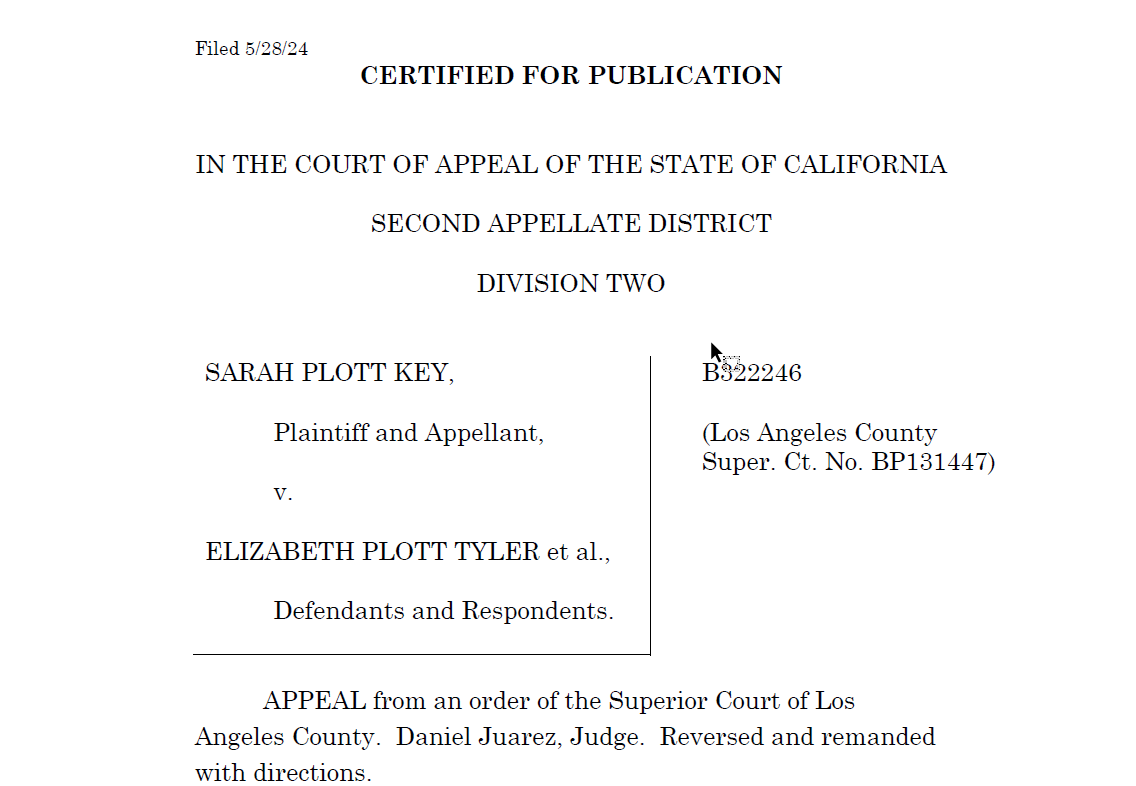
California Court addresses LLC issues pertaining to a demand for inspection including the member list

Perry v. Stuart, 2025 WL 1501935 (Cal. Ct. App. May 27, 2025)

In Perry v. Stuart the California Court of Appeal, Sixth District, addressed certain issues pertaining to a demand for inspection that was made by a member of the LLC. The Court’s holding is not only applicable to the parties in the case, but also might be instructive for other LLCs, LLC managers, members, officers and boards in similar circumstances. LLC governance and litigation are interesting and can be challenging because of their flexibility in some circumstances but also their definite or fairly definite statutory or operating agreement requirements in other circumstances.

In relevant part the Opinion in Perry v. Stuart held as follows:

1. That the LLC is ordered to provide former members of the manager managed LLC the information (in hardcopy or readable electronic form) required to be maintained by Cal. Corp. Code §17701.13(d)(6);

2. That the former members who had made a demand for inspection of records of the LLC under Cal. Corp. Code §17704.10 had standing as at they were members of the LLC at the time that they made their demand;

3. That Cal. Corp. Code §17704.10 and in particular §17704.10 subdivision (c) and subdivision (c)(3) are to be read as they are written (e.g., unless stated in the statute, do not require financial records that are either audited or signed by an accountant); and

4. That there was sufficient evidence that the LLC’s actual member list constituted a protected trade secret, but that the names and addresses of the members were obtainable or discoverable as required by statute or by other means such as through information that was contained in other LLC records that were required to be produced or made available (see also, e.g., Cal. Corp. Code §§17704.10(a) and 17701.13(d)(1).

David W. Tate, Esq.

Please reach out to me if you have an LLC issue, or reach out on other topics.

* * * *

Thank you for viewing and reading this discussion. Please do pass this blog and blog post and information to other people who would be interested as it is only through collaboration and sharing that great things and success are more quickly achieved. If you are interested in discussing anything that I have said in the discussion above or in either of my two blogs (see blog addresses below), or if you simply want to reach out or are seeking assistance, it is best to reach me by email at dave@tateattorney.com.

David Tate, Esq. (and inactive CPA)

Trust, estate, probate, power of attorney, fiduciary, beneficiary, conservatorship, and elder and dependent adult abuse litigation and contentious administrations, undue influence, fraud and deceit, physical and mental health and challenging and contentious personalities and relationships.

Trust, estate and probate administrations and litigation involving special assets such as business ownership interests and operating businesses, asset co-ownership disputes, contentious governance, intellectual property assets, art and collectible assets, ongoing future contractual rights, buyouts and sales, M&A disputes, businesses divorces, and accountings.

Businesses and third party disputes and litigation – contract, licensing, co-business, royalty and other arrangements, unfair business practices, fraud and deceit, lack of good faith and fair dealing, buyouts and sales, mergers, acquisitions, ventures, etc.

Business co-ownership and internal governance disputes and litigation, business divorces, buyouts and sales, merger and acquisition disputes, family, closely held and professional businesses, accountings, and audits, D&O, boards, audit committees and investigations. Legal authority, duties, rights, conflicts of interest, diligence, compliance, liability, BJR, legal risk management, and resolution.

Real property and co-ownership disputes and litigation.

Trials.

Mediator and dispute and litigation resolution services.

Other and additional disputes, litigation and issues that fall within the above areas – court and trial evidence, persuasion, debate and fallacies, using AI assistance, IP, meetings, defamation, risk management processes, workplace, new laws, regulations and government actions – impact/legality, law and legal matters in the news, etc.

Remember, every case and situation is different. It is important to obtain and evaluate all of the evidence that is available, and to apply that evidence to the applicable standards and laws. You do need to consult with an attorney and other professionals about your particular situation. This post is not a solicitation for legal or other services inside of or outside of California, and, of course, this post only is a summary of information that changes from time to time, and does not apply to any particular situation or to your specific situation. So . . . you cannot rely on this post for your situation or as legal or other professional advice or representation, or as or for my opinions and views on the subject matter.

Also note – sometimes I include links to or comments about materials from other organizations or people – if I do so, it is because I believe that the materials are worthwhile reading or viewing; however, that does not mean that I do not or that I might not have a different view about some or even all of the subject matter or materials, or that I necessarily agree with, or agree with everything about or relating to, that organization or person, or those materials or the subject matter.

Please also subscribe to this blog and my other blog (see below), and connect with me on LinkedIn and Twitter.

My blogs are:

http://tateattorney.com – business, D&O, audit committee, governance, compliance, etc. – previously at http://auditcommitteeupdate.com

Prior blog: Trust, estate, conservatorship, elder and elder abuse, etc. litigation and contentious administrations http://californiaestatetrust.com

David Tate, Esq. (and inactive California CPA) – practicing only as an attorney in California.

Goebner v. Superior Court – in Probate Court the timing for bringing a demurrer is determined under Probate Code provisions not under the Code of Civil Procedure

The following is a brief discussion about the recent holding in Goebner v. Superior Court (2025) 110 Cal. App. 5th 1105.

In relevant part, the Court in Goebner held that the timing for the filing of a demurrer in a probate court case is governed by the California Probate Code provisions for the bringing of a response or objection to the petition and is not governed by the California Code of Civil Procedure.

The holding is important not only to the particular case in question but also for attorneys who practice in the Probate Court. This has been an issue that I have run into in my cases many times. For example, in response to a petition a demurrer might be filed in which the respondent argues that the petition is in some manner defective or fails to state a claim. Some Judges in Probate Court are receptive to the filing of a demurrer, some Judges in Probate Court are not receptive to the filing of a demurrer, and as addressed in Goebner, in the Probate Court there can be questions whether Probate Code rules or rules of civil procedure apply.

In Goebner a demurrer was filed just two days before the hearing. Under the Probate Code a response or objection to a petition can be filed in writing at the time of the initial hearing and also can be made orally at the initial hearing. But under the rules of Civil Procedure a response or objection to the complaint is due 30 days after service of the complaint on the party.

In Goebner the Probate trial court held that the demurrer was filed too late. The Court of Appeal overruled, holding that under the Probate Code a responsive objection such as a demurrer can be brought as late as at the initial hearing. Note however, although permissible, if at all possible, I do not recommend waiting until the day of the hearing to file or bring a demurrer to the petition – instead, it is better to file a written demurrer upon available time prior to the initial hearing.

Although not the primary issue, the holding in Goebner also is relevant as it confirms that demurrer can be brought in response to and against a petition that is brought in the Probate Court, and that responses and objections in Probate Court can be made according the Probate Court procedures just prior to and even at the initial hearing (although, again, in my view, if possible it is better practice to try to not wait so long).

As the pleadings (i.e., the petition in a Probate Court case, or the complaint in a civil action) set the scope and boundaries of the relevant claims and issues to be resolved in the case, I do find it useful in appropriate circumstances to file a demurrer to try to ensure that the claims made are sufficient pleaded and are not vague or ambiguous.

The following quotes are some of the relevant discussions from the holding in Goebner:

  • Section 1000 provides, in relevant part, “Except to the extent that [the Probate Code] provides applicable rules, the rules of practice applicable to civil actions … apply to, and constitute the rules of practice” in proceedings under the Probate Code. (§ 1000, subd. (a).) This is a rule of default — that is, the Probate Code “adopts the civil practice rules only where special rules are not prescribed.”
  • Under the plain language of the Probate Code, it “does provide specially applicable rules” that address the timing for filing a response or objection to a petition. (citations omitted)
  • Within that chapter is section 1043, providing “[a]n interested person may appear and make a response or objection in writing at or before the hearing.” (§ 1043, subd. (a), italics added.) Similarly, interested persons “may appear and make a response or objection orally at the hearing.” (Id., subd. (b), italics added.) The statute underscores that oral objections may be made initially at the hearing by noting that the “court in its discretion” may “grant a continuance for the purpose of allowing a response or objection to be made in writing.” (Ibid.)
  • While the Probate Code does not expressly define “objection[s]” to include demurrers, we conclude that interpretation is appropriate. Pursuant to section 1000 we look to the Code of Civil Procedure (§ 1000, subd. (a).) The Code of Civil Procedure recognizes that a demurrer is a form of an objection to a petition or complaint. (Code Civ. Proc., §430.30, subd. (a) [a “ground for objection to a complaint, cross-complaint or answer” “may be taken by a demurrer to the pleading”]; see also id. §430.10 [party “may object, by demurrer” on enumerated grounds] . . .. (citations omitted)
  • Indeed, Code of Civil Procedure part 2, title 6, chapter 3, article 1, which includes these provisions, is titled “Objections to Pleadings.” Reading these Probate Code and Code of Civil Procedure statutes together, an interested party may file a demurrer to a petition under the Probate Code “at or before the hearing.” (citations omitted) The Probate Code further addresses concerns that a party may present a demurrer at a hearing — thus placing the petitioner at a disadvantage — by allowing a court to “continue or postpone any hearing, from time to time, in the interest of justice.”1 (§ 1045.) The deadline in the Code of Civil Procedure to respond and object within 30 days after a complaint is served is inapposite.

David W. Tate, Esq.

Please reach out on this topic or on other topics if you wish.

* * * *

Thank you for viewing and reading this discussion. Please do pass this blog and blog post and information to other people who would be interested as it is only through collaboration and sharing that great things and success are more quickly achieved. If you are interested in discussing anything that I have said in the discussion above or in either of my two blogs (see blog addresses below), or if you simply want to reach out or are seeking assistance, it is best to reach me by email at dave@tateattorney.com.

David Tate, Esq. (and inactive CPA)

Trust, estate, probate, power of attorney, fiduciary, beneficiary, conservatorship, and elder and dependent adult abuse litigation and contentious administrations, undue influence, fraud and deceit, physical and mental health and challenging and contentious personalities and relationships.

Trust, estate and probate administrations and litigation involving special assets such as business ownership interests and operating businesses, asset co-ownership disputes, contentious governance, intellectual property assets, art and collectible assets, ongoing future contractual rights, buyouts and sales, M&A disputes, businesses divorces, and accountings.

Businesses and third party disputes and litigation – contract, licensing, co-business, royalty and other arrangements, unfair business practices, fraud and deceit, lack of good faith and fair dealing, buyouts and sales, mergers, acquisitions, ventures, etc.

Business co-ownership and internal governance disputes and litigation, business divorces, buyouts and sales, merger and acquisition disputes, family, closely held and professional businesses, accountings, and audits, D&O, boards, audit committees and investigations. Legal authority, duties, rights, conflicts of interest, diligence, compliance, liability, BJR, legal risk management, and resolution.

Real property and co-ownership disputes and litigation.

Trials.

Mediator and dispute and litigation resolution services.

Other and additional disputes, litigation and issues that fall within the above areas – court and trial evidence, persuasion, debate and fallacies, using AI assistance, IP, meetings, defamation, risk management processes, workplace, new laws, regulations and government actions – impact/legality, law and legal matters in the news, etc.

Remember, every case and situation is different. It is important to obtain and evaluate all of the evidence that is available, and to apply that evidence to the applicable standards and laws. You do need to consult with an attorney and other professionals about your particular situation. This post is not a solicitation for legal or other services inside of or outside of California, and, of course, this post only is a summary of information that changes from time to time, and does not apply to any particular situation or to your specific situation. So . . . you cannot rely on this post for your situation or as legal or other professional advice or representation, or as or for my opinions and views on the subject matter.

Also note – sometimes I include links to or comments about materials from other organizations or people – if I do so, it is because I believe that the materials are worthwhile reading or viewing; however, that does not mean that I do not or that I might not have a different view about some or even all of the subject matter or materials, or that I necessarily agree with, or agree with everything about or relating to, that organization or person, or those materials or the subject matter.

Please also subscribe to this blog and my other blog (see below), and connect with me on LinkedIn and Twitter.

My blogs are:

http://tateattorney.com – business, D&O, audit committee, governance, compliance, etc. – previously at http://auditcommitteeupdate.com

Prior blog: Trust, estate, conservatorship, elder and elder abuse, etc. litigation and contentious administrations http://californiaestatetrust.com

David Tate, Esq. (and inactive California CPA) – practicing only as an attorney in California.
Gaslighting and other bad persons and personalities – forwarding from The Atlantic – bad people and personalities are more common

The following is a link from Yahoo to a discussion from an author in The Atlantic about gaslighting and other personalities, and defenses. https://www.yahoo.com/news/spot-stop-sociopath-160000775.html?guccounter=1

I believe that these bad people and personalities are more common in people than reported or thought. Note: I do not know the author of the article or his expertise – I am posting the link for discussion purposes only. Particularly since 2019 (i.e., even prior to COVID) the numbers of situations and people and cases that I have directly or indirectly been involved in that have involved varying levels or degrees of opposing bad people with dysfunctional personalities have increased to a shocking level (including cases and situations involving fraud, deceit, concealment, control, possession, false narrative, lying, undue influence and excessive persuasion, and use of the law and the court’s for wrongful purposes and wrongful intentions to see what they can get away with (e.g., lawfare, litigationfare, courtfare)) . This is unfortunate of course, and also because there truly are good, sharing, helpful, honest and truthful people. But everyone needs to protect themselves. As the author discusses, there are many different “bad” persons and personality types.

David W. Tate, Esq.

Please reach out on this topic or on other topics if you wish.

* * * *

Thank you for viewing this discussion. Please do pass this blog and blog post and information to other people who would be interested as it is only through collaboration and sharing that great things and success are more quickly achieved. If you are interested in discussing anything that I have said in the discussion above or in either of my two blogs (see blog addresses below), or if you simply want to reach out or are seeking assistance, it is best to reach me by email at dave@tateattorney.com.

David Tate, Esq. (and inactive CPA)

Trust, estate, probate, will, fiduciary and elder abuse disputes, litigation, trials and law – probate, trust, estate, will, power of attorney, elder abuse, real property and conservatorship disputes, conflicts and litigation, challenging and contentious administrations, and personalities, people and relationships, mental and physical health, limitations and capacity, undue influence and fraud; and and mediator services.

Business litigation and internal business and co-ownership disputes, litigation, trials and law, and contentious officer, director, board and audit and governance committee, D&O, conflict of interest, workplace, and governance disputes, conflicts and litigation; and mediator services. Legal authority, duties, rights, conflicts of interest, governance, diligence, compliance, legal risk management, and personalities, people and relationships; and mediator services.

Governance, law, legal risk management processes, compliance and success, audits and auditing, internal controls, executive officers, boards, directors, audit and governance committees, investigations, publicity rights, AI, defamation and First Amendment, legislation, statutes and laws, regulations, and headline news, and issue, people and relationship effective meetings, discussions and deliberations, debates and debating, communications, and wording and use of words.

Real property disputes, litigation, trials and law – primarily co-ownership and joint-ownership disputes, conflicts and litigation, and sales and purchases that go wrong, and mediator services.

Mediator and mediator and dispute resolution services (evaluative and facilitative).

  • Trust, estate, probate, conservatorship, elder and dependent abuse, etc.
  • Business, breach of contract/commercial, owner, shareholder, investor, etc.
  • D&O, board, audit and governance committee, accountant and CPA related.
  • Other: workplace and employment, environmental, trade secret.
  • Law and legal issues relating to authority, duties, rights, conflicts of interest, governance, diligence, compliance, risk management, disputes, evidence, liability, litigation, and mediation and resolution services.

Remember, every case and situation is different. It is important to obtain and evaluate all of the evidence that is available, and to apply that evidence to the applicable standards and laws. You do need to consult with an attorney and other professionals about your particular situation. This post is not a solicitation for legal or other services inside of or outside of California, and, of course, this post only is a summary of information that changes from time to time, and does not apply to any particular situation or to your specific situation. So . . . you cannot rely on this post for your situation or as legal or other professional advice or representation, or as or for my opinions and views on the subject matter.

Also note – sometimes I include links to or comments about materials from other organizations or people – if I do so, it is because I believe that the materials are worthwhile reading or viewing; however, that does not mean that I do not or that I might not have a different view about some or even all of the subject matter or materials, or that I necessarily agree with, or agree with everything about or relating to, that organization or person, or those materials or the subject matter.

Please also subscribe to this blog and my other blog (see below), and connect with me on LinkedIn and Twitter.

My two blogs are:

http://tateattorney.com – business, D&O, audit committee, governance, compliance, etc. – previously at http://auditcommitteeupdate.com

Trust, estate, conservatorship, elder and elder abuse, etc. litigation and contentious administrations http://californiaestatetrust.com

David Tate, Esq. (and inactive California CPA) – practicing only as an attorney in California.

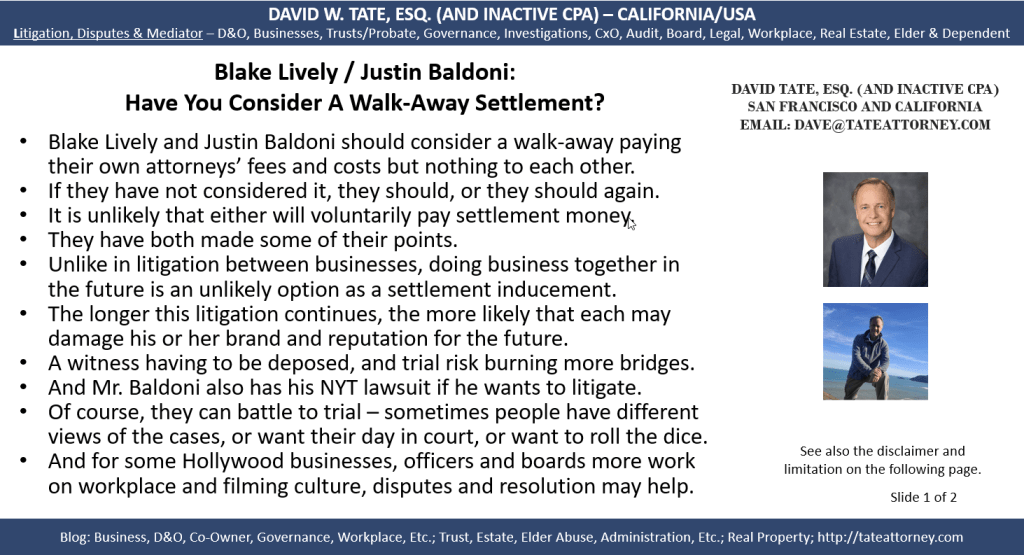
Lively and Baldoni should consider a walk-away settlement, or yes they can duke it out at trial . . . .

I hope that you can read/enlarge the slide that is below containing the primary points. Later this week I may also add a short video as I am looking to get back to some video media. Dave Tate, Esq.

* * * *

Thank you for viewing this discussion. Please do pass this blog and blog post and information to other people who would be interested as it is only through collaboration and sharing that great things and success are more quickly achieved. If you are interested in discussing anything that I have said in the discussion above or in either of my two blogs (see blog addresses below), or if you simply want to reach out or are seeking assistance, it is best to reach me by email at dave@tateattorney.com.

David Tate, Esq. (and inactive CPA)

Trust, estate, probate, will, fiduciary and elder abuse disputes, litigation, trials and law – probate, trust, estate, will, power of attorney, elder abuse, real property and conservatorship disputes, conflicts and litigation, challenging and contentious administrations, and personalities, people and relationships, mental and physical health, limitations and capacity, undue influence and fraud; and and mediator services.

Business litigation and internal business and co-ownership disputes, litigation, trials and law, and contentious officer, director, board and audit and governance committee, D&O, conflict of interest, workplace, and governance disputes, conflicts and litigation; and mediator services. Legal authority, duties, rights, conflicts of interest, governance, diligence, compliance, legal risk management, and personalities, people and relationships; and mediator services.

Governance, law, legal risk management processes, compliance and success, audits and auditing, internal controls, executive officers, boards, directors, audit and governance committees, investigations, publicity rights, AI, defamation and First Amendment, legislation, statutes and laws, regulations, and headline news, and issue, people and relationship effective meetings, discussions and deliberations, debates and debating, communications, and wording and use of words.

Real property disputes, litigation, trials and law – primarily co-ownership and joint-ownership disputes, conflicts and litigation, and sales and purchases that go wrong, and mediator services.

Mediator and mediator and dispute resolution services (evaluative and facilitative).

  • Trust, estate, probate, conservatorship, elder and dependent abuse, etc.
  • Business, breach of contract/commercial, owner, shareholder, investor, etc.
  • D&O, board, audit and governance committee, accountant and CPA related.
  • Other: workplace and employment, environmental, trade secret.
  • Law and legal issues relating to authority, duties, rights, conflicts of interest, governance, diligence, compliance, risk management, disputes, evidence, liability, litigation, and mediation and resolution services.

Remember, every case and situation is different. It is important to obtain and evaluate all of the evidence that is available, and to apply that evidence to the applicable standards and laws. You do need to consult with an attorney and other professionals about your particular situation. This post is not a solicitation for legal or other services inside of or outside of California, and, of course, this post only is a summary of information that changes from time to time, and does not apply to any particular situation or to your specific situation. So . . . you cannot rely on this post for your situation or as legal or other professional advice or representation, or as or for my opinions and views on the subject matter.

Also note – sometimes I include links to or comments about materials from other organizations or people – if I do so, it is because I believe that the materials are worthwhile reading or viewing; however, that does not mean that I do not or that I might not have a different view about some or even all of the subject matter or materials, or that I necessarily agree with, or agree with everything about or relating to, that organization or person, or those materials or the subject matter.

Please also subscribe to this blog and my other blog (see below), and connect with me on LinkedIn and Twitter.

My two blogs are:

http://tateattorney.com – business, D&O, audit committee, governance, compliance, etc. – previously at http://auditcommitteeupdate.com

Trust, estate, conservatorship, elder and elder abuse, etc. litigation and contentious administrations http://californiaestatetrust.com

David Tate, Esq. (and inactive California CPA) – practicing only as an attorney in California.

State of California pursues legal action against the plastics industry and association – bet the business, bet the industry, and society and way of life cases

There is a theme in California that the State will pursue legal action against certain or select industries and their associations for products that allegedly cause pollution and climate change including possible claims or charges of secrecy, concealment, misrepresentation or fraud.

I have pasted below a scan and a link to news from the California Department of Justice Attorney General discussing California’s ongoing investigation into the plastics industry. This might be considered similar to actions against oil and gas and tobacco. I am onboard that we have or can have pollution problems with plastics, but it is not that simple (and proof of climate change?) – legal challenges and issues of proof v. speculation exist – for example, liability for which alleged unlawful act(s) against which specific businesses, causation, and injuries and payments, if any, from which sources and in what amounts and for which possible plaintiffs present legal challenges and issues of proof v. speculation.

Plastics are used everywhere in society and have been for decades – problems with plastics have also been known for decades – plastic use is a fundamental element and way of life or commerce in our society and day-to-day living (similar to oil and gas).

California legal actions like this are bet the business, bet the industry, and bet the public and society legal actions – California and its public, the Legislature, the Governor, and the Department of Justice need to evaluate and decide upon the risk management and legal risk management issues, options, objectives, and plan. For example, there is a legislative process available if the Legislature and the Governor believe that plastics present a fundamental risk to health and safety and climate change – which is for the Legislature and the Governor to pass a law that makes the use and sale of plastics and plastic containers unlawful in California or perhaps some other less drastic legislation (but in making this point I am of course also bypassing whether California can in fact legally enact that type of legislation without taking into consideration and satisfying interstate commerce and other federal and California limitations on legislation and regulation).

If you are in business and industry (large and small, because these issues and product liability laws generally apply to everyone in business and industry), perhaps you should consider what your prudent legal, product, and disclosure options are in preparation for and in response to these types of lawsuits by the State of California, and also consider which businesses and industries California will next pursue for climate change and pollution? Thirty years from now, for example, will it be battery manufacturers and businesses that sell products that operate on batteries such as electric vehicles, with the waste that the batteries might cause, although EVs are now encouraged?

Yes these cases present significant legal issues, but they also present public and society policy, legal risk management, and way of life issues. More to follow.

There is a link to the California Department of Justice news discussion: https://oag.ca.gov/news/press-releases/attorney-general-bonta-issues-statement-sacramento-county-superior-court%E2%80%99s

And here is a link to a scan:

* * * *

Thank you for viewing this discussion. Please do pass this blog and blog post and information to other people who would be interested as it is only through collaboration and sharing that great things and success are more quickly achieved. If you are interested in discussing anything that I have said in the discussion above or in either of my two blogs (see blog addresses below), or if you simply want to reach out or are seeking assistance, it is best to reach me by email at dave@tateattorney.com.

David Tate, Esq. (and inactive CPA)

Trust, estate, probate, will, fiduciary and elder abuse disputes, litigation, trials and law – probate, trust, estate, will, power of attorney, elder abuse, real property and conservatorship disputes, conflicts and litigation, challenging and contentious administrations, and personalities, people and relationships, mental and physical health, limitations and capacity, undue influence and fraud; and and mediator services.

Business litigation and internal business and co-ownership disputes, litigation, trials and law, and contentious officer, director, board and audit and governance committee, D&O, conflict of interest, workplace, and governance disputes, conflicts and litigation; and mediator services. Legal authority, duties, rights, conflicts of interest, governance, diligence, compliance, legal risk management, and personalities, people and relationships; and mediator services.

Governance, law, legal risk management processes, compliance and success, audits and auditing, internal controls, executive officers, boards, directors, audit and governance committees, investigations, publicity rights, AI, defamation and First Amendment, legislation, statutes and laws, regulations, and headline news, and issue, people and relationship effective meetings, discussions and deliberations, debates and debating, communications, and wording and use of words.

Real property disputes, litigation, trials and law – primarily co-ownership and joint-ownership disputes, conflicts and litigation, and sales and purchases that go wrong, and mediator services.

Mediator and mediator and dispute resolution services (evaluative and facilitative).

  • Trust, estate, probate, conservatorship, elder and dependent abuse, etc.
  • Business, breach of contract/commercial, owner, shareholder, investor, etc.
  • D&O, board, audit and governance committee, accountant and CPA related.
  • Other: workplace and employment, environmental, trade secret.
  • Law and legal issues relating to authority, duties, rights, conflicts of interest, governance, diligence, compliance, risk management, disputes, evidence, liability, litigation, and mediation and resolution services.

Remember, every case and situation is different. It is important to obtain and evaluate all of the evidence that is available, and to apply that evidence to the applicable standards and laws. You do need to consult with an attorney and other professionals about your particular situation. This post is not a solicitation for legal or other services inside of or outside of California, and, of course, this post only is a summary of information that changes from time to time, and does not apply to any particular situation or to your specific situation. So . . . you cannot rely on this post for your situation or as legal or other professional advice or representation, or as or for my opinions and views on the subject matter.

Also note – sometimes I include links to or comments about materials from other organizations or people – if I do so, it is because I believe that the materials are worthwhile reading or viewing; however, that does not mean that I do not or that I might not have a different view about some or even all of the subject matter or materials, or that I necessarily agree with, or agree with everything about or relating to, that organization or person, or those materials or the subject matter.

Please also subscribe to this blog and my other blog (see below), and connect with me on LinkedIn and Twitter.

My two blogs are:

http://tateattorney.com – business, D&O, audit committee, governance, compliance, etc. – previously at http://auditcommitteeupdate.com

Trust, estate, conservatorship, elder and elder abuse, etc. litigation and contentious administrations http://californiaestatetrust.com

David Tate, Esq. (and inactive California CPA) – practicing only as an attorney in California.

Interesting from the Lively/Baldoni litigation: defamation and civil extortion allegations

I am finding the defamation and civil extortion allegations some of the more interesting from a legal perspective, of course while seeing the allegations and the arguments and supposed evidence presented to the public is very interesting and something that we almost never see. Broadly speaking, defamation is: an untrue statement of fact or purported fact (e.g., not opinion) that is published (i.e., said or in print or in writing) to a third party (i.e. not simply to the person about whom the statement or writing is about, but to a third person) that hurts the reputation of the person about whom the statement or writing is about.

In Lively/Baldoni there are allegations that defamatory statements were made by Lively and by Baldoni themselves, and by agents such as PR or crisis firms representing Lively and Baldoni, and by the regular press (NYT). The allegations against the press include allegations that what they wrote was defamatory because of the alleged selective or incomplete nature of the statements and information that were included in the writing – thus allegedly not presenting an accurate writing or statement and alleged defamatory. If you are wondering, yes, a claim of defamation can be alleged on the basis of an alleged selective or incomplete statement or writing. As defamation is not an uncommon possibility, you might also be wondering whether someone possibly has defamed someone else in your circles or activities – slander (i.e., spoken) or libel (i.e., written).

There is a lot of discovery to be done – requests and subpoenas for documents, taking depositions, interrogatories, requests for admissions, experts, and more.

Keep in mind however, that none of what you are seeing is actual evidence that has been rebutted or cross-examined or questioned or even presented and admitted into evidence in Court at trial. I will be providing additional posts pertaining to defamation, and we also have not touched on the claim of civil extortion, or on the allegations of hostile or harassing workplace environment (including in the context of the script, the filming, and Hollywood), or on the efforts to resolve issues during the filming, or on workplace and filming oversight, diligence and compliance by HR, executive and management officers, boards/committees, and others.

Also keep in mind that the allegations, documents and arguments that you are seeing are or will be questions and issues of fact to be applied to the applicable laws and to be determined by the trier of fact (i.e., the jury). No one knows how the claims would be viewed by the selected jury at trial. And I should add that of course the above is just a summary discussion – for example, some statements are privileged or protected, there can be First Amendment freedom of speech issues, there are differing standards of culpability or wrongdoing depending on whether the person to whom the alleged statement applies is a public person or figure, and in California you can have anti-SLAPP issues, in addition to other issues, criteria and elements.

* * * *

Thank you for viewing this discussion. Please do pass this blog and blog post and information to other people who would be interested as it is only through collaboration and sharing that great things and success are more quickly achieved. If you are interested in discussing anything that I have said in the discussion above or in either of my two blogs (see blog addresses below), or if you simply want to reach out or are seeking assistance, it is best to reach me by email at dave@tateattorney.com.

David Tate, Esq. (and inactive CPA)

Trust, estate, probate, will, fiduciary and elder abuse disputes, litigation, trials and law – probate, trust, estate, will, power of attorney, elder abuse, real property and conservatorship disputes, conflicts and litigation, challenging and contentious administrations, and personalities, people and relationships, mental and physical health, limitations and capacity, undue influence and fraud; and and mediator services.

Business litigation and internal business and co-ownership disputes, litigation, trials and law, and contentious officer, director, board and audit and governance committee, D&O, conflict of interest, workplace, and governance disputes, conflicts and litigation; and mediator services. Legal authority, duties, rights, conflicts of interest, governance, diligence, compliance, legal risk management, and personalities, people and relationships; and mediator services.

Governance, law, legal risk management processes, compliance and success, audits and auditing, internal controls, executive officers, boards, directors, audit and governance committees, investigations, publicity rights, AI, defamation and First Amendment, legislation, statutes and laws, regulations, and headline news, and issue, people and relationship effective meetings, discussions and deliberations, debates and debating, communications, and wording and use of words.

Real property disputes, litigation, trials and law – primarily co-ownership and joint-ownership disputes, conflicts and litigation, and sales and purchases that go wrong, and mediator services.

Mediator and mediator and dispute resolution services (evaluative and facilitative).

  • Trust, estate, probate, conservatorship, elder and dependent abuse, etc.
  • Business, breach of contract/commercial, owner, shareholder, investor, etc.
  • D&O, board, audit and governance committee, accountant and CPA related.
  • Other: workplace and employment, environmental, trade secret.
  • Law and legal issues relating to authority, duties, rights, conflicts of interest, governance, diligence, compliance, risk management, disputes, evidence, liability, litigation, and mediation and resolution services.

Remember, every case and situation is different. It is important to obtain and evaluate all of the evidence that is available, and to apply that evidence to the applicable standards and laws. You do need to consult with an attorney and other professionals about your particular situation. This post is not a solicitation for legal or other services inside of or outside of California, and, of course, this post only is a summary of information that changes from time to time, and does not apply to any particular situation or to your specific situation. So . . . you cannot rely on this post for your situation or as legal or other professional advice or representation, or as or for my opinions and views on the subject matter.

Also note – sometimes I include links to or comments about materials from other organizations or people – if I do so, it is because I believe that the materials are worthwhile reading or viewing; however, that does not mean that I do not or that I might not have a different view about some or even all of the subject matter or materials, or that I necessarily agree with, or agree with everything about or relating to, that organization or person, or those materials or the subject matter.

Please also subscribe to this blog and my other blog (see below), and connect with me on LinkedIn and Twitter.

My two blogs are:

http://tateattorney.com – business, D&O, audit committee, governance, compliance, etc. – previously at http://auditcommitteeupdate.com

Trust, estate, conservatorship, elder and elder abuse, etc. litigation and contentious administrations http://californiaestatetrust.com

David Tate, Esq. (and inactive California CPA) – practicing only as an attorney in California.

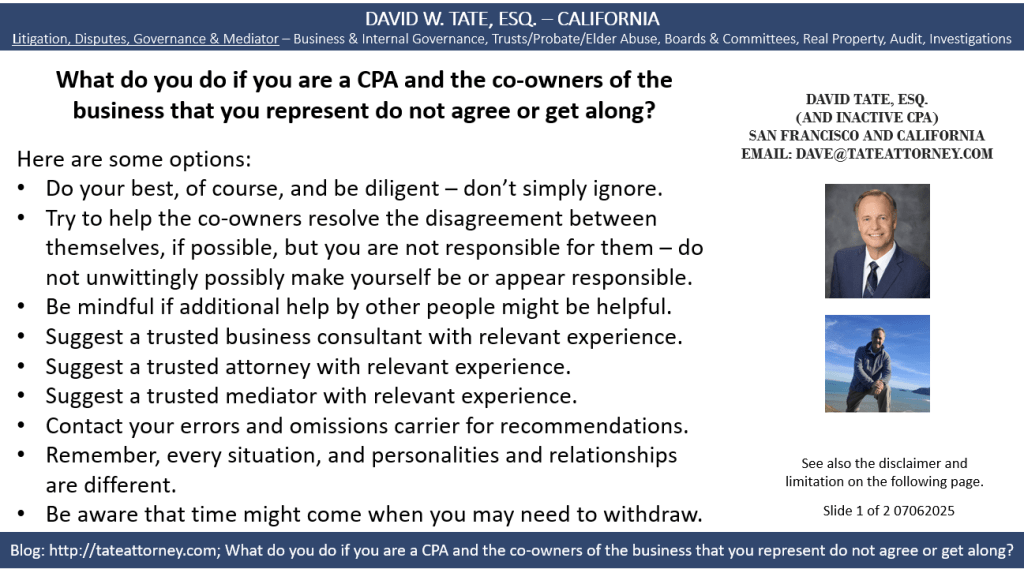
Three Slides: My Primary Practice Areas; A Definition of the Term Governance; A Simple Risk, Uncertainty and Success Process

* * * *

Thank you for viewing this discussion. Please do pass this blog and blog post and information to other people who would be interested as it is only through collaboration and sharing that great things and success are more quickly achieved. If you are interested in discussing anything that I have said in the discussion above or in either of my two blogs (see blog addresses below), or if you simply want to reach out or are seeking assistance, it is best to reach me by email at dave@tateattorney.com.

David Tate, Esq. (and inactive CPA)

Trust, estate, probate, will, fiduciary and elder abuse disputes, litigation, trials and law – probate, trust, estate, will, power of attorney, elder abuse, real property and conservatorship disputes, conflicts and litigation, challenging and contentious administrations, and personalities, people and relationships, mental and physical health, limitations and capacity, undue influence and fraud; and and mediator services.

Business litigation and internal business and co-ownership disputes, litigation, trials and law, and contentious officer, director, board and audit and governance committee, D&O, conflict of interest, workplace, and governance disputes, conflicts and litigation; and mediator services. Legal authority, duties, rights, conflicts of interest, governance, diligence, compliance, legal risk management, and personalities, people and relationships; and mediator services.

Governance, law, legal risk management processes, compliance and success, audits and auditing, internal controls, executive officers, boards, directors, audit and governance committees, investigations, publicity rights, AI, defamation and First Amendment, legislation, statutes and laws, regulations, and headline news, and issue, people and relationship effective meetings, discussions and deliberations, debates and debating, communications, and wording and use of words.

Real property disputes, litigation, trials and law – primarily co-ownership and joint-ownership disputes, conflicts and litigation, and sales and purchases that go wrong, and mediator services.

Mediator and mediator and dispute resolution services (evaluative and facilitative).

  • Trust, estate, probate, conservatorship, elder and dependent abuse, etc.
  • Business, breach of contract/commercial, owner, shareholder, investor, etc.
  • D&O, board, audit and governance committee, accountant and CPA related.
  • Other: workplace and employment, environmental, trade secret.
  • Law and legal issues relating to authority, duties, rights, conflicts of interest, governance, diligence, compliance, risk management, disputes, evidence, liability, litigation, and mediation and resolution services.

Remember, every case and situation is different. It is important to obtain and evaluate all of the evidence that is available, and to apply that evidence to the applicable standards and laws. You do need to consult with an attorney and other professionals about your particular situation. This post is not a solicitation for legal or other services inside of or outside of California, and, of course, this post only is a summary of information that changes from time to time, and does not apply to any particular situation or to your specific situation. So . . . you cannot rely on this post for your situation or as legal or other professional advice or representation, or as or for my opinions and views on the subject matter.

Also note – sometimes I include links to or comments about materials from other organizations or people – if I do so, it is because I believe that the materials are worthwhile reading or viewing; however, that does not mean that I do not or that I might not have a different view about some or even all of the subject matter or materials, or that I necessarily agree with, or agree with everything about or relating to, that organization or person, or those materials or the subject matter.

Please also subscribe to this blog and my other blog (see below), and connect with me on LinkedIn and Twitter.

My two blogs are:

http://tateattorney.com – business, D&O, audit committee, governance, compliance, etc. – previously at http://auditcommitteeupdate.com

Trust, estate, conservatorship, elder and elder abuse, etc. litigation and contentious administrations http://californiaestatetrust.com

David Tate, Esq. (and inactive California CPA) – practicing only as an attorney in California.
