If you are involved in the sale or lease of goods or services to a consumer – you need to be aware of Cal. Civ. Code §1770 unfair or deceptive acts or practices, including the new hidden fees prohibition.

I am making this post for two purposes: (1) because providers of goods or services need to be aware of the unfair or deceptive acts and practices that are listed and need to avoid doing them including the new hidden fee prohibition (see prohibition (29)), and (2) because perhaps you really would not believe how broad, vague, ambiguous, uncertain, unclear, and potentially all-encompassing this statute is worded. In keeping with my view, Government first should be required do it and to comply with its legislation, regulations and rules.

On October 7, 2023, California SB 478 Amendment to the Consumer Legal Remedies Act was signed into law in part effective July 1, 2024. The following is the amendment to Cal. Civ. Code §1770. Section 1770(a) states as follows: “The unfair methods of competition and unfair or deceptive acts or practices listed in this subdivision undertaken by any person in a transaction intended to result or that results in the sale or lease of goods or services to any consumer are unlawful: . . ..” Thus, the unfair methods of competition and unfair or deceptive acts or practices that are listed apply not only to goods but also to services.

People who should be aware: officers, partners, managing agents, boards and audit committees (risk management processes, oversight and legal compliance), chief legal officers, and other people who are in positions of authority.

The following is the wording of Cal. Civ. Code §1770 and the 29 subsections effective July 1, 2024 (also note that there are additional prohibitions that are listed elsewhere other than in Cal. Civ. Code §1770.

SEC. 3.

 Section 1770 is added to the Civil Code, to read:

1770.

 (a) The unfair methods of competition and unfair or deceptive acts or practices listed in this subdivision undertaken by any person in a transaction intended to result or that results in the sale or lease of goods or services to any consumer are unlawful:

(1) Passing off goods or services as those of another.

(2) Misrepresenting the source, sponsorship, approval, or certification of goods or services.

(3) Misrepresenting the affiliation, connection, or association with, or certification by, another.

(4) Using deceptive representations or designations of geographic origin in connection with goods or services.

(5) Representing that goods or services have sponsorship, approval, characteristics, ingredients, uses, benefits, or quantities that they do not have or that a person has a sponsorship, approval, status, affiliation, or connection that the person does not have.

(6) Representing that goods are original or new if they have deteriorated unreasonably or are altered, reconditioned, reclaimed, used, or secondhand.

(7) Representing that goods or services are of a particular standard, quality, or grade, or that goods are of a particular style or model, if they are of another.

(8) Disparaging the goods, services, or business of another by false or misleading representation of fact.

(9) Advertising goods or services with intent not to sell them as advertised.

(10) Advertising goods or services with intent not to supply reasonably expectable demand, unless the advertisement discloses a limitation of quantity.

(11) Advertising furniture without clearly indicating that it is unassembled if that is the case.

(12) Advertising the price of unassembled furniture without clearly indicating the assembled price of that furniture if the same furniture is available assembled from the seller.

(13) Making false or misleading statements of fact concerning reasons for, existence of, or amounts of, price reductions.

(14) Representing that a transaction confers or involves rights, remedies, or obligations that it does not have or involve, or that are prohibited by law.

(15) Representing that a part, replacement, or repair service is needed when it is not.

(16) Representing that the subject of a transaction has been supplied in accordance with a previous representation when it has not.

(17) Representing that the consumer will receive a rebate, discount, or other economic benefit, if the earning of the benefit is contingent on an event to occur subsequent to the consummation of the transaction.

(18) Misrepresenting the authority of a salesperson, representative, or agent to negotiate the final terms of a transaction with a consumer.

(19) Inserting an unconscionable provision in the contract.

(20) Advertising that a product is being offered at a specific price plus a specific percentage of that price unless (A) the total price is set forth in the advertisement, which may include, but is not limited to, shelf tags, displays, and media advertising, in a size larger than any other price in that advertisement, and (B) the specific price plus a specific percentage of that price represents a markup from the seller’s costs or from the wholesale price of the product. This subdivision shall not apply to in-store advertising by businesses that are open only to members or cooperative organizations organized pursuant to Division 3 (commencing with Section 12000) of Title 1 of the Corporations Code if more than 50 percent of purchases are made at the specific price set forth in the advertisement.

(21) Selling or leasing goods in violation of Chapter 4 (commencing with Section 1797.8) of Title 1.7.

(22) (A) Disseminating an unsolicited prerecorded message by telephone without an unrecorded, natural voice first informing the person answering the telephone of the name of the caller or the organization being represented, and either the address or the telephone number of the caller, and without obtaining the consent of that person to listen to the prerecorded message.

(B) This subdivision does not apply to a message disseminated to a business associate, customer, or other person having an established relationship with the person or organization making the call, to a call for the purpose of collecting an existing obligation, or to any call generated at the request of the recipient.

(23) (A) The home solicitation, as defined in subdivision (h) of Section 1761, of a consumer who is a senior citizen where a loan or assessment is made encumbering the primary residence of that consumer for purposes of paying for home improvements and where the transaction is part of a pattern or practice in violation any of the following:

(i) Subsection (h) or (i) of Section 1639 of Title 15 of the United States Code.

(ii) Paragraph (1), (2), or (4) of subdivision (a) of Section 226.34 of Title 12 of the Code of Federal Regulations.

(iii) Section 22684, 22685, 22686, or 22687 of the Financial Code.

(iv) Section 5898.16, 5898.17, 5913, 5922, 5923, 5924, 5925, 5926, or 5940 of the Streets and Highways Code.

(B) A third party shall not be liable under this subdivision unless (i) there was an agency relationship between the party who engaged in home solicitation and the third party, or (ii) the third party had actual knowledge of, or participated in, the unfair or deceptive transaction. A third party who is a holder in due course under a home solicitation transaction shall not be liable under this subdivision.

(24) (A) Charging or receiving an unreasonable fee to prepare, aid, or advise any prospective applicant, applicant, or recipient in the procurement, maintenance, or securing of public social services.

(B) For purposes of this paragraph:

(i) “Public social services” means those activities and functions of state and local government administered or supervised by the State Department of Health Care Services, the State Department of Public Health, or the State Department of Social Services, and involved in providing aid or services, or both, including health care services, and medical assistance, to those persons who, because of their economic circumstances or social condition, are in need of that aid or those services and may benefit from them.

(ii) “Public social services” also includes activities and functions administered or supervised by the United States Department of Veterans Affairs or the California Department of Veterans Affairs involved in providing aid or services, or both, to veterans, including pension benefits.

(iii) “Unreasonable fee” means a fee that is exorbitant and disproportionate to the services performed. Factors to be considered, if appropriate, in determining the reasonableness of a fee, are based on the circumstances existing at the time of the service and shall include, but not be limited to, all of the following:

(I) The time and effort required.

(II) The novelty and difficulty of the services.

(III) The skill required to perform the services.

(IV) The nature and length of the professional relationship.

(V) The experience, reputation, and ability of the person providing the services.

(C) This paragraph shall not apply to attorneys licensed to practice law in California, who are subject to the California Rules of Professional Conduct and to the mandatory fee arbitration provisions of Article 13 (commencing with Section 6200) of Chapter 4 of Division 3 of the Business and Professions Code, when the fees charged or received are for providing representation in administrative agency appeal proceedings or court proceedings for purposes of procuring, maintaining, or securing public social services on behalf of a person or group of persons.

(25) (A) Advertising or promoting any event, presentation, seminar, workshop, or other public gathering regarding veterans’ benefits or entitlements that does not include the following statement in the same type size and font as the term “veteran” or any variation of that term:

(i) “I am not authorized to file an initial application for Veterans’ Aid and Attendance benefits on your behalf, or to represent you before the Board of Veterans’ Appeals within the United States Department of Veterans Affairs in any proceeding on any matter, including an application for those benefits. It would be illegal for me to accept a fee for preparing that application on your behalf.” The requirements of this clause do not apply to a person licensed to act as an agent or attorney in proceedings before the Agency of Original Jurisdiction and the Board of Veterans’ Appeals within the United States Department of Veterans Affairs when that person is offering those services at the advertised event.

(ii) The statement in clause (i) shall also be disseminated, both orally and in writing, at the beginning of any event, presentation, seminar, workshop, or public gathering regarding veterans’ benefits or entitlements.

(B) Advertising or promoting any event, presentation, seminar, workshop, or other public gathering regarding veterans’ benefits or entitlements that is not sponsored by, or affiliated with, the United States Department of Veterans Affairs, the California Department of Veterans Affairs, or any other congressionally chartered or recognized organization of honorably discharged members of the Armed Forces of the United States, or any of their auxiliaries that does not include the following statement, in the same type size and font as the term “veteran” or the variation of that term:

“This event is not sponsored by, or affiliated with, the United States Department of Veterans Affairs, the California Department of Veterans Affairs, or any other congressionally chartered or recognized organization of honorably discharged members of the Armed Forces of the United States, or any of their auxiliaries. None of the insurance products promoted at this sales event are endorsed by those organizations, all of which offer free advice to veterans about how to qualify and apply for benefits.”

(i) The statement in this subparagraph shall be disseminated, both orally and in writing, at the beginning of any event, presentation, seminar, workshop, or public gathering regarding veterans’ benefits or entitlements.

(ii) The requirements of this subparagraph shall not apply in a case where the United States Department of Veterans Affairs, the California Department of Veterans Affairs, or other congressionally chartered or recognized organization of honorably discharged members of the Armed Forces of the United States, or any of their auxiliaries have granted written permission to the advertiser or promoter for the use of its name, symbol, or insignia to advertise or promote the event, presentation, seminar, workshop, or other public gathering.

(26) Advertising, offering for sale, or selling a financial product that is illegal under state or federal law, including any cash payment for the assignment to a third party of the consumer’s right to receive future pension or veteran’s benefits.

(27) Representing that a product is made in California by using a Made in California label created pursuant to Section 12098.10 of the Government Code, unless the product complies with Section 12098.10 of the Government Code.

(28) (A) Failing to include either of the following in a solicitation by a covered person, or an entity acting on behalf of a covered person, to a consumer for a consumer financial product or service:

(i) The name of the covered person, and, if applicable, the entity acting on behalf of the covered person, and relevant contact information, including a mailing address and telephone number.

(ii) The following disclosure statement in at least 18-point bold type and in the language in which the solicitation is drafted: “THIS IS AN ADVERTISEMENT. YOU ARE NOT REQUIRED TO MAKE ANY PAYMENT OR TAKE ANY OTHER ACTION IN RESPONSE TO THIS OFFER.”

(B) For purposes of this paragraph:

(i) “Consumer financial product or service” has the same meaning as defined in Section 90005 of the Financial Code.

(ii) (I) “Covered person” has the same meaning as defined in Section 90005 of the Financial Code.

(II) “Covered person” does not mean an entity exempt from Division 24 (commencing with Section 90000) of the Financial Code pursuant to Section 90002 of the Financial Code.

(iii) “Solicitation” means an advertisement or marketing communication through writing or graphics that is directed to, or likely to give the impression of being directed to, an individually identified person, residence, or business location. “Solicitation” does not include any of the following:

(I) Communication through a mass advertisement, including in a catalog, on a radio or television broadcast, or on a publicly accessible internet website, if that communication is not directed to, or is not likely to give the impression of being directed to, an individually identified person, residence, or business location.

(II) Communication via a telephone, mail, or electronic communication that was initiated by a consumer.

(III) A written credit or insurance solicitation that is subject to the disclosure requirements of subsection (d) of Section 1681m of Title 15 of the United States Code.

(29) (A) Advertising, displaying, or offering a price for a good or service that does not include all mandatory fees or charges other than either of the following:

(i) Taxes or fees imposed by a government on the transaction.

(ii) Postage or carriage charges that will be reasonably and actually incurred to ship the physical good to the consumer.

(B) Compliance by a person providing broadband internet access service on its own or as part of a bundle, as defined in Section 8.1(b) of Title 47 of the Code of Federal Regulations, with the broadband consumer label requirements adopted by the Federal Communications Commission in FCC 22-86 on November 14, 2022, codified in Section 8.1(a) of Title 47 of the Code of Federal Regulations, shall be deemed compliance with this paragraph.

(C) (i) For purposes of this subparagraph, “financial entity” means an entity that is exempt from Division 24 (commencing with Section 90000) of the Financial Code pursuant to Section 90002 of the Financial Code.

(ii) A financial entity that is required to provide disclosures in compliance with any of the following federal or state acts or regulations with respect to a financial transaction is exempt from this paragraph for purposes of that financial transaction:

(I) The federal Truth in Savings Act, as amended (12 U.S.C. Sec. 4301 et seq.).

(II) The federal Electronic Fund Transfer Act, as amended (15 U.S.C. Sec. 1693 et seq.).

(III) Section 19 of the Federal Reserve Act, as amended (12 U.S.C. Sec. 461 et seq.).

(IV) The federal Truth in Lending Act, as amended (15 U.S.C. Sec. 1601 et seq.).

(V) The federal Real Estate Settlement Procedures Act, as amended (12 U.S.C. Sec. 2601 et seq.).

(VI) The federal Home Ownership and Equity Protection Act (15 U.S.C. Sec. 1639).

(VII) Any regulation adopted pursuant to any of the federal acts in subclauses (I) to (VI), inclusive.

(VIII) The California Financing Law (Division 9 (commencing with Section 22000) of the Financial Code).

(IX) The California Residential Mortgage Lending Act (Division 20 (commencing with Section 50000) of the Financial Code).

(X) The Real Estate Law (Part 1 (commencing with Section 10000) of Division 4 of the Business and Professions Code).

(XI) Any regulation adopted pursuant to any of the state acts in subclauses (VIII) to (X), inclusive.

(b) (1) It is an unfair or deceptive act or practice for a mortgage broker or lender, directly or indirectly, to use a home improvement contractor to negotiate the terms of any loan that is secured, whether in whole or in part, by the residence of the borrower and that is used to finance a home improvement contract or any portion of a home improvement contract. For purposes of this subdivision, “mortgage broker or lender” includes a finance lender licensed pursuant to the California Financing Law (Division 9 (commencing with Section 22000) of the Financial Code), a residential mortgage lender licensed pursuant to the California Residential Mortgage Lending Act (Division 20 (commencing with Section 50000) of the Financial Code), or a real estate broker licensed under the Real Estate Law (Division 4 (commencing with Section 10000) of the Business and Professions Code).

(2) This section shall not be construed to either authorize or prohibit a home improvement contractor from referring a consumer to a mortgage broker or lender by this subdivision. However, a home improvement contractor may refer a consumer to a mortgage lender or broker if that referral does not violate Section 7157 of the Business and Professions Code or any other law. A mortgage lender or broker may purchase an executed home improvement contract if that purchase does not violate Section 7157 of the Business and Professions Code or any other law. Nothing in this paragraph shall have any effect on the application of Chapter 1 (commencing with Section 1801) of Title 2 to a home improvement transaction or the financing of a home improvement transaction.

(c) This section shall become operative on July 1, 2024.

* * * *

Thank you for viewing this discussion. Please do pass this blog and blog post and information to other people who would be interested as it is only through collaboration and sharing that great things and success are more quickly achieved. If you are interested in discussing anything that I have said in the discussion above or in either of my two blogs (see blog addresses below), or if you simply want to reach out or are seeking assistance, it is best to reach me by email at dave@tateattorney.com.

David Tate, Esq. (and inactive CPA)

Probate Court and administration related disputes and litigation – probate, trust, estate, will, power of attorney, elder abuse, real property and conservatorship disputes, conflicts and litigation, and challenging and contentious administrations, and personalities and relationships; and mediator services.

Business litigation and internal business and co-ownership disputes, and contentious officer, director, board and audit and governance committee, D&O, conflict of interest, workplace, and governance disputes, conflicts and litigation; and mediator services. Legal authority, duties, rights, conflicts of interest, governance, diligence, compliance, and risk Management.

Real property disputes and litigation – primarily co-ownership and joint-ownership disputes, conflicts and litigation, and sales and purchases that go wrong; and mediator services.

Mediator services and dispute resolution (evaluative and facilitative).

Trust, estate, probate, conservatorship, elder and dependent abuse, etc.

Business, breach of contract/commercial, owner, shareholder, investor, etc.

D&O, board, audit and governance committee, accountant and CPA related.

Other: workplace and employment, environmental, trade secret.

Law and legal issues relating to authority, duties, rights, conflicts of interest, governance, diligence, compliance, risk management, disputes, liability, litigation, and mediation and resolution services.

Remember, every case and situation is different. It is important to obtain and evaluate all of the evidence that is available, and to apply that evidence to the applicable standards and laws. You do need to consult with an attorney and other professionals about your particular situation. This post is not a solicitation for legal or other services inside of or outside of California, and, of course, this post only is a summary of information that changes from time to time, and does not apply to any particular situation or to your specific situation. So . . . you cannot rely on this post for your situation or as legal or other professional advice or representation, or as or for my opinions and views on the subject matter.

Also note – sometimes I include links to or comments about materials from other organizations or people – if I do so, it is because I believe that the materials are worthwhile reading or viewing; however, that does not mean that I do not or that I might not have a different view about some or even all of the subject matter or materials, or that I necessarily agree with, or agree with everything about or relating to, that organization or person, or those materials or the subject matter.

Please also subscribe to this blog and my other blog (see below), and connect with me on LinkedIn and Twitter.

My two blogs are:

http://tateattorney.com – business, D&O, audit committee, governance, compliance, etc. – previously at http://auditcommitteeupdate.com

Trust, estate, conservatorship, elder and elder abuse, etc. litigation and contentious administrations http://californiaestatetrust.com

David Tate, Esq. (and inactive California CPA) – practicing only as an attorney in California.

What are the 3 primary personalities and relationship ranges that I see in litigation and mediation?

What are the 3 primary personalities and relationship ranges that I see in litigation and mediation? (1) a strong advocate for their position or view, although they might be incorrect, but more often a reasonable thought-out position, generally good minded, generally trustworthy but verify; (2) the contra of (1), self-absorbed, only their viewpoint, gaslighting, secretive, deceitful, controlling and possessive, but not necessarily absolutely entrenched in their position and not necessarily hopeless for resolution and working together; and (3) to the dark side of (2) including evil, possessive, controlling, lying, mean, and possibly physical or emotionally hurtful and damaging.

Three (1, 2, 3) primary personalities and relationship ranges that I see in litigation and mediation:

* * * *

Thank you for viewing this discussion. Please do pass this blog and blog post and information to other people who would be interested as it is only through collaboration and sharing that great things and success are more quickly achieved. If you are interested in discussing anything that I have said in the discussion above or in either of my two blogs (see blog addresses below), or if you simply want to reach out or are seeking assistance, it is best to reach me by email at dave@tateattorney.com.

David Tate, Esq. (and inactive CPA)

Probate Court and administration related disputes and litigation – probate, trust, estate, will, power of attorney, elder abuse, real property and conservatorship disputes, conflicts and litigation, and challenging and contentious administrations, and personalities and relationships; and mediator services.

Business litigation and internal business and co-ownership disputes, and contentious officer, director, board and audit and governance committee, D&O, conflict of interest, workplace, and governance disputes, conflicts and litigation; and mediator services. Legal authority, duties, rights, conflicts of interest, governance, diligence, compliance, and risk Management.

Real property disputes and litigation – primarily co-ownership and joint-ownership disputes, conflicts and litigation, and sales and purchases that go wrong; and mediator services.

Mediator services and dispute resolution (evaluative and facilitative).

Trust, estate, probate, conservatorship, elder and dependent abuse, etc.

Business, breach of contract/commercial, owner, shareholder, investor, etc.

D&O, board, audit and governance committee, accountant and CPA related.

Other: workplace and employment, environmental, trade secret.

Law and legal issues relating to authority, duties, rights, conflicts of interest, governance, diligence, compliance, risk management, disputes, liability, litigation, and mediation and resolution services.

Remember, every case and situation is different. It is important to obtain and evaluate all of the evidence that is available, and to apply that evidence to the applicable standards and laws. You do need to consult with an attorney and other professionals about your particular situation. This post is not a solicitation for legal or other services inside of or outside of California, and, of course, this post only is a summary of information that changes from time to time, and does not apply to any particular situation or to your specific situation. So . . . you cannot rely on this post for your situation or as legal or other professional advice or representation, or as or for my opinions and views on the subject matter.

Also note – sometimes I include links to or comments about materials from other organizations or people – if I do so, it is because I believe that the materials are worthwhile reading or viewing; however, that does not mean that I do not or that I might not have a different view about some or even all of the subject matter or materials, or that I necessarily agree with, or agree with everything about or relating to, that organization or person, or those materials or the subject matter.

Please also subscribe to this blog and my other blog (see below), and connect with me on LinkedIn and Twitter.

My two blogs are:

http://tateattorney.com – business, D&O, audit committee, governance, compliance, etc. – previously at http://auditcommitteeupdate.com

Trust, estate, conservatorship, elder and elder abuse, etc. litigation and contentious administrations http://californiaestatetrust.com

David Tate, Esq. (and inactive California CPA) – practicing only as an attorney in California.

The charge against Trump – intent to falsify business records in the second degree, when that intent includes an intent to commit another crime or to aid or conceal the commission of another crime.

In his criminal trial which begins today Donald Trump has been charged with violation of New York Penal Code section 175.10, which I have pasted below – the charge is for allegedly falsifying business records. Thus, I would say that all New York businesses and officers should be following this case for the new law and clarifications that it might create. The case raises many legal and evidentiary issues, including, for example, who will testify for the prosecution, their credibility, and significant issues of attorney client privilege and possibly work product protections. There will also be issues pertaining to the selection of jurors, the instructions and limitations that the Judge has implemented or ordered, and whether or not jurors can be impartial. This is a case that Donald Trump can win or lose. The verdict certainly will be appealed either way.

The following is New York Penal Code section 175.10, the violation of which is the charge against Donald Trump.

New York Penal Code section 175.10

A person is guilty of falsifying business records in the first degree when he commits the crime of falsifying business records in the second degree, and when his intent to defraud includes an intent to commit another crime or to aid or conceal the commission thereof.

Falsifying business records in the first degree is a class E felony.

* * * *

Thank you for viewing this discussion. Please do pass this blog and blog post and information to other people who would be interested as it is only through collaboration and sharing that great things and success are more quickly achieved. If you are interested in discussing anything that I have said in the discussion above or in either of my two blogs (see blog addresses below), or if you simply want to reach out or are seeking assistance, it is best to reach me by email at dave@tateattorney.com.

David Tate, Esq. (and inactive CPA)

  • Business litigation and disputes – business, breach of contract/commercial, co-owners, shareholders, investors, founders, workplace and employment, environmental, D&O, governance, boards and committees.
  • Trust, estate and probate court litigation and disputes – trust, estate, probate, elder and dependent abuse, conservatorship, POA, real property, mental health and care, mental capacity, undue influence, conflicts of interest, and contentious administrations.
  • Governance, boards, audit and governance committees, investigations, auditing, ESG, etc.
  • Mediator and facilitating dispute resolution (evaluative and facilitative):
    • Trust, estate, probate, conservatorship, elder and dependent abuse, etc.
    • Business, breach of contract/commercial, owner, shareholder, investor, etc.
    • D&O, board, audit and governance committee, accountant and CPA related.
    • Other: workplace and employment, environmental, trade secret.

Remember, every case and situation is different. It is important to obtain and evaluate all of the evidence that is available, and to apply that evidence to the applicable standards and laws. You do need to consult with an attorney and other professionals about your particular situation. This post is not a solicitation for legal or other services inside of or outside of California, and, of course, this post only is a summary of information that changes from time to time, and does not apply to any particular situation or to your specific situation. So . . . you cannot rely on this post for your situation or as legal or other professional advice or representation, or as or for my opinions and views on the subject matter.

Also note – sometimes I include links to or comments about materials from other organizations or people – if I do so, it is because I believe that the materials are worthwhile reading or viewing; however, that does not mean that I do not or that I might not have a different view about some or even all of the subject matter or materials, or that I necessarily agree with, or agree with everything about or relating to, that organization or person, or those materials or the subject matter.

Please also subscribe to this blog and my other blog (see below), and connect with me on LinkedIn and Twitter.

My two blogs are:

http://tateattorney.com – business, D&O, audit committee, governance, compliance, etc. – previously at http://auditcommitteeupdate.com

Trust, estate, conservatorship, elder and elder abuse, etc. litigation and contentious administrations http://californiaestatetrust.com

David Tate, Esq. (and inactive California CPA) – practicing only as an attorney in California.
David Tate, Esq. – The Options Are Available Talk/Post – additional options exist for solution, resolution, moving forward, mediation, negotiation, bargaining, success, and dispute resolution and settlement, etc.

It is common that options for resolution are expressed as being either A or B, or X or Y, which in truth is very seldom if ever entirely valid, true, or correct.

It is also common or typical that expressing options for resolution as being either A or B, or X or Y is based on a story or a narrative that is incomplete (or that ignores or omits or fails to investigate and fully explore and establish facts), or that is argumentative, or that is misleading, or that is exaggerated or incorrect or concocted or false or even intentionally false or misleading, etc.

The parties may have reached a point where or at which resolution appears intractable based on their current positions and the supposed options that have been listed or identified, but as a general matter belief that reaching such would be an erroneous position.

Instead, it is just that the parties have not yet identified or are unwilling or not sufficiently motivated at that point to identify, develop, or meet positions or options of resolution or of at least partial or relatively small even itty-bitty positions or options of resolution including that might be on certain, or limited, or less than the entirety of matters or issues.

I am writing this post to encourage you – to prompt you – to think openly, creatively and constructively about positions and options that are or that might be available with respect to issues that you are dealing with or perhaps that you are simply reading about or viewing, and to not think in terms that while in part might be true are in fact limited, or erroneous, or not absolute. A risk management approach also would help.

Thus, the heading – additional options exist for solution, resolution, moving forward, mediation, negotiation, bargaining, success, and dispute resolution and settlement, etc.

Be the solution.

* * * *

Thank you for viewing this discussion. Please do pass this blog and blog post and information to other people who would be interested as it is only through collaboration and sharing that great things and success are more quickly achieved. If you are interested in discussing anything that I have said in the discussion above or in either of my two blogs (see blog addresses below), or if you simply want to reach out or are seeking assistance, it is best to reach me by email at dave@tateattorney.com.

David Tate, Esq. (and inactive CPA)

  • Business litigation and disputes – business, breach of contract/commercial, co-owners, shareholders, investors, founders, workplace and employment, environmental, D&O, governance, boards and committees.
  • Trust, estate and probate court litigation and disputes – trust, estate, probate, elder and dependent abuse, conservatorship, POA, real property, mental health and care, mental capacity, undue influence, conflicts of interest, and contentious administrations.
  • Governance, boards, audit and governance committees, investigations, auditing, ESG, etc.
  • Mediator and facilitating dispute resolution (evaluative and facilitative):
    • Trust, estate, probate, conservatorship, elder and dependent abuse, etc.
    • Business, breach of contract/commercial, owner, shareholder, investor, etc.
    • D&O, board, audit and governance committee, accountant and CPA related.
    • Other: workplace and employment, environmental, trade secret.

Remember, every case and situation is different. It is important to obtain and evaluate all of the evidence that is available, and to apply that evidence to the applicable standards and laws. You do need to consult with an attorney and other professionals about your particular situation. This post is not a solicitation for legal or other services inside of or outside of California, and, of course, this post only is a summary of information that changes from time to time, and does not apply to any particular situation or to your specific situation. So . . . you cannot rely on this post for your situation or as legal or other professional advice or representation, or as or for my opinions and views on the subject matter.

Also note – sometimes I include links to or comments about materials from other organizations or people – if I do so, it is because I believe that the materials are worthwhile reading or viewing; however, that does not mean that I do not or that I might not have a different view about some or even all of the subject matter or materials, or that I necessarily agree with, or agree with everything about or relating to, that organization or person, or those materials or the subject matter.

Please also subscribe to this blog and my other blog (see below), and connect with me on LinkedIn and Twitter.

My two blogs are:

http://tateattorney.com – business, D&O, audit committee, governance, compliance, etc. – previously at http://auditcommitteeupdate.com

Trust, estate, conservatorship, elder and elder abuse, etc. litigation and contentious administrations http://californiaestatetrust.com

David Tate, Esq. (and inactive California CPA) – practicing only as an attorney in California.

David Tate, Esq. – 1bad1good – what is it?

1bad1good is a simple concept.

In basic terms – it is easy, very easy, perhaps too easy at times to be negative or to have communications turn into gripe-focused sessions – thus:

  • When you say or express a “bad,” e.g., something negative, critical, insulting, destructive, etc.,
  • Also say or express a “good,” e.g., something positive, constructive, helpful, complimentary, productive, or “good” under the circumstances (and not snarky or sarcastic),
  • Such as about the person, or what has been accomplished, or what is being done, or that is helpful, or that can be done, or the actual details about what you are doing to solve, resolve, fix, remedy, make better, or improve the situation or the 1bad.

* * * *

Thank you for viewing this discussion. Please do pass this blog and blog post and information to other people who would be interested as it is only through collaboration and sharing that great things and success are more quickly achieved. If you are interested in discussing anything that I have said in the discussion above or in either of my two blogs (see blog addresses below), or if you simply want to reach out or are seeking assistance, it is best to reach me by email at dave@tateattorney.com.

David Tate, Esq. (and inactive CPA)

  • Business litigation and disputes – business, breach of contract/commercial, co-owners, shareholders, investors, founders, workplace and employment, environmental, D&O, governance, boards and committees.
  • Trust, estate and probate court litigation and disputes – trust, estate, probate, elder and dependent abuse, conservatorship, POA, real property, mental health and care, mental capacity, undue influence, conflicts of interest, and contentious administrations.
  • Governance, boards, audit and governance committees, investigations, auditing, ESG, etc.
  • Mediator and facilitating dispute resolution (evaluative and facilitative):
    • Trust, estate, probate, conservatorship, elder and dependent abuse, etc.
    • Business, breach of contract/commercial, owner, shareholder, investor, etc.
    • D&O, board, audit and governance committee, accountant and CPA related.
    • Other: workplace and employment, environmental, trade secret.

Remember, every case and situation is different. It is important to obtain and evaluate all of the evidence that is available, and to apply that evidence to the applicable standards and laws. You do need to consult with an attorney and other professionals about your particular situation. This post is not a solicitation for legal or other services inside of or outside of California, and, of course, this post only is a summary of information that changes from time to time, and does not apply to any particular situation or to your specific situation. So . . . you cannot rely on this post for your situation or as legal or other professional advice or representation, or as or for my opinions and views on the subject matter.

Also note – sometimes I include links to or comments about materials from other organizations or people – if I do so, it is because I believe that the materials are worthwhile reading or viewing; however, that does not mean that I do not or that I might not have a different view about some or even all of the subject matter or materials, or that I necessarily agree with, or agree with everything about or relating to, that organization or person, or those materials or the subject matter.

Please also subscribe to this blog and my other blog (see below), and connect with me on LinkedIn and Twitter.

My two blogs are:

http://tateattorney.com – business, D&O, audit committee, governance, compliance, etc. – previously at http://auditcommitteeupdate.com

Trust, estate, conservatorship, elder and elder abuse, etc. litigation and contentious administrations http://californiaestatetrust.com

David Tate, Esq. (and inactive California CPA) – practicing only as an attorney in California.

Forget ESG – well, don’t forget it – but 2024 needs to be the year of risk management processes; legal compliance; governance; and mediation, discourse, debate, dispute processes, and mental health

Of course I do not mean that you should forget ESG – if ESG is legally required for what you are involved in or are dealing with, of course you need to be in legal compliance, and seek legal counsel as you need help. And, if you or your organization decides voluntarily (i.e., without legal mandate) to implement ESG, in that case you also need to be in legal compliance requirements that are triggered or brought about by your implementation and communications about your ESG.

However, as “E” is environment, “S” is social, whatever “S” is legally determined to be, and “G” is governance, ESG falls within the four areas that I have listed above. But the four areas that I have listed are both more broad and more specific than ESG, and are in direct line with addressing, dealing with and resolving difficulties and needs that we face daily and that are causing disruptions, delays, unhappiness, turmoil and worse. You can also find various prior posts about these topics on this blog (and on my other blog http://californiaestatetrust.com) – going forward, risk management processes; legal compliance; governance; and mediation, discourse, debate, dispute processes, and mental health will be topics and themes in later posts, in addition to other topics. For example, in a post that discusses a current audit committee or governance committee issue or task, one or more the four above areas will also apply – and that also similarly applies for issues and tasks that are addressed by CEOs, CFOs, Directors, Chief Legal Officers, Chief Audit Executives (internal audit and outside audit), Chief Compliance and Ethics Officers, Chief Risk Officers, and other executives and professionals.

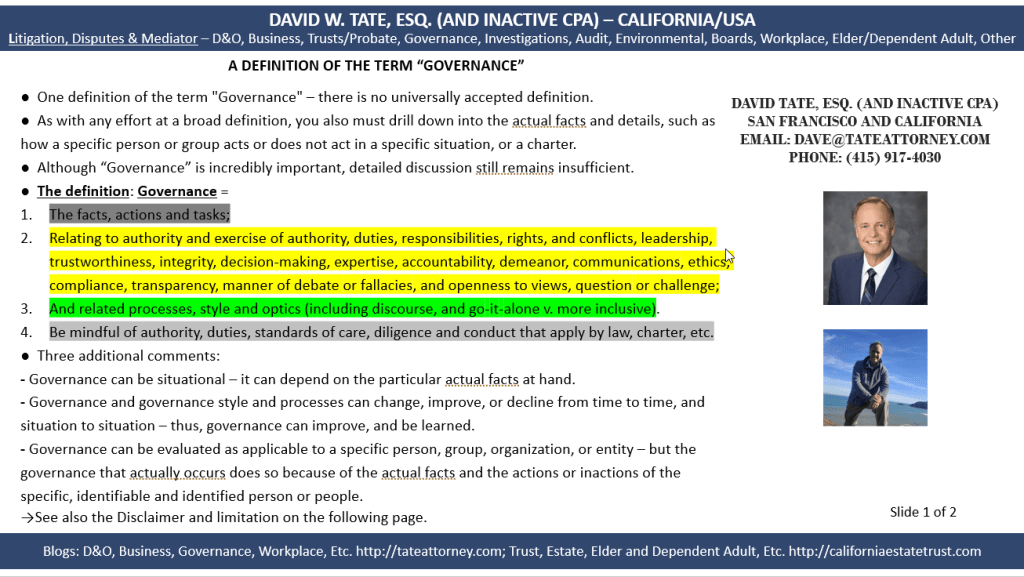
I have also pasted below my risk management processes slide and my definition of governance slide.

* * * *

Thank you for viewing this discussion. Please do pass this blog and blog post and information to other people who would be interested as it is only through collaboration and sharing that great things and success are more quickly achieved. If you are interested in discussing anything that I have said in the discussion above or in either of my two blogs (see blog addresses below), or if you simply want to reach out or are seeking assistance, it is best to reach me by email at dave@tateattorney.com.

David Tate, Esq. (and inactive CPA)

  • Business litigation and disputes – business, breach of contract/commercial, co-owners, shareholders, investors, founders, workplace and employment, environmental, D&O, governance, boards and committees.
  • Trust, estate and probate court litigation and disputes – trust, estate, probate, elder and dependent abuse, conservatorship, POA, real property, mental health and care, mental capacity, undue influence, conflicts of interest, and contentious administrations.
  • Governance, boards, audit and governance committees, investigations, auditing, ESG, etc.
  • Mediator and facilitating dispute resolution (evaluative and facilitative):
    • Trust, estate, probate, conservatorship, elder and dependent abuse, etc.
    • Business, breach of contract/commercial, owner, shareholder, investor, etc.
    • D&O, board, audit and governance committee, accountant and CPA related.
    • Other: workplace and employment, environmental, trade secret.

Remember, every case and situation is different. It is important to obtain and evaluate all of the evidence that is available, and to apply that evidence to the applicable standards and laws. You do need to consult with an attorney and other professionals about your particular situation. This post is not a solicitation for legal or other services inside of or outside of California, and, of course, this post only is a summary of information that changes from time to time, and does not apply to any particular situation or to your specific situation. So . . . you cannot rely on this post for your situation or as legal or other professional advice or representation, or as or for my opinions and views on the subject matter.

Also note – sometimes I include links to or comments about materials from other organizations or people – if I do so, it is because I believe that the materials are worthwhile reading or viewing; however, that does not mean that I do not or that I might not have a different view about some or even all of the subject matter or materials, or that I necessarily agree with, or agree with everything about or relating to, that organization or person, or those materials or the subject matter.

Please also subscribe to this blog and my other blog (see below), and connect with me on LinkedIn and Twitter.

My two blogs are:

http://tateattorney.com – business, D&O, audit committee, governance, compliance, etc. – previously at http://auditcommitteeupdate.com

Trust, estate, conservatorship, elder and elder abuse, etc. litigation and contentious administrations http://californiaestatetrust.com

David Tate, Esq. (and inactive California CPA) – practicing only as an attorney in California.

Thomas v. Regents of the University of California – Opinion on demurrer to Cal. Civ. Code §51.9 for sexual harassment – pleading that she/Thomas would not have been treated in the same manner if she were a man

I have attached below a pdf of the recent Opinion in Renee Thomas v. Regents of the University of California, et al. The Opinion is on what is called a demurrer – which is a motion by a defendant in which the defendant argues that assuming everything that is alleged in the complaint (or amended complaint in this case) is true, plaintiff still has not pleaded a legal and factual claim upon which plaintiff can recover, and that, accordingly, the complaint (or amended complaint in this case) should be dismissed and plaintiff should recover nothing.

The attached Opinion is long; however, it is interesting reading both for the allegation that are made (i.e., allegations of harassment and/or sexual harassment in the University/school athletic women’s soccer team setting) and for the discussions about the law that is applicable to each of the causes of action that are alleged.

But I am writing this blog post for the purpose of briefly discussing only the part of the Opinion relating to the demurrer on what the Court has identified or defined as a cause of action under California Code of Civil Procedure §51.9 for sexual harassment, and I am only discussing one aspect of that part of the Opinion – the part in which the Court discusses that on a claim for sexual harassment under Cal. Civ. Code §51.9, the sexual harassment element of that claim can be pleaded and sufficiently alleged and ultimately recovered upon in different ways one of which is upon sufficient allegations that in the context of the Thomas case if she can allege (and then prove) that she would not have been treated in the same manner if she were a man. Thus, for example, the wrongful conduct does not have to involve direct sexual conduct.

The trial court granted the demurrer against each cause of action. The Court of Appeal did so also but allowed plaintiff the opportunity to amend the complaint again to try to state a proper and allowable claim under Cal. Civ. Code §51.9 for sexual harassment.

As I typically try to do, below I have pasted select wording from the Opinion because I believe it is beneficial for you to be able to read the actual, exact wording from the Court’s actual source Opinion. Thus, below I have provided select wording pertaining to the part of the Opinion discussing Cal. Civ. Code §51.9 in the context of the pleading allegations and whether Thomas can sufficiently plead on a demurrer that she would not have been treated in the same manner if she were a man (which, of course, she would also ultimately have to prove). However, you do need to read the entire Opinion to fully understand what the Court has held. I have also pasted below Cal. Civ. Code §51.9. Please also note that although Thomas v. Regents of the University of California is based on the allegations of that case (i.e., allegations of harassment and/or sexual harassment in the women’s soccer team setting), the reasoning of the Court could be applicable (at least in legal theory) to any sufficient allegation (and upon proof) of sexual harassment under Cal. Civ. Code §51.9 and would not be limited to a University or women’s or athletic or soccer team settings.  

The following is Cal. Civ. Code §51.9:

Cal. Civ. Code §51.9

(a) A person is liable in a cause of action for sexual harassment under this section when the plaintiff proves all of the following elements:

(1) There is a business, service, or professional relationship between the plaintiff and defendant or the defendant holds himself or herself out as being able to help the plaintiff establish a business, service, or professional relationship with the defendant or a third party. Such a relationship may exist between a plaintiff and a person, including, but not limited to, any of the following persons:

(A) Physician, psychotherapist, or dentist. For purposes of this section, “psychotherapist” has the same meaning as set forth in paragraph (1) of subdivision (c) of Section 728 of the Business and Professions Code.

(B) Attorney, holder of a master’s degree in social work, real estate agent, real estate appraiser, investor, accountant, banker, trust officer, financial planner loan officer, collection service, building contractor, or escrow loan officer.

(C) Executor, trustee, or administrator.

(D) Landlord or property manager.

(E) Teacher.

(F) Elected official.

(G) Lobbyist.

(H) Director or producer.

(I) A relationship that is substantially similar to any of the above.

(2) The defendant has made sexual advances, solicitations, sexual requests, demands for sexual compliance by the plaintiff, or engaged in other verbal, visual, or physical conduct of a sexual nature or of a hostile nature based on gender, that were unwelcome and pervasive or severe.

(3) The plaintiff has suffered or will suffer economic loss or disadvantage or personal injury, including, but not limited to, emotional distress or the violation of a statutory or constitutional right, as a result of the conduct described in paragraph (2).

(b) In an action pursuant to this section, damages shall be awarded as provided by subdivision (b) of Section 52.

(c) Nothing in this section shall be construed to limit application of any other remedies or rights provided under the law.

(d) The definition of sexual harassment and the standards for determining liability set forth in this section shall be limited to determining liability only with regard to a cause of action brought under this section.

(Amended by Stats. 2018, Ch. 951, Sec. 1. (SB 224) Effective January 1, 2019.)

The following is select wording from the Opinion in Thomas v. Regents of the University of California pertaining to the sufficiency of allegations at least at the pleading stage (and to survive a demurrer) under Cal. Civ. Code §51.9 upon sufficient allegations, and if those allegations can be made, that Thomas would not have been treated in the same manner if she were a man (note: I added the yellow highlight, and, as stated above, you do need to read and understand the Court’s entire, complete Opinion, and then apply that understanding to your particular unique factual situation).

* * * * *

            “Renee Thomas was recruited to play on the women’s soccer team at the University of California, Berkeley (UCB), played on the team during her freshman year and, in the spring of that year, was released from the team. She sued UCB, the head coach of the women’s soccer team [Neil McGuire], and the Director of Athletics (collectively, defendants), first in federal court and then in state court. The present appeal is from the judgment in favor of the defendants entered after the trial court sustained demurrers to all Thomas’s causes of action without leave to amend. As we will explain, we conclude Thomas sufficiently pleaded a cause of action for sexual harassment in violation of Civil Code section 51.9 against the head coach [Neil McGuire] and UCB and should have been granted leave to amend her complaint to clarify the statutory basis of this claim.”

* * * * *

            “Civil Code section 51.9 is not part of the Unruh Act; it is a separate civil rights statute. (Hughes v. Pair (2009) 46 Cal.4th 1035, 1044, fn. 1 (Hughes); Ramirez v. Wong (2010) 188 Cal.App.4th 1480, 1487, fn. 5.)4

* * * * *

            “In the employment context, “ ‘[t]he plaintiff must prove that the defendant’s conduct would have interfered with a reasonable employee’s work performance and would have seriously affected the psychological well-being of a reasonable employee and that she was actually offended. [Citation.] [¶] The factors that can be considered in evaluating the totality of the circumstances are: (1) the nature of the unwelcome sexual acts or works (generally, physical touching is more offensive than unwelcome verbal abuse); (2) the frequency of the offensive encounters; (3) the total number of days over which all of the offensive conduct occurs; and (4) the context in which the sexually harassing conduct occurred.’ ” (Singleton v. United States Gypsum Co. (2006) 140 Cal.App.4th 1547, 1557, quoting Fisher v. San Pedro Peninsula Hospital (1989) 214 Cal.App.3d 590, 609-610 (Fisher).)

            “The plaintiff must show that the harassing conduct took place because of the plaintiff’s sex, but need not show that the conduct was motivated by sexual desire. (Singleton v. United States Gypsum Co. [supra,] 140 Cal.App.4th [at p.] 1564; see also Oncale v. Sundowner Offshore Services, Inc. (1998) 523 U.S. 75, 80 [same principle applies under title VII].)” (Pantoja v. Anton (2011) 198 Cal.App.4th 87, 114 (Pantoja).) “Sexual harassment does not necessarily involve sexual conduct. It need not have anything to do with lewd acts, double entendres or sexual advances. Sexual harassment may involve conduct, whether blatant or subtle, that discriminates against a person solely because of that person’s sex.” (Accardi v. Superior Court (1993) 17 Cal.App.4th 341, 345 (Accardi).) “For example, a female plaintiff can prevail by showing that the harassment was because of the defendant’s bias against women” or that an employer created a hostile work environment “because the employer feels important or powerful while humiliating women.” (Pantoja, at pp. 114-115.) Harassment “because of sex” may be shown where “an abusive bully takes advantage of a traditionally female workplace because he is more comfortable when bullying women than when bullying men.” (E.E.O.C. v. National Educ. Ass’n, Alaska (9th Cir. 2005) 422 F.3d 840, 845 (E.E.O.C.).) To plead a cause of action for sexual harassment in the form of a hostile environment, “it is ‘only necessary to show that gender is a substantial factor in the discrimination, and that if the plaintiff “had been a man she would not have been treated in the same manner.”’ [Citation.]” (Tomkins v. Public Serv. Elec. & Gas Co. (3d Cir.1977) 568 F.2d 1044, 1047, fn. 4.)” (Accardi, at p. 348.)”

* * * * *

3.  Thomas Sufficiently Pleaded Sexual Harassment by McGuire.

            The elements of a cause of action for sexual harassment under Civil Code section 51.9 are 1) a “business, service, or professional relationship between the plaintiff and defendant”; 2) the defendant “made sexual advances, solicitations, sexual requests, demands for sexual compliance by the plaintiff, or engaged in other verbal, visual, or physical conduct of a sexual nature or of a hostile nature based on gender”; 3) the defendant’s conduct was “unwelcome and pervasive or severe”; and 4) the plaintiff “has suffered or will suffer economic loss or disadvantage or personal injury, including, but not limited to, emotional distress or the violation of a statutory or constitutional right, as a result of the [defendant’s] conduct.” (Civ. Code, § 51.9; CACI No. 3065.)

            The parties dispute whether Thomas sufficiently alleged conduct of the required nature and pervasiveness or severity. In our view, she did.”

* * * * *

            “As earlier explained, Thomas claims sexual harassment in the form of a hostile environment—that McGuire, in the words of Civil Code section 51.9, “engaged in . . . verbal, visual, or physical conduct . . . of a hostile nature based on gender” that was “unwelcome and pervasive or severe.” She alleged that McGuire “berated” the players in front of the team “to make an example out of them and strike fear in the witnessing athletes”; called the players names, cursed at them and “degraded them with personal insults”; “tormented them psychologically”; “punished them with grueling workouts”; and was described to the UCB athletic administration as “creating a culture of fear and intimidation.” This included making “unwelcome and inappropriate comments about players’ bodies,” “call[ing] out the physique of one player in front of the team and call[ing] her weak” and “berat[ing] a young woman for having what he perceived as a hickey on her neck.” Thomas alleged that his conduct made her feel she had to be “absolutely perfect” and caused her and her teammates to “tread extremely lightly around [McGuire]” to “avoid drawing his aggression or being retaliated against.” Team members and their parents complained to the athletics department and to the UCB Chancellor about the “abuse.”

            These allegations unquestionably describe pervasive bullying behavior toward the young women on the soccer team that created a hostile environment. The defendants argue (and the trial court concluded) that they do not allege pervasive sexual harassment because the alleged conduct and comments were not of a sexual or hostile gender-based nature. We disagree. As we have explained, “there is no legal requirement that hostile acts be overtly sex- or gender-specific in content, whether marked by language, by sex or gender stereotypes, or by sexual overtures.” (E.E.O.C., supra, 422 F.3d at p. 844.) Even with no express reference to sex or gender, harassment creating a hostile environment may constitute sexual harassment if the plaintiff can prove “ ‘ “she would not have been treated in the same manner” ’ ” if she were a man. (Accardi, supra, 17 Cal.App.4th at p. 348.)”

* * * * *

That is all for now in this post. Obviously, these are complicated issues of law and fact that require considerable evaluation in the context of your situation or any possible situation. Thomas is not the first Opinion that has expressed these holdings, but Thomas does so in a manner that is perhaps more relatable.

The following is a complete copy of the Opinion in Renee Thomas v. Regents of the University of California, et al.

* * * *

Thank you for viewing this discussion. Please do pass this blog and blog post and information to other people who would be interested as it is only through collaboration and sharing that great things and success are more quickly achieved. If you are interested in discussing anything that I have said in the discussion above or in either of my two blogs (see blog addresses below), or if you simply want to reach out or are seeking assistance, it is best to reach me by email at dave@tateattorney.com.

David Tate, Esq. (and inactive CPA)

  • Business litigation and disputes – business, breach of contract/commercial, co-owners, shareholders, investors, founders, workplace and employment, environmental, D&O, governance, boards and committees.
  • Trust, estate and probate court litigation and disputes – trust, estate, probate, elder and dependent abuse, conservatorship, POA, real property, mental health and care, mental capacity, undue influence, conflicts of interest, and contentious administrations.
  • Governance, boards, audit and governance committees, investigations, auditing, ESG, etc.
  • Mediator and facilitating dispute resolution (evaluative and facilitative):
    • Trust, estate, probate, conservatorship, elder and dependent abuse, etc.
    • Business, breach of contract/commercial, owner, shareholder, investor, etc.
    • D&O, board, audit and governance committee, accountant and CPA related.
    • Other: workplace and employment, environmental, trade secret.

Remember, every case and situation is different. It is important to obtain and evaluate all of the evidence that is available, and to apply that evidence to the applicable standards and laws. You do need to consult with an attorney and other professionals about your particular situation. This post is not a solicitation for legal or other services inside of or outside of California, and, of course, this post only is a summary of information that changes from time to time, and does not apply to any particular situation or to your specific situation. So . . . you cannot rely on this post for your situation or as legal or other professional advice or representation, or as or for my opinions and views on the subject matter.

Also note – sometimes I include links to or comments about materials from other organizations or people – if I do so, it is because I believe that the materials are worthwhile reading or viewing; however, that does not mean that I do not or that I might not have a different view about some or even all of the subject matter or materials, or that I necessarily agree with, or agree with everything about or relating to, that organization or person, or those materials or the subject matter.

Please also subscribe to this blog and my other blog (see below), and connect with me on LinkedIn and Twitter.

My two blogs are:

http://tateattorney.com – business, D&O, audit committee, governance, compliance, etc. – previously at http://auditcommitteeupdate.com

Trust, estate, conservatorship, elder and elder abuse, etc. litigation and contentious administrations http://californiaestatetrust.com

David Tate, Esq. (and inactive California CPA) – practicing only as an attorney in California.

Major expansion of required California employer injury/safety and violence prevention compliance programs – California SB 553

California Senate Bill 553 which was signed into law by Governor Newsom on September 30, 2023, is lengthy and covers several different pieces of legislation. Two of the lengthy provisions require most and sometimes all California employers to implement injury/safety and violence prevention compliance programs. The provisions are detailed, and yet, as is typical with legislation, also are vague in parts and contain uncertainties. It must be stressed that all California employers need to be aware of these provisions. There will be a lot of legal discussions about these provisions. Below I have pasted select wording from the required injury/safety and violence prevention provisions to give you an overall feel for what employers will be looking at – the below pasted provisions are not the entire provisions pertaining to injury/safety and violence prevention provisions – you will need to read the entire legislation. I am also providing below a link to a discussion about new 2024 California employer requirements by Saul Ewing – there is a discussion about SB 553 in the larger article in addition to other new 2024 requirements.

The following is the link to the Saul Ewing discussion https://www.saul.com/insights/article/2024-brings-new-obligations-california-employers

The following is the select wording from SB 553 pertaining to required injury/safety and violence prevention compliance programs (again, the select wording below is not the entirety of the relating legislation – you will need to obtain a complete copy of SB 553):

Senate Bill No. 553

CHAPTER 289

An act to amend, repeal, and add Section 527.8 of the Code of Civil Procedure, and to amend Section 6401.7 of, and to add Section 6401.9 to, the Labor Code, relating to occupational safety.

[ Approved by Governor September 30, 2023. Filed with Secretary of State September 30, 2023.]

* * * * *

Required injury/safety compliance programs:

SEC. 3.

 Section 6401.7 of the Labor Code is amended to read:

6401.7.

 (a) Every employer shall establish, implement, and maintain an effective injury prevention program. The program shall be written, except as provided in subdivision (e), and shall include, but not be limited to, the following elements:

(1) Identification of the person or persons responsible for implementing the program.

(2) The employer’s system for identifying and evaluating workplace hazards, including scheduled periodic inspections to identify unsafe conditions and work practices.

(3) The employer’s methods and procedures for correcting unsafe or unhealthy conditions and work practices in a timely manner.

(4) An occupational health and safety training program designed to instruct employees in general safe and healthy work practices and to provide specific instruction with respect to hazards specific to each employee’s job assignment.

(5) The employer’s system for communicating with employees on occupational health and safety matters, including provisions designed to encourage employees to inform the employer of hazards at the worksite without fear of reprisal.

(6) The employer’s system for ensuring that employees comply with safe and healthy work practices, which may include disciplinary action.

(7) A workplace violence prevention plan conforming to the requirements of Section 6401.9.

(b) The employer shall correct unsafe and unhealthy conditions and work practices in a timely manner based on the severity of the hazard.

(c) The employer shall train all employees when the training program is first established, all new employees, and all employees given a new job assignment, and shall train employees whenever new substances, processes, procedures, or equipment are introduced to the workplace and represent a new hazard, and whenever the employer receives notification of a new or previously unrecognized hazard. An employer in the construction industry who is required to be licensed under Chapter 9 (commencing with Section 7000) of Division 3 of the Business and Professions Code may use employee training provided to the employer’s employees under a construction industry occupational safety and health training program approved by the division to comply with the requirements of subdivision (a) relating to employee training, and shall only be required to provide training on hazards specific to an employee’s job duties.

(d) The employer shall keep appropriate records of steps taken to implement and maintain the program. An employer in the construction industry who is required to be licensed under Chapter 9 (commencing with Section 7000) of Division 3 of the Business and Professions Code may use records relating to employee training provided to the employer in connection with an occupational safety and health training program approved by the division to comply with this subdivision, and shall only be required to keep records of those steps taken to implement and maintain the program with respect to hazards specific to an employee’s job duties.

* * * * *

Required violence prevention compliance programs:

SEC. 4.

 Section 6401.9 is added to the Labor Code, to read:

6401.9.

 (a) For purposes of this section, the following definitions apply:

(1) “Emergency” means unanticipated circumstances that can be life threatening or pose a risk of significant injuries to employees or other persons.

(2) “Engineering controls” mean an aspect of the built space or a device that removes a hazard from the workplace or creates a barrier between the worker and the hazard.

(3) “Log” means the violent incident log required by this section.

(4) “Plan” means the workplace violence prevention plan required by this section.

(5) “Threat of violence” means any verbal or written statement, including, but not limited to, texts, electronic messages, social media messages, or other online posts, or any behavioral or physical conduct, that conveys an intent, or that is reasonably perceived to convey an intent, to cause physical harm or to place someone in fear of physical harm, and that serves no legitimate purpose.

(6) (A) “Workplace violence” means any act of violence or threat of violence that occurs in a place of employment.

(B) “Workplace violence” includes, but is not limited to, the following:

(i) The threat or use of physical force against an employee that results in, or has a high likelihood of resulting in, injury, psychological trauma, or stress, regardless of whether the employee sustains an injury.

(ii) An incident involving a threat or use of a firearm or other dangerous weapon, including the use of common objects as weapons, regardless of whether the employee sustains an injury.

(iii) The following four workplace violence types:

(I) “Type 1 violence,” which means workplace violence committed by a person who has no legitimate business at the worksite, and includes violent acts by anyone who enters the workplace or approaches workers with the intent to commit a crime.

(II) “Type 2 violence,” which means workplace violence directed at employees by customers, clients, patients, students, inmates, or visitors.

(III) “Type 3 violence,” which means workplace violence against an employee by a present or former employee, supervisor, or manager.

(IV) “Type 4 violence,” which means workplace violence committed in the workplace by a person who does not work there, but has or is known to have had a personal relationship with an employee.

(C) “Workplace violence” does not include lawful acts of self-defense or defense of others.

(7) “Work practice controls” means procedures and rules which are used to effectively reduce workplace violence hazards.

(b) (1) Except as provided in paragraph (2), this section applies to all employers, employees, places of employment, and employer-provided housing.

(2) Subject to paragraph (3), the following employers, employees, and places of employment are exempt from this section:

(A) Health care facilities, service categories, and operations covered by Section 3342 of Title 8 of the California Code of Regulations.

(B) Employers that comply with Section 3342 of Title 8 of the California Code of Regulations.

(C) Facilities operated by the Department of Corrections and Rehabilitation, if the facilities are in compliance with Section 3203 of Title 8 of the California Code of Regulations.

(D) Employers that are law enforcement agencies that are a “department or participating department,” as defined in Section 1001 of Title 11 of the California Code of Regulations and that have received confirmation of compliance with the Commission on Peace Officer Standards and Training (POST) Program from the POST Executive Director in accordance with Section 1010 of Title 11 of the California Code of Regulations. However, an employer shall be exempt pursuant to this subparagraph only if all facilities operated by the agency are in compliance with Section 3203 of Title 8 of the California Code of Regulations.

(E) Employees teleworking from a location of the employee’s choice, which is not under the control of the employer.

(F) Places of employment where there are less than 10 employees working at the place at any given time and that are not accessible to the public, if the places are in compliance with Section 3203 of Title 8 of the California Code of Regulations.

(3) Notwithstanding paragraph (1), the division may, by issuance of an order to take special action, require an employer that is exempt pursuant to paragraph (1) to comply with this section or require an employer to include employees or places of employment that are exempt pursuant to paragraph (1) in their compliance with this section.

(c) (1) (A) An employer shall establish, implement, and maintain an effective workplace violence prevention plan.

(B) The plan shall be in writing and shall be available and easily accessible to employees, authorized employee representatives, and representatives of the division at all times. The plan shall be in effect at all times and in all work areas and be specific to the hazards and corrective measures for each work area and operation. The written plan may be incorporated as a stand-alone section in the written injury and illness prevention program required by Section 3203 of Title 8 of the California Code of Regulations or maintained as a separate document.

(2) The plan shall include all of the following:

(A) Names or job titles of the persons responsible for implementing the plan. If there are multiple persons responsible for the plan, their roles shall be clearly described.

(B) Effective procedures to obtain the active involvement of employees and authorized employee representatives in developing and implementing the plan, including, but not limited to, through their participation in identifying, evaluating, and correcting workplace violence hazards, in designing and implementing training, and in reporting and investigating workplace violence incidents.

(C) Methods the employer will use to coordinate implementation of the plan with other employers, when applicable, to ensure that those employers and employees understand their respective roles, as provided in the plan. These methods shall ensure that all employees are provided the training required by subdivision (e) and that workplace violence incidents involving any employee are reported, investigated, and recorded.

(D) Effective procedures for the employer to accept and respond to reports of workplace violence, and to prohibit retaliation against an employee who makes such a report.

(E) Effective procedures to ensure that supervisory and nonsupervisory employees comply with the plan in a manner consistent with paragraph (2) of subdivision (a) of Section 3203 of Title 8 of the California Code of Regulations.

(F) Effective procedures to communicate with employees regarding workplace violence matters, including, but not limited to, both of the following:

(i) How an employee can report a violent incident, threat, or other workplace violence concern to the employer or law enforcement without fear of reprisal.

(ii) How employee concerns will be investigated as part of the employer’s responsibility in complying with subparagraph (I), and how employees will be informed of the results of the investigation and any corrective actions to be taken as part of the employer’s responsibility in complying with subparagraph (J).

(G) Effective procedures to respond to actual or potential workplace violence emergencies, including, but not limited to, all of the following:

(i) Effective means to alert employees of the presence, location, and nature of workplace violence emergencies.

(ii) Evacuation or sheltering plans that are appropriate and feasible for the worksite.

(iii) How to obtain help from staff assigned to respond to workplace violence emergencies, if any, security personnel, if any, and law enforcement.

(H) Procedures to develop and provide the training required in subdivision (e).

(I) Procedures to identify and evaluate workplace violence hazards, including, but not limited to, scheduled periodic inspections to identify unsafe conditions and work practices and employee reports and concerns. Inspections shall be conducted when the plan is first established, after each workplace violence incident, and whenever the employer is made aware of a new or previously unrecognized hazard.

(J) Procedures to correct workplace violence hazards identified and evaluated in subparagraph (I) in a timely manner consistent with paragraph (6) of subdivision (a) of Section 3203 of Title 8 of the California Code of Regulations.

(K) Procedures for postincident response and investigation.

(L) Procedures to review the effectiveness of the plan and revise the plan as needed, including, but not limited to, procedures to obtain the active involvement of employees and authorized employee representatives in reviewing the plan. The plan shall be reviewed at least annually, when a deficiency is observed or becomes apparent, and after a workplace violence incident.

(M) Procedures or other information required by the division and standards board as being necessary and appropriate to protect the health and safety of employees, pursuant to subdivision (h).

(d) (1) (A) The employer shall record information in a violent incident log for every workplace violence incident.

* * * *

Thank you for viewing this discussion. Please do pass this blog and blog post and information to other people who would be interested as it is only through collaboration and sharing that great things and success are more quickly achieved. If you are interested in discussing anything that I have said in the discussion above or in either of my two blogs (see blog addresses below), or if you simply want to reach out or are seeking assistance, it is best to reach me by email at dave@tateattorney.com.

David Tate, Esq. (and inactive CPA)

  • Business litigation and disputes – business, breach of contract/commercial, co-owners, shareholders, investors, founders, workplace and employment, environmental, D&O, governance, boards and committees.
  • Trust, estate and probate court litigation and disputes – trust, estate, probate, elder and dependent abuse, conservatorship, POA, real property, mental health and care, mental capacity, undue influence, conflicts of interest, and contentious administrations.
  • Governance, boards, audit and governance committees, investigations, auditing, ESG, etc.
  • Mediator and facilitating dispute resolution (evaluative and facilitative):
    • Trust, estate, probate, conservatorship, elder and dependent abuse, etc.
    • Business, breach of contract/commercial, owner, shareholder, investor, etc.
    • D&O, board, audit and governance committee, accountant and CPA related.
    • Other: workplace and employment, environmental, trade secret.

Remember, every case and situation is different. It is important to obtain and evaluate all of the evidence that is available, and to apply that evidence to the applicable standards and laws. You do need to consult with an attorney and other professionals about your particular situation. This post is not a solicitation for legal or other services inside of or outside of California, and, of course, this post only is a summary of information that changes from time to time, and does not apply to any particular situation or to your specific situation. So . . . you cannot rely on this post for your situation or as legal or other professional advice or representation, or as or for my opinions and views on the subject matter.

Also note – sometimes I include links to or comments about materials from other organizations or people – if I do so, it is because I believe that the materials are worthwhile reading or viewing; however, that does not mean that I do not or that I might not have a different view about some or even all of the subject matter or materials, or that I necessarily agree with, or agree with everything about or relating to, that organization or person, or those materials or the subject matter.

Please also subscribe to this blog and my other blog (see below), and connect with me on LinkedIn and Twitter.

My two blogs are:

http://tateattorney.com – business, D&O, audit committee, governance, compliance, etc. – previously at http://auditcommitteeupdate.com

Trust, estate, conservatorship, elder and elder abuse, etc. litigation and contentious administrations http://californiaestatetrust.com

David Tate, Esq. (and inactive California CPA) – practicing only as an attorney in California.

Questions to Consider to Help Facilitate Legal Dispute Resolution and Settlement (please use, and forward to other people who would benefit)

I have provided below a snapshot of the first page and a complete pdf copy to my paper Questions to Consider to Help Facilitate Legal Dispute Resolution and Settlement. Please use the paper, and please also pass the paper and this blog post to other people who would benefit or who would at least find the paper and the discussions interesting. I have also posted this to my trust, estate, elder, etc. litigation blog (http://californiaestatetrust.com).

The following is a snapshot of the first page of the paper:

The following is a pdf of the complete paper, including a pdf link:

* * * *

Thank you for viewing this discussion. Please do pass this blog and blog post and information to other people who would be interested as it is only through collaboration and sharing that great things and success are more quickly achieved. If you are interested in discussing anything that I have said in the discussion above or in either of my two blogs (see blog addresses below), or if you simply want to reach out or are seeking assistance, it is best to reach me by email at dave@tateattorney.com.

David Tate, Esq. (and inactive CPA)

  • Business litigation and disputes – business, breach of contract/commercial, co-owners, shareholders, investors, founders, workplace and employment, environmental, D&O, governance, boards and committees.
  • Trust, estate and probate court litigation and disputes – trust, estate, probate, elder and dependent abuse, conservatorship, POA, real property, mental health and care, mental capacity, undue influence, conflicts of interest, and contentious administrations.
  • Governance, boards, audit and governance committees, investigations, auditing, ESG, etc.
  • Mediator and facilitating dispute resolution (evaluative and facilitative):
    • Trust, estate, probate, conservatorship, elder and dependent abuse, etc.
    • Business, breach of contract/commercial, owner, shareholder, investor, etc.
    • D&O, board, audit and governance committee, accountant and CPA related.
    • Other: workplace and employment, environmental, trade secret.

Remember, every case and situation is different. It is important to obtain and evaluate all of the evidence that is available, and to apply that evidence to the applicable standards and laws. You do need to consult with an attorney and other professionals about your particular situation. This post is not a solicitation for legal or other services inside of or outside of California, and, of course, this post only is a summary of information that changes from time to time, and does not apply to any particular situation or to your specific situation. So . . . you cannot rely on this post for your situation or as legal or other professional advice or representation, or as or for my opinions and views on the subject matter.

Also note – sometimes I include links to or comments about materials from other organizations or people – if I do so, it is because I believe that the materials are worthwhile reading or viewing; however, that does not mean that I do not or that I might not have a different view about some or even all of the subject matter or materials, or that I necessarily agree with, or agree with everything about or relating to, that organization or person, or those materials or the subject matter.

Please also subscribe to this blog and my other blog (see below), and connect with me on LinkedIn and Twitter.

My two blogs are:

http://tateattorney.com – business, D&O, audit committee, governance, compliance, etc. – previously at http://auditcommitteeupdate.com

Trust, estate, conservatorship, elder and elder abuse, etc. litigation and contentious administrations http://californiaestatetrust.com

David Tate, Esq. (and inactive California CPA) – practicing only as an attorney in California.

I had new professional pictures (head pictures) taken – I selected these four out of many

I have also posted the following to my trust, estate, elder, etc. litigation blog (http://californiaestatetrust.com).

This just a fun post. It has been six years since I last had professional head pictures taken. It was time (actually past time) to get new pictures. Out of many pictures, I narrowed the pictures and I selected these four because I just could not decide which one of the two with a tie and which one of the two without a tie. If you are interested, the pictures taken at Dawdy Photography (in Burlingame, California). Dawdy Photography was great. I will be substituting out my existing pictures for the new pictures – which may take a week or more as I have a trial this coming week.

* * * *

Thank you for viewing this discussion. Please do pass this blog and blog post and information to other people who would be interested as it is only through collaboration and sharing that great things and success are more quickly achieved. If you are interested in discussing anything that I have said in the discussion above or in either of my two blogs (see blog addresses below), or if you simply want to reach out or are seeking assistance, it is best to reach me by email at dave@tateattorney.com.

David Tate, Esq. (and inactive CPA)

  • Business litigation and disputes – business, breach of contract/commercial, co-owners, shareholders, investors, founders, workplace and employment, environmental, D&O, governance, boards and committees.
  • Trust, estate and probate court litigation and disputes – trust, estate, probate, elder and dependent abuse, conservatorship, POA, real property, mental health and care, mental capacity, undue influence, conflicts of interest, and contentious administrations.
  • Governance, boards, audit and governance committees, investigations, auditing, ESG, etc.
  • Mediator and facilitating dispute resolution (evaluative and facilitative):
    • Trust, estate, probate, conservatorship, elder and dependent abuse, etc.
    • Business, breach of contract/commercial, owner, shareholder, investor, etc.
    • D&O, board, audit and governance committee, accountant and CPA related.
    • Other: workplace and employment, environmental, trade secret.

Remember, every case and situation is different. It is important to obtain and evaluate all of the evidence that is available, and to apply that evidence to the applicable standards and laws. You do need to consult with an attorney and other professionals about your particular situation. This post is not a solicitation for legal or other services inside of or outside of California, and, of course, this post only is a summary of information that changes from time to time, and does not apply to any particular situation or to your specific situation. So . . . you cannot rely on this post for your situation or as legal or other professional advice or representation, or as or for my opinions and views on the subject matter.

Also note – sometimes I include links to or comments about materials from other organizations or people – if I do so, it is because I believe that the materials are worthwhile reading or viewing; however, that does not mean that I do not or that I might not have a different view about some or even all of the subject matter or materials, or that I necessarily agree with, or agree with everything about or relating to, that organization or person, or those materials or the subject matter.

Please also subscribe to this blog and my other blog (see below), and connect with me on LinkedIn and Twitter.

My two blogs are:

http://tateattorney.com – business, D&O, audit committee, governance, compliance, etc. – previously at http://auditcommitteeupdate.com

Trust, estate, conservatorship, elder and elder abuse, etc. litigation and contentious administrations http://californiaestatetrust.com

David Tate, Esq. (and inactive California CPA) – practicing only as an attorney in California.