Opportunities for internal audit, lawyers, and privacy law compliance professionals – California Attorney General sends investigation letters requesting employer information about compliance with the CCPA

The California Attorney General has sent investigation letters to large employers requesting that they provide information about how they are complying with the California Privacy Act (CCPA). I have provided below a screenshot from the California Attorney General website. Obviously all businesses and other entitles that are or that might be subject to the CCPA or various provisions should to be on top of whether they have responsibilities under the CCPA and if so whether their programs and processes are in compliance. This sounds like more opportunities (and possibly duties) for a list of officers and other people holding different positions, possibly including board and audit committee or risk committee oversight, compliance with laws and regulations, corporate counsel and chief legal officers (CLOs), chief compliance officers (COOs), CFOs, internal audit and chief audit executives (CAEs), outside legal counsel, and other privacy law and compliance and risk management professionals.

The following is the screenshot from the Attorney General website:

* * * *

Thank you for viewing this discussion. Please do pass this blog and blog post and information to other people who would be interested as it is only through collaboration and sharing that great things and success are more quickly achieved. If you are interested in discussing anything that I have said in the discussion above or in either of my two blogs (see blog addresses below), or if you simply want to reach out or are seeking assistance, it is best to reach me by email at dave@tateattorney.com.

David Tate, Esq. (and inactive CPA)

  • Business litigation and disputes – business, breach of contract/commercial, co-owners, shareholders, investors, founders, workplace and employment, environmental, D&O, governance, boards and committees.
  • Trust, estate and probate court litigation and disputes – trust, estate, probate, elder and dependent abuse, conservatorship, POA, real property, mental health and care, mental capacity, undue influence, conflicts of interest, and contentious administrations.
  • Governance, boards, audit and governance committees, investigations, auditing, ESG, etc.
  • Mediator and facilitating dispute resolution (evaluative and facilitative):
    • Trust, estate, probate, conservatorship, elder and dependent abuse, etc.
    • Business, breach of contract/commercial, owner, shareholder, investor, etc.
    • D&O, board, audit and governance committee, accountant and CPA related.
    • Other: workplace and employment, environmental, trade secret.

Remember, every case and situation is different. It is important to obtain and evaluate all of the evidence that is available, and to apply that evidence to the applicable standards and laws. You do need to consult with an attorney and other professionals about your particular situation. This post is not a solicitation for legal or other services inside of or outside of California, and, of course, this post only is a summary of information that changes from time to time, and does not apply to any particular situation or to your specific situation. So . . . you cannot rely on this post for your situation or as legal or other professional advice or representation, or as or for my opinions and views on the subject matter.

Also note – sometimes I include links to or comments about materials from other organizations or people – if I do so, it is because I believe that the materials are worthwhile reading or viewing; however, that does not mean that I do not or that I might not have a different view about some or even all of the subject matter or materials, or that I necessarily agree with, or agree with everything about or relating to, that organization or person, or those materials or the subject matter.

Please also subscribe to this blog and my other blog (see below), and connect with me on LinkedIn and Twitter.

My two blogs are:

http://tateattorney.com – business, D&O, audit committee, governance, compliance, etc. – previously at http://auditcommitteeupdate.com

Trust, estate, conservatorship, elder and elder abuse, etc. litigation and contentious administrations http://californiaestatetrust.com

David Tate, Esq. (and inactive California CPA) – practicing only as an attorney in California.

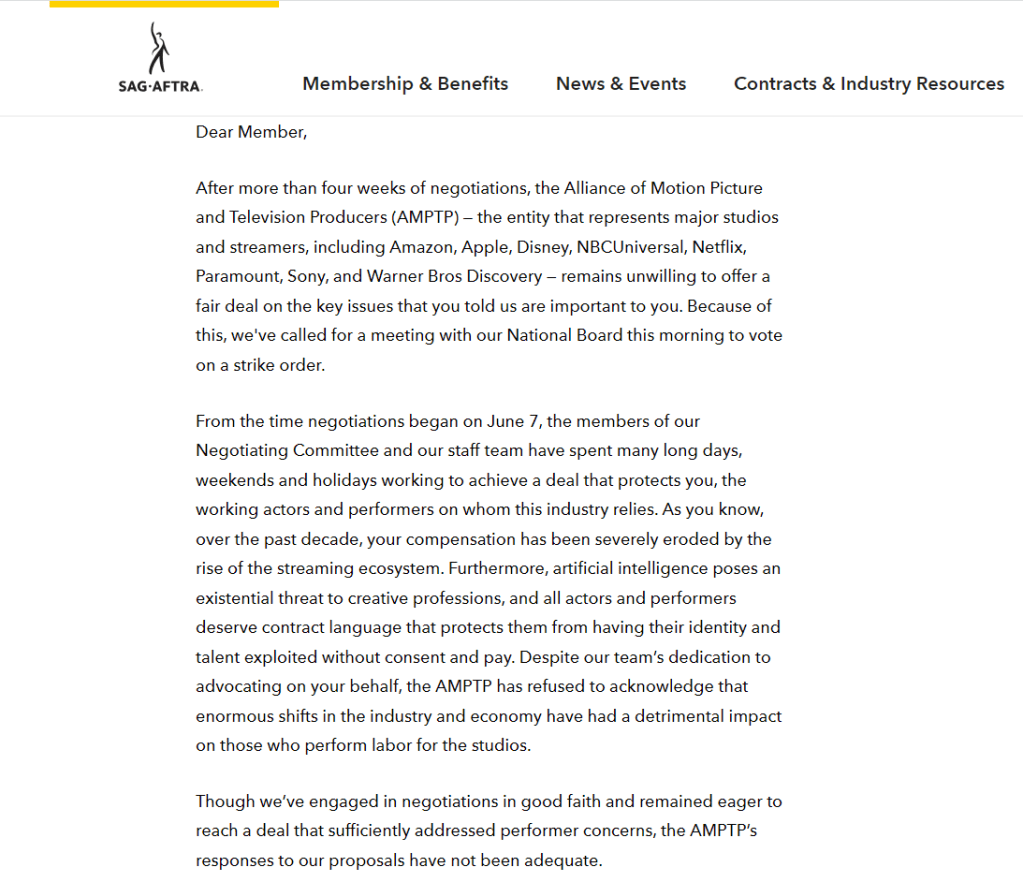
Mediator’s Hat: SAG-AFTRA, WGA, and AMPTP strikes and an industry subject to current/constant change and mid- and long-term risk, and risk and change management

Ultimately the SAG-AFTRA and WGA strikes will be resolved and settled. The pressure on the producers is tremendous and will continue to increase the longer that there is no resolution. But the actors, writers, and artists also are at risk. There are significant pay, perhaps residuals, perhaps long-term job security, and perhaps industry or individual economic business viability issues.

A contract of relatively short duration and then with longer term negotiations would be easiest, if the parties will do so in earnest. This is an industry that seems to be in a state of relatively constant significant change and possible disruption risk – AI is only one of the most recent possible disruptors and AI is just getting started – although there might be current efforts to delay AI, I just do not see it as stopping, and any segment of any industry that does temporarily delay AI is at risk from possible other outside existing third party disruptors, or new disruptors. There is risk for everyone who is involved in this industry, both short-term and long-term.

There will be a settlement. But everyone will remain in ongoing future risk – thus, although perhaps difficult to structure, a longer mid-term agreement that also recognizes existing and later new and perhaps unknown changes, risks and disruption in the industry would be best. But for that, there must also be a level of trust – thus, although to a certain extent inevitable, hopefully conduct such as name calling, hyperbole, or argument gimmicks or distortion will be kept to a minimum.

The following is a scan from the SAG-AFTRA website – I am sure that consider of the issues that are involved actually started longer ago (and the Writers Guild strike itself started back on May 2), but four weeks of negotiations is not very long for any of the parties, and they must keep at the efforts to resolve these disputes, as I resume that the parties are in fact doing and are being encouraged:

* * * * *

Thank you for viewing. Please do pass this blog and blog post and information to other people who would be interested as it is only through collaboration and sharing that great things and success are more quickly achieved.

David Tate, Esq. (and inactive CPA)

  • Business litigation and disputes – business, breach of contract/commercial, co-owners, shareholders, investors, founders, workplace and employment, environmental, D&O, governance, boards and committees.
  • Trust, estate and probate court litigation and disputes – trust, estate, probate, elder and dependent abuse, conservatorship, POA, real property, mental health and care, mental capacity, undue influence, conflicts of interest, and contentious administrations.
  • Governance, boards, audit and governance committees, investigations, auditing, ESG, etc.
  • Mediator and facilitating dispute resolution:
    • Trust, estate, probate, conservatorship, elder and dependent abuse, etc.
    • Business, breach of contract/commercial, owner, shareholder, investor, etc.
    • D&O, board, audit and governance committee, accountant and CPA related.
    • Other: workplace and employment, environmental, trade secret.

Remember, every case and situation is different. It is important to obtain and evaluate all of the evidence that is available, and to apply that evidence to the applicable standards and laws. You do need to consult with an attorney and other professionals about your particular situation. This post is not a solicitation for legal or other services inside of or outside of California, and, of course, this post only is a summary of information that changes from time to time, and does not apply to any particular situation or to your specific situation. So . . . you cannot rely on this post for your situation or as legal or other professional advice or representation, or as or for my opinions and views on the subject matter.

Also note – sometimes I include links to or comments about materials from other organizations or people – if I do so, it is because I believe that the materials are worthwhile reading or viewing; however, that does not mean that I do not or that I might not have a different view about some or even all of the subject matter or materials, or that I necessarily agree with, or agree with everything about or relating to, that organization or person, or those materials or the subject matter.

Please also subscribe to this blog and my other blog (see below), and connect with me on LinkedIn and Twitter.

My two blogs are:

http://tateattorney.com – business, D&O, audit committee, governance, compliance, etc. – previously at http://auditcommitteeupdate.com

Trust, estate, conservatorship, elder and elder abuse, etc. litigation and contentious administrations http://californiaestatetrust.com

David Tate, Esq. (and inactive California CPA) – practicing only as an attorney in California.
Saw this: IIA and internal audit (IA) expanding – I would like to see IA used (more) to conduct internal government audits and investigations of ethics and conduct, unlawful acts, and compliance with laws and regulations

I have provided below a scan of part of an article about the IIA and internal audit (IA) expanding internationally. Here at home (i.e., the U.S.) I would like to see the federal government, state governments and local governments use their internal audit (IA) more effectively to conduct internal audits and investigations of the government itself including of internal ethics and conduct, unlawful acts, and compliance with laws and regulations.

Corporations, businesses, nonprofits and other entities are required by statutes and case law in some circumstances to conduct internal investigations into such matters. At least based on the news, currently there are few actual or effective internal government audits and investigations into ethical conduct, unlawful acts, and compliance with laws and regulations, and those types of audits or investigations that do occur sometimes can be viewed as partisan or seem to get delayed and bogged down taking too long to investigate and obtain the evidence (such as, for example, with House and Senate investigations).

Similar in nature to required internal corporate and business investigations, perhaps something such as a U.S./State/Local Government Office, or Commission, or Board of Internal Government Ethics and Conduct, Unlawful Acts, and Compliance with Laws and Regulations to conduct nonpartisan audits and investigations. And, similar to internal corporate and business investigations, the refusal of someone to cooperate who is still employed by or who is still with the government could carry repercussions or presumptions, unless (of course) the person takes the Fifth. Whistleblowers are fine, but their allegations, credibility, and authenticity and reliable evidentiary support need to be vetted in a trustworthy and timely manner.

You might be aware that the PCAOB has proposed increasing audit requirements relating to compliance or noncompliance with laws and regulations – see https://tateattorney.com/2023/06/21/ai-brief-focus-on-recent-us-regulation-statements-and-orders-may-4-2023-whitehouse-statement-joint-ftc-cfpb-eeoc-doj-statement-february-16-2023-executive-order/.

Perhaps similar expanded audit requirements for certain other entities and situations might also be considered. You might also be aware of CAMs (which have been around for a short while), and the new NOCLAR AICPA ethics rules (see other of my posts for both CAMs and NOCLAR rules).

Below is a scan of the introduction to the IIA and IA article.

* * * * * *

Thank you for viewing. Please do pass this blog and blog post and information to other people who would be interested as it is only through collaboration and sharing that great things and success are more quickly achieved.

David Tate, Esq. (and inactive CPA)

  • Business litigation and disputes – business, breach of contract/commercial, co-owners, shareholders, investors, founders, workplace and employment, environmental, D&O, governance, boards and committees.
  • Trust, estate and probate court litigation and disputes – trust, estate, probate, elder and dependent abuse, conservatorship, POA, real property, mental health and care, mental capacity, undue influence, conflicts of interest, and contentious administrations.
  • Governance, boards, audit and governance committees, investigations, auditing, ESG, etc.
  • Mediator and facilitating dispute resolution:
    • Trust, estate, probate, conservatorship, elder and dependent abuse, etc.
    • Business, breach of contract/commercial, owner, shareholder, investor, etc.
    • D&O, board, audit and governance committee, accountant and CPA related.
    • Other: workplace and employment, environmental, trade secret.

Remember, every case and situation is different. It is important to obtain and evaluate all of the evidence that is available, and to apply that evidence to the applicable standards and laws. You do need to consult with an attorney and other professionals about your particular situation. This post is not a solicitation for legal or other services inside of or outside of California, and, of course, this post only is a summary of information that changes from time to time, and does not apply to any particular situation or to your specific situation. So . . . you cannot rely on this post for your situation or as legal or other professional advice or representation, or as or for my opinions and views on the subject matter.

Also note – sometimes I include links to or comments about materials from other organizations or people – if I do so, it is because I believe that the materials are worthwhile reading or viewing; however, that does not mean that I do not or that I might not have a different view about some or even all of the subject matter or materials, or that I necessarily agree with, or agree with everything about or relating to, that organization or person, or those materials or the subject matter.

Please also subscribe to this blog and my other blog (see below), and connect with me on LinkedIn and Twitter.

My two blogs are:

http://tateattorney.com – business, D&O, audit committee, governance, compliance, etc. – previously at http://auditcommitteeupdate.com

Trust, estate, conservatorship, elder and elder abuse, etc. litigation and contentious administrations http://californiaestatetrust.com

David Tate, Esq. (and inactive California CPA) – practicing only as an attorney in California.

AI – brief focus on recent US regulation statements and orders – May 4, 2023, Whitehouse statement; Joint FTC, CFPB, EEOC, DOJ statement; February 16, 2023, Executive Order

Artificial intelligence already is being and has been regulated, and new expanded regulations are upcoming and will be ongoing, as also will legal and compliance challenges (including, for example, in whatever manner people decide to variously define or interpret from time to time exactly what is or what constitutes AI).

I have generally been following AI news since late 2022, and mostly on its possible impact on the practice of law and litigation, auditing, risk management processes, compliance with laws and regulations, and the possible duties, actions and diligence by CEOs, CFOs, general counsel/CLOs, internal auditors/CAEs and outside auditors, compliance officers/CCOs, other officers such as under the McDonald’s January, 2023, case in Delaware, and board, director, audit committee and governance committee members. Thus, in that regard I also follow efforts, laws and regulations to regulate AI.

As the impact of AI will be felt by everyone, so also will its legal regulation which directly or indirectly also will impact what can be said and done and how, rights, and possible liability exposure. Whereas one approach could be to require some form of notice that something has been AI generated in part or entirely, it is certain that that is not the extent of the regulation that is being developed. Thus, there will be many legal and compliance challenges.

Below I have attached discussions about three recent AI related actions (frankly, it would be difficult and perhaps impossible to keep up-to-speed as there are so many different entities and organizations that are working on possible and proposed AI standards and regulations). Below I have attached a February 2023, Executive Order; a joint FTC, CFPB, EEOC, and DOJ statement, and a May 4, 2023, Whitehouse statement.

* * * * * *

Thank you for viewing. Please do pass this blog and blog post and information to other people who would be interested as it is only through collaboration and sharing that great things and success are more quickly achieved.

David Tate, Esq. (and inactive CPA)

  • Business litigation and disputes – business, breach of contract/commercial, co-owners, shareholders, investors, founders, workplace and employment, environmental, D&O, governance, boards and committees.
  • Trust, estate and probate court litigation and disputes – trust, estate, probate, elder and dependent abuse, conservatorship, POA, real property, mental health and care, mental capacity, undue influence, conflicts of interest, and contentious administrations.
  • Governance, boards, audit and governance committees, investigations, auditing, ESG, etc.
  • Mediator and facilitating dispute resolution:
    • Trust, estate, probate, conservatorship, elder and dependent abuse, etc.
    • Business, breach of contract/commercial, owner, shareholder, investor, etc.
    • D&O, board, audit and governance committee, accountant and CPA related.
    • Other: workplace and employment, environmental, trade secret.

Remember, every case and situation is different. It is important to obtain and evaluate all of the evidence that is available, and to apply that evidence to the applicable standards and laws. You do need to consult with an attorney and other professionals about your particular situation. This post is not a solicitation for legal or other services inside of or outside of California, and, of course, this post only is a summary of information that changes from time to time, and does not apply to any particular situation or to your specific situation. So . . . you cannot rely on this post for your situation or as legal or other professional advice or representation, or as or for my opinions and views on the subject matter.

Also note – sometimes I include links to or comments about materials from other organizations or people – if I do so, it is because I believe that the materials are worthwhile reading or viewing; however, that does not mean that I do not or that I might not have a different view about some or even all of the subject matter or materials, or that I necessarily agree with, or agree with everything about or relating to, that organization or person, or those materials or the subject matter.

Please also subscribe to this blog and my other blog (see below), and connect with me on LinkedIn and Twitter.

My two blogs are:

http://tateattorney.com – business, D&O, audit committee, governance, compliance, etc. – previously at http://auditcommitteeupdate.com

Trust, estate, conservatorship, elder and elder abuse, etc. litigation and contentious administrations http://californiaestatetrust.com

David Tate, Esq. (and inactive California CPA) – practicing only as an attorney in California.

PCAOB proposes amended auditing standard to increase requirements to identify, evaluate, and communicate possible or actual noncompliance with laws and regulations

On June 6, the Public Company Accounting Oversight Board announced for public comment a proposed auditing standard amendment that would increase auditor requirements to identify, evaluate, and communicate possible or actual noncompliance with laws and regulations, and replace AS 2405, Illegal Acts by Clients, and retitle the standard A Company’s Noncompliance with Laws and Regulations. The current public comment deadline is August 7, 2023.

I have not yet had the time to review the entire proposed amendment; however, in respect to its applicability to noncompliance with laws and regulations it strikes me as being a bit similar in nature to new AICPA member/CPA NOCLAR (Noncompliance With Laws and Regulations) ethics responsibilities when a possible or actual noncompliance with laws and regulations is noticed. As you might know, under new AICPA rules of ethics members/CPAs have new NOCLAR reporting up the ladder responsibilities effective June 30, 2023, although those responsibilities are in some ways different for members/CPAs who work in business than they are for members/CPAs who work in public practice. More important, with respect to the proposed PCAOB amendment, the proposal appears to strengthen and enact an affirmative public company auditing requirement to identify, evaluate and communicate possible or actual noncompliance with laws and regulations, whereas NOCLAR is an AIPCA member/CPA ethics responsibility and is fashioned in the manner of a reporting up the ladder requirement if possible or actual noncompliance with laws and regulations is noticed. For a long time outside auditors already have been required to include procedures for identifying and auditing for material financial fraud in their audit plan and audit procedures.

Here is a screenshot of the PCAOB June 6 announcement:

See also my November 25, 2022, post where I discussed NOCLAR requirements coming for AICPA members/CPAs working in business – the November 25, post also includes several links to posts in which I discuss CAMs. I will now also be posting a discussion about the NOCLAR rules for AICPA members/CPAs in public practice. The following are two of the paragraphs from my November 25, 2022 post discussing NOCLAR rules for AICPA members/CPAs working in business:

“NOCLAR is coming for CPAs – (NOCLAR = noncompliance with laws and regulations). NOCLARs apply to CPAs in business, and to CPAs in public practice, but with some differing provisions. This brief discussion pertains to the NOCLAR provisions that apply to CPAs in business (i.e., CPAs who work at businesses). When I was more active with CalCPA the members who worked at businesses were broadly referred to as members in the Business and Industry section. The AICPA Code of Professional Conduct contains NOCLAR provisions for members (CPAs) in business at ET 2.180.010, although under the facts and circumstances of the situation other ethics rules might well also apply. And, of course, issues of law and legal issues most likely will or may also be involved or at least relevant. ET 2.180.010 is effective June 30, 2023, but early implementation is allowed.”

* * * * * *

“The NOCLAR rules for CPAs in public practice are separately contained at AICPA Code of Professional Conduct ET 1.180.010, although under the facts of circumstances of the situation other ethics rules might well also apply. And, of course, issues of law and legal issues most likely will or may also be involved or at least relevant. ET 2.180.010 also is effective June 30, 2023, but early implementation is allowed.”

We are now seeing a new push to enhance and strengthen both auditing and reporting requirements, in addition to compliance processes (by the U. S. Department of Justice and others), pertaining to fraud, both financial and non-financial, and also more broadly compliance and noncompliance with laws and regulations.

* * * * * *

Thank you for viewing. Please do pass this blog and blog post and information to other people who would be interested as it is only through collaboration and sharing that great things and success are more quickly achieved.

David Tate, Esq. (and inactive CPA)

  • Business litigation and disputes – business, breach of contract/commercial, co-owners, shareholders, investors, founders, workplace and employment, environmental, D&O, governance, boards and committees.
  • Trust, estate and probate court litigation and disputes – trust, estate, probate, elder and dependent abuse, conservatorship, POA, real property, mental health and care, mental capacity, undue influence, conflicts of interest, and contentious administrations.
  • Governance, boards, audit and governance committees, investigations, auditing, ESG, etc.
  • Mediator and facilitating dispute resolution:
    • Trust, estate, probate, conservatorship, elder and dependent abuse, etc.
    • Business, breach of contract/commercial, owner, shareholder, investor, etc.
    • D&O, board, audit and governance committee, accountant and CPA related.
    • Other: workplace and employment, environmental, trade secret.

Remember, every case and situation is different. It is important to obtain and evaluate all of the evidence that is available, and to apply that evidence to the applicable standards and laws. You do need to consult with an attorney and other professionals about your particular situation. This post is not a solicitation for legal or other services inside of or outside of California, and, of course, this post only is a summary of information that changes from time to time, and does not apply to any particular situation or to your specific situation. So . . . you cannot rely on this post for your situation or as legal or other professional advice or representation, or as or for my opinions and views on the subject matter.

Also note – sometimes I include links to or comments about materials from other organizations or people – if I do so, it is because I believe that the materials are worthwhile reading or viewing; however, that does not mean that I do not or that I might not have a different view about some or even all of the subject matter or materials, or that I necessarily agree with, or agree with everything about or relating to, that organization or person, or those materials or the subject matter.

Please also subscribe to this blog and my other blog (see below), and connect with me on LinkedIn and Twitter.

My two blogs are:

http://tateattorney.com – business, D&O, audit committee, governance, compliance, etc. – previously at http://auditcommitteeupdate.com

Trust, estate, conservatorship, elder and elder abuse, etc. litigation and contentious administrations http://californiaestatetrust.com

David Tate, Esq. (and inactive California CPA) – practicing only as an attorney in California.

Understanding the new 2023 California Privacy Rights ACT (CPRA) – discussion by attorneys Maureen Duffy and Christopher Nepacena of the Donahue Fitzgerald Firm

I have provided below a screenshot of page 1, and a full pdf copy of Understanding The California Privacy Rights Act (CPRA): A Brief Overview With Regards To Employees, written by attorneys Maureen Duffy and Christopher Nepacena of the Donahue Fitzgerald firm. I like the paper because it is short but detailed and to-the-point on important provisions. Of course, for your situation you will need to go into greater detail and you also might need professional help and advice. I included the screenshot of page 1 to give you an idea of how the paper is written, and so that you can quickly see that some of the CPRA provisions might well be uncertain or subject to interpretation. Please click on the pdf for the full paper, and seek legal and other professional help and advice.

The following is a screenshot of page 1:

The following is the full pdf of the article:

* * * * * *

Thank you for viewing. Please do pass this blog and blog post and information to other people who would be interested as it is only through collaboration and sharing that great things and success are more quickly achieved.

David Tate, Esq. (and inactive CPA)

  • Business litigation and disputes – business, breach of contract/commercial, co-owners, shareholders, investors, founders, workplace and employment, environmental, D&O, governance, boards and committees.
  • Trust, estate and probate court litigation and disputes – trust, estate, probate, elder and dependent abuse, conservatorship, POA, real property, mental health and care, mental capacity, undue influence, conflicts of interest, and contentious administrations.
  • Governance, boards, audit and governance committees, investigations, auditing, ESG, etc.
  • Mediator and facilitating dispute resolution:
    • Trust, estate, probate, conservatorship, elder and dependent abuse, etc.
    • Business, breach of contract/commercial, owner, shareholder, investor, etc.
    • D&O, board, audit and governance committee, accountant and CPA related.
    • Other: workplace and employment, environmental, trade secret.

Remember, every case and situation is different. It is important to obtain and evaluate all of the evidence that is available, and to apply that evidence to the applicable standards and laws. You do need to consult with an attorney and other professionals about your particular situation. This post is not a solicitation for legal or other services inside of or outside of California, and, of course, this post only is a summary of information that changes from time to time, and does not apply to any particular situation or to your specific situation. So . . . you cannot rely on this post for your situation or as legal or other professional advice or representation, or as or for my opinions and views on the subject matter.

Also note – sometimes I include links to or comments about materials from other organizations or people – if I do so, it is because I believe that the materials are worthwhile reading or viewing; however, that does not mean that I do not or that I might not have a different view about some or even all of the subject matter or materials, or that I necessarily agree with, or agree with everything about or relating to, that organization or person, or those materials or the subject matter.

Please also subscribe to this blog and my other blog (see below), and connect with me on LinkedIn and Twitter.

My two blogs are:

http://tateattorney.com – business, D&O, audit committee, governance, compliance, etc. – previously at http://auditcommitteeupdate.com

Trust, estate, conservatorship, elder and elder abuse, etc. litigation and contentious administrations http://californiaestatetrust.com

David Tate, Esq. (and inactive California CPA) – practicing only as an attorney in California.
Can the 14TH Amendment really be used to resolve the debt ceiling issue?

The following is a summary of the 14TH Amendment to the Constitution (Amendment XIV) from https://www.senate.gov, followed by the text of the 14TH Amendment. Can the 14TH Amendment really be used to address and resolve the debt ceiling issue? Perhaps, but I am not seeing it. The issue certainly would go up to the Supreme Court. As with any use or attempted use of authority, the user (or reporter as the case might be) should be prepared to cite and to support the actual specific authority or the relevant part of the authority, and the specific source of the specific authority, and the specific authorization to use the specific authority as it is intended to be used in the current situation.

The following is the summary from http://www.senate.gov:

Landmark Legislation: The Fourteenth Amendment


Image: page one of the Fourteenth Amendment

Passed by the Senate on June 8, 1866, and ratified two years later, on July 9, 1868, the Fourteenth Amendment granted citizenship to all persons “born or naturalized in the United States,” including formerly enslaved people, and provided all citizens with “equal protection under the laws,” extending the provisions of the Bill of Rights to the states. The amendment authorized the government to punish states that abridged citizens’ right to vote by proportionally reducing their representation in Congress. It banned those who “engaged in insurrection” against the United States from holding any civil, military, or elected office without the approval of two-thirds of the House and Senate. The amendment prohibited former Confederate states from repaying war debts and compensating former slave owners for the emancipation of their enslaved people. Finally, it granted Congress the power to enforce this amendment, a provision that led to the passage of other landmark legislation in the 20th century, including the Civil Rights Act of 1964, and the Voting Rights Act of 1965. Congress required former Confederate states to ratify the Fourteenth Amendment as a condition of regaining federal representation.

The following is the text of the 14TH Amendment to the Constitution (Amendment XIV):

Section 1

All persons born or naturalized in the United States, and subject to the jurisdiction thereof, are citizens of the United States and of the State wherein they reside. No State shall make or enforce any law which shall abridge the privileges or immunities of citizens of the United States; nor shall any State deprive any person of life, liberty, or property, without due process of law; nor deny to any person within its jurisdiction the equal protection of the laws.


Section 2

Representatives shall be apportioned among the several States according to their respective numbers, counting the whole number of persons in each State, excluding Indians not taxed. But when the right to vote at any election for the choice of electors for President and Vice-President of the United States, Representatives in Congress, the Executive and Judicial officers of a State, or the members of the Legislature thereof, is denied to any of the male inhabitants of such State, being twenty-one years of age, and citizens of the United States, or in any way abridged, except for participation in rebellion, or other crime, the basis of representation therein shall be reduced in the proportion which the number of such male citizens shall bear to the whole number of male citizens twenty-one years of age in such State.


Section 3

No person shall be a Senator or Representative in Congress, or elector of President and Vice-President, or hold any office, civil or military, under the United States, or under any State, who, having previously taken an oath, as a member of Congress, or as an officer of the United States, or as a member of any State legislature, or as an executive or judicial officer of any State, to support the Constitution of the United States, shall have engaged in insurrection or rebellion against the same, or given aid or comfort to the enemies thereof. But Congress may by a vote of two-thirds of each House, remove such disability.


Section 4

The validity of the public debt of the United States, authorized by law, including debts incurred for payment of pensions and bounties for services in suppressing insurrection or rebellion, shall not be questioned. But neither the United States nor any State shall assume or pay any debt or obligation incurred in aid of insurrection or rebellion against the United States, or any claim for the loss or emancipation of any slave; but all such debts, obligations and claims shall be held illegal and void.


Section 5

The Congress shall have the power to enforce, by appropriate legislation, the provisions of this article.

* * * *

Regards, and best to you,

David Tate, Esq.

Thank you for reading. Please do pass this blog and blog post and information to other people who would be interested as it is only through collaboration and sharing that great things and success are more quickly achieved.

David Tate, Esq. (and inactive CPA)

  • Business litigation and disputes – business, breach of contract/commercial, co-owners, shareholders, investors, founders, workplace and employment, environmental, D&O, governance, boards and committees.
  • Trust, estate and probate court litigation and disputes – trust, estate, probate, elder and dependent abuse, conservatorship, POA, real property, mental health and care, mental capacity, undue influence, conflicts of interest, and contentious administrations.
  • Governance, boards, audit and governance committees, investigations, auditing, ESG, etc.
  • Mediator and facilitating dispute resolution:
    • Trust, estate, probate, conservatorship, elder and dependent abuse, etc.
    • Business, breach of contract/commercial, owner, shareholder, investor, etc.
    • D&O, board, audit and governance committee, accountant and CPA related.
    • Other: workplace and employment, environmental, trade secret.

Remember, every case and situation is different. It is important to obtain and evaluate all of the evidence that is available, and to apply that evidence to the applicable standards and laws. You do need to consult with an attorney and other professionals about your particular situation. This post is not a solicitation for legal or other services inside of or outside of California, and, of course, this post only is a summary of information that changes from time to time, and does not apply to any particular situation or to your specific situation. So . . . you cannot rely on this post for your situation or as legal or other professional advice or representation, or as or for my opinions and views on the subject matter.

Also note – sometimes I include links to or comments about materials from other organizations or people – if I do so, it is because I believe that the materials are worthwhile reading or viewing; however, that doesn’t mean that I don’t or might not have a different view about some or even all of the subject matter or materials, or that I necessarily agree with, or agree with everything about or relating to, that organization or person, or those materials or the subject matter.

Please also subscribe to this blog and my other blog (see below), and connect with me on LinkedIn and Twitter.

My two blogs are:

http://tateattorney.com – business, D&O, audit committee, governance, compliance, etc. – previously at http://auditcommitteeupdate.com

Trust, estate, conservatorship, elder and elder abuse, etc. litigation and contentious administrations http://californiaestatetrust.com

David Tate, Esq. (and inactive California CPA) – practicing only as an attorney in California.

INSTANCES OF POSSIBLE DEFAMATION PRESENT COMPLICATED ISSUES OF LAW, FACT, AND EVIDENCE . . .

Instances of possible defamation present complicated issues of law, fact, (admissible) evidence, judge and juror views, etc. – for example, consider 1 and 2 below, and some of the possible issues.

1.  If third party person or a victim alleges that someone else committed a wrongdoing, in what circumstances can that constitute a defamatory statement against the alleged wrongdoer?

2.  When the alleged wrongdoer denies the allegations, in what circumstances can that denial constitute a defamatory statement against the person who made the allegation?

– For both 1 and 2, we need to evaluate the words that were used, and the venue and circumstances relating to how and where the words were published and disseminated.

– Are the words defamatory or not? What is “defamation” – very generally and broadly: a false statement of purported or deemed fact (v. opinion), that is made about a person to a third party (published), if the statement is unprivileged, is negligently, recklessly or intentionally made, and results in and causes damage to the person’s reputation.  

– Is the statement false? Is the statement negative? Truth is a defense to defamation.

– Are the words of fact or of opinion or of something other than fact, or perhaps over-generalizations or substantially true?

– Are the words oral (slander) or written (libel)? Different rules apply to each.

– Is the person a public person/figure or a limited-purpose public person/figure?

– Is the subject matter of the statement at issue because of something that the person said?

– Is the statement or the manner or venue in which it was published unprivileged?

– Is the statement topic or subject matter of public or common interest?

– Is the statement classified as per se defamatory or per quod? Different rules apply to each.

– Does the statement cause damages to the person – general or special damages?

– Consider other defenses that might apply, if any.

– Consider which person(s) have the burdens of proof.

– Consider the culpability or degree of wrongful intent that must be established.

– Consider whether other possible areas of law, duties and rights might be relevant or involved, such as privacy, for example.

– On all issues we need to know the evidence that is obtainable and that is admissible at trial.

Instances of possible defamation (and other possible areas such as privacy) present complicated issues of law, fact, (admissible) evidence, judge and juror views, etc. . . . .

* * * *

Regards, and best to you,

David Tate, Esq.

Thank you for reading. Please do pass this blog and blog post and information to other people who would be interested as it is only through collaboration and sharing that great things and success are more quickly achieved.

David Tate, Esq. (and inactive CPA)

  • Business litigation and disputes – business, breach of contract/commercial, co-owners, shareholders, investors, founders, workplace and employment, environmental, D&O, governance, boards and committees.
  • Trust, estate and probate court litigation and disputes – trust, estate, probate, elder and dependent abuse, conservatorship, POA, real property, mental health and care, mental capacity, undue influence, conflicts of interest, and contentious administrations.
  • Governance, boards, audit and governance committees, investigations, auditing, ESG, etc.
  • Mediator and facilitating dispute resolution:
    • Trust, estate, probate, conservatorship, elder and dependent abuse, etc.
    • Business, breach of contract/commercial, owner, shareholder, investor, etc.
    • D&O, board, audit and governance committee, accountant and CPA related.
    • Other: workplace and employment, environmental, trade secret.

Remember, every case and situation is different. It is important to obtain and evaluate all of the evidence that is available, and to apply that evidence to the applicable standards and laws. You do need to consult with an attorney and other professionals about your particular situation. This post is not a solicitation for legal or other services inside of or outside of California, and, of course, this post only is a summary of information that changes from time to time, and does not apply to any particular situation or to your specific situation. So . . . you cannot rely on this post for your situation or as legal or other professional advice or representation, or as or for my opinions and views on the subject matter.

Also note – sometimes I include links to or comments about materials from other organizations or people – if I do so, it is because I believe that the materials are worthwhile reading or viewing; however, that doesn’t mean that I don’t or might not have a different view about some or even all of the subject matter or materials, or that I necessarily agree with, or agree with everything about or relating to, that organization or person, or those materials or the subject matter.

Please also subscribe to this blog and my other blog (see below), and connect with me on LinkedIn and Twitter.

My two blogs are:

http://tateattorney.com – business, D&O, audit committee, governance, compliance, etc. – previously at http://auditcommitteeupdate.com

Trust, estate, conservatorship, elder and elder abuse, etc. litigation and contentious administrations http://californiaestatetrust.com

David Tate, Esq. (and inactive California CPA) – practicing only as an attorney in California.

Federal Reserve SVB Report – Briefly

I have provided below a link to the Federal Reserve Report re SVB. The Report is 118 pages. I have briefly reviewed the report, but have not studied it. Suffice it to say that the Report is very critical. The following is the first paragraph from the initial Report summary:

You can read the entire report yourself (see below). The Report discusses several failures. Globally these are issues of risk management, governance, diligence, legal compliance, investigation, audit, and business judgment – my reference to “audit” in this sentence is as a process or activity that people of all positions do generally (and not to the specific external or internal audit functions).

When reading the report, you should also keep in mind that from a legal perspective, a failure or a negative event does not by itself necessarily result in entity liability or individual liability for the event or for the damages that resulted if proven. Authority, duty, rights, breach of duty, causation, and damages are complicated issues of law, fact and (admissible) evidence that need to be investigated, discovered, evaluated, and adjudicated (or mediated or otherwise settled) on a case-by-case basis.

At least for now I have decided to not get into the weeds and to not discuss the Report in detail item-by-item. However, for your reading below I have provided the full Federal Reserve Report:

* * * *

Regards, and best to you,

David Tate, Esq.

Thank you for reading. Please do pass this blog and blog post and information to other people who would be interested as it is only through collaboration and sharing that great things and success are more quickly achieved.

David Tate, Esq. (and inactive CPA)

  • Business litigation and disputes – business, breach of contract/commercial, co-owners, shareholders, investors, founders, workplace and employment, environmental, D&O, governance, boards and committees.
  • Trust, estate and probate court litigation and disputes – trust, estate, probate, elder and dependent abuse, conservatorship, POA, real property, mental health and care, mental capacity, undue influence, conflicts of interest, and contentious administrations.
  • Governance, boards, audit and governance committees, investigations, auditing, ESG, etc.
  • Mediator and facilitating dispute resolution:
    • Trust, estate, probate, conservatorship, elder and dependent abuse, etc.
    • Business, breach of contract/commercial, owner, shareholder, investor, etc.
    • D&O, board, audit and governance committee, accountant and CPA related.
    • Other: workplace and employment, environmental, trade secret.

Remember, every case and situation is different. It is important to obtain and evaluate all of the evidence that is available, and to apply that evidence to the applicable standards and laws. You do need to consult with an attorney and other professionals about your particular situation. This post is not a solicitation for legal or other services inside of or outside of California, and, of course, this post only is a summary of information that changes from time to time, and does not apply to any particular situation or to your specific situation. So . . . you cannot rely on this post for your situation or as legal or other professional advice or representation, or as or for my opinions and views on the subject matter.

Also note – sometimes I include links to or comments about materials from other organizations or people – if I do so, it is because I believe that the materials are worthwhile reading or viewing; however, that doesn’t mean that I don’t or might not have a different view about some or even all of the subject matter or materials, or that I necessarily agree with, or agree with everything about or relating to, that organization or person, or those materials or the subject matter.

Please also subscribe to this blog and my other blog (see below), and connect with me on LinkedIn and Twitter.

My two blogs are:

http://tateattorney.com – business, D&O, audit committee, governance, compliance, etc. – previously at http://auditcommitteeupdate.com

Trust, estate, conservatorship, elder and elder abuse, etc. litigation and contentious administrations http://californiaestatetrust.com

David Tate, Esq. (and inactive California CPA) – practicing only as an attorney in California.

We have many issues, problems and uncertainties for which using a risk management processes is the only solution . . .

I considered writing a longer discussion explaining my reason for this post, but then decided otherwise as a short comment should suffice.

We are at, and have been at, a point where some people are having difficulty engaging in discourse, discussions and debate about pressing and sometimes very difficult issues, topics and disagreements, and, making matters worse or more difficult, some people are using this scenario to create divisions, or for power and control, or to encourage ongoing delay and deadlock, or to avoid, or to make, options, compromise or working together, and solutions more difficult, delayed or impossible to achieve.

A constructive, conscious decision and movement is needed to encourage the pendulum to swing back in the other direction when people are constructively interacting, discussing, debating and even proclaiming.

To be clear, I am not advocating for or even suggesting limitations on discourse, debate and disagreement – instead, I am advocating for just the opposite and for more debate and openness, just in a different manner, and for people to learn and to recognize when the discourse, debate and disagreement is based on or turns into fallacies, errors or mistakes, generalities, personal attacks or branding, or misrepresentations and even fraud – if you take notice, you might well see some of these daily – these situations seem to be feeding on themselves, and need to be constructively encouraged in the other direction.

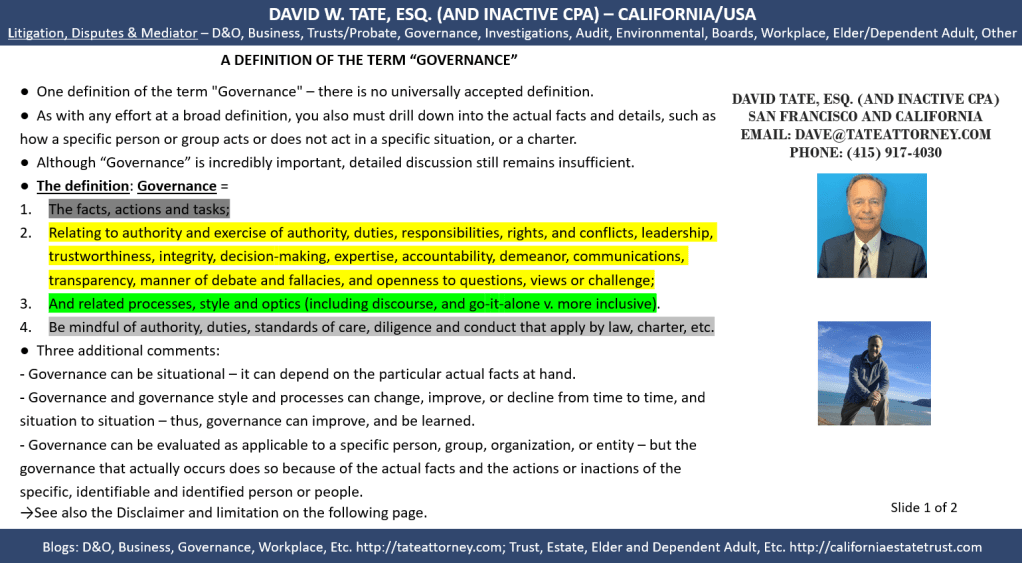
Taking a risk management approach or process would help to focus on the issues at hand, possible options and solutions. It is my belief that taking a risk management approach or process is the only solution in some or perhaps many of these situations. Unfortunately, as an argument in opposition, by some people an effort toward a risk management approach or process would be labeled or branded as surrender or capitulation (hint: nothing in a risk management approach or process says surrender or capitulate – instead, strength always is or can be advantageous). The following is a slide for one possible risk and uncertainty management process approach – you might find it useful, or at least worthwhile for discussion purposes.

I have also provided below my slightly revised definition of governance slide.

I have also provided below Questions to Consider to Help Facilitate Dispute Resolution and Settlement – I hope that you find it helpful.

* * * *

Regards, and best to you,

David Tate, Esq.

Thank you for reading. Please do pass this blog and blog post and information to other people who would be interested as it is only through collaboration and sharing that great things and success are more quickly achieved.

David Tate, Esq. (and inactive CPA)

  • Business litigation and disputes – business, breach of contract/commercial, co-owners, shareholders, investors, founders, workplace and employment, environmental, D&O, governance, boards and committees.
  • Trust, estate and probate court litigation and disputes – trust, estate, probate, elder and dependent abuse, conservatorship, POA, real property, mental health and care, mental capacity, undue influence, conflicts of interest, and contentious administrations.
  • Governance, boards, audit and governance committees, investigations, auditing, ESG, etc.
  • Mediator and facilitating dispute resolution:
    • Trust, estate, probate, conservatorship, elder and dependent abuse, etc.
    • Business, breach of contract/commercial, owner, shareholder, investor, etc.
    • D&O, board, audit and governance committee, accountant and CPA related.
    • Other: workplace and employment, environmental, trade secret.

Remember, every case and situation is different. It is important to obtain and evaluate all of the evidence that is available, and to apply that evidence to the applicable standards and laws. You do need to consult with an attorney and other professionals about your particular situation. This post is not a solicitation for legal or other services inside of or outside of California, and, of course, this post only is a summary of information that changes from time to time, and does not apply to any particular situation or to your specific situation. So . . . you cannot rely on this post for your situation or as legal or other professional advice or representation, or as or for my opinions and views on the subject matter.

Also note – sometimes I include links to or comments about materials from other organizations or people – if I do so, it is because I believe that the materials are worthwhile reading or viewing; however, that doesn’t mean that I don’t or might not have a different view about some or even all of the subject matter or materials, or that I necessarily agree with, or agree with everything about or relating to, that organization or person, or those materials or the subject matter.

Please also subscribe to this blog and my other blog (see below), and connect with me on LinkedIn and Twitter.

My two blogs are:

http://tateattorney.com – business, D&O, audit committee, governance, compliance, etc. – previously at http://auditcommitteeupdate.com

Trust, estate, conservatorship, elder and elder abuse, etc. litigation and contentious administrations http://californiaestatetrust.com

David Tate, Esq. (and inactive California CPA) – practicing only as an attorney in California.