California High Speed Rail – can it be saved, can it be completed, is it sustainable, is it legal . . . let’s apply a risk management process

It is well-known that the California High Speed train is significantly over the costs and behind the construction and completion schedule that were approved, possibly with no end in sight. It would have been better for the project to be completed in stages that would have been economically and passenger worthwhile. For example, I read the High Speed Authority reports from time to time, aside from the fact that they are written like push promotions, sometimes there are worthwhile comments such as that the train will not be profitable (if at all) until the line into the Bay Area is completed. The problems with the project are too many to list – I prefer to deal with the current state of the project as a whole and where it might or might not go from this point.

I do favor some form of high speed transportation in Northern California linking the central valley to the Bay Area. I cannot currently speak about the prospects for Southern California; however, as Southern California is more geographically spread out, it is more difficult to build a line that will effectively serve high density business and population areas. I do wish that the initial rail line into the Bay Area was over the Altamont Pass instead of up through the Gilroy southern route (or actually, both routes are needed).

I have pasted below a scan and a link to a californiaglobe.com article discussing some of the cost overruns and time delays. The entirety of the project was projected to cost $33 billion and was to be completed (LA to San Francisco) by 2028. The current cost projection is $135 billion with only Bakersfield to Merced to be completed perhaps by approximately 2033. Based on history, I would expect both of those projected costs and the delays to increase. Further, the project basically has to continually obtain new funding to build additional construction – that is, the money to build further isn’t there, but must be obtained, and obtained again, and obtained again on an ongoing basis for there to be additional construction.

In any event, with the costs and delays the project is not what was approved in 2008, or anywhere close to what was approved, which perhaps presents an interesting legal issue: at what point, if any, does or can a project or its costs become deemed not approved by the voters due to significantly different or changed actual facts?

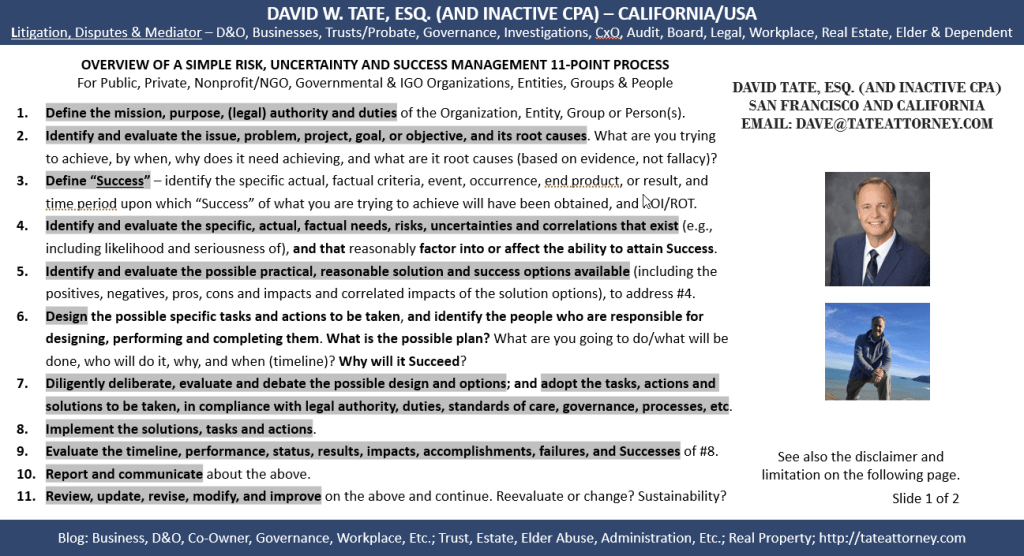
However, the current situation does present a good opportunity for the High Speed Authority to discuss and justify the current status and the eventual projections for the completion of the project (or if only projected partial completion v. full completion), including projected costs, timing, ridership, costs to operate, anticipated revenue, sustainability, etc., that are realistic and verifiable. I recommend a risk management process approach – as one example, I have also pasted below my risk management processes slide.

My 11-point simple risk management slide:

* * * *

Thank you for viewing this discussion. Please do pass this blog and blog post and information to other people who would be interested as it is only through collaboration and sharing that great things and success are more quickly achieved. If you are interested in discussing anything that I have said in the discussion above or in either of my two blogs (see blog addresses below), or if you simply want to reach out or are seeking assistance, it is best to reach me by email at dave@tateattorney.com.

David Tate, Esq. (and inactive CPA)

Trust, estate, probate, will, fiduciary and elder abuse disputes, litigation, trials and law – probate, trust, estate, will, power of attorney, elder abuse, real property and conservatorship disputes, conflicts and litigation, challenging and contentious administrations, and personalities, people and relationships, mental and physical health, limitations and capacity, undue influence and fraud; and and mediator services.

Business litigation and internal business and co-ownership disputes, litigation, trials and law, and contentious officer, director, board and audit and governance committee, D&O, conflict of interest, workplace, and governance disputes, conflicts and litigation; and mediator services. Legal authority, duties, rights, conflicts of interest, governance, diligence, compliance, legal risk management, and personalities, people and relationships; and mediator services.

Governance, law, legal risk management processes, compliance and success, audits and auditing, internal controls, executive officers, boards, directors, audit and governance committees, investigations, publicity rights, AI, defamation and First Amendment, legislation, statutes and laws, regulations, and headline news, and issue, people and relationship effective meetings, discussions and deliberations, debates and debating, communications, and wording and use of words.

Real property disputes, litigation, trials and law – primarily co-ownership and joint-ownership disputes, conflicts and litigation, and sales and purchases that go wrong, and mediator services.

Mediator and mediator and dispute resolution services (evaluative and facilitative).

  • Trust, estate, probate, conservatorship, elder and dependent abuse, etc.
  • Business, breach of contract/commercial, owner, shareholder, investor, etc.
  • D&O, board, audit and governance committee, accountant and CPA related.
  • Other: workplace and employment, environmental, trade secret.
  • Law and legal issues relating to authority, duties, rights, conflicts of interest, governance, diligence, compliance, risk management, disputes, evidence, liability, litigation, and mediation and resolution services.

Remember, every case and situation is different. It is important to obtain and evaluate all of the evidence that is available, and to apply that evidence to the applicable standards and laws. You do need to consult with an attorney and other professionals about your particular situation. This post is not a solicitation for legal or other services inside of or outside of California, and, of course, this post only is a summary of information that changes from time to time, and does not apply to any particular situation or to your specific situation. So . . . you cannot rely on this post for your situation or as legal or other professional advice or representation, or as or for my opinions and views on the subject matter.

Also note – sometimes I include links to or comments about materials from other organizations or people – if I do so, it is because I believe that the materials are worthwhile reading or viewing; however, that does not mean that I do not or that I might not have a different view about some or even all of the subject matter or materials, or that I necessarily agree with, or agree with everything about or relating to, that organization or person, or those materials or the subject matter.

Please also subscribe to this blog and my other blog (see below), and connect with me on LinkedIn and Twitter.

My two blogs are:

http://tateattorney.com – business, D&O, audit committee, governance, compliance, etc. – previously at http://auditcommitteeupdate.com

Trust, estate, conservatorship, elder and elder abuse, etc. litigation and contentious administrations http://californiaestatetrust.com

David Tate, Esq. (and inactive California CPA) – practicing only as an attorney in California.

The Business Law class topics – the following is a list of the 9 outlines of topics that I covered:

The Business Law class topics – the following is a list of the 9 outlines of topics that I covered:

First major topics – courts, jurisdiction, due process, standing, laws, legal research, constitution

Second major topics – legal forms of doing business, corporations, sole proprietorships, LLCs, partnerships, limited partnerships, LLPs, nonprofits

Third major topics – contracts and agreements

Fourth major topics – UCC, sale of goods, leases of goods or personal property, and related warranties

Fifth major topics – litigation, procedures, pleadings, discovery, evidence, testimony, demonstrative evidence, direct examination, cross-examination, burdens and presumptions, dispositive motions, dispute resolution, trials

Sixth major topics – agency, employer and employee, employment opportunity, and workplace

Seventh major topics – intellectual property; trade secret; patent; trademark, copyright, personal publicity, NIL

Eighth major topics – intentional torts and negligence, product and strict liability, criminal law and cybercrime

Ninth major topics – administrative law and regulatory agencies, consumer protection and product safety, environmental protection, antitrust law and unfair trade practices

* * * *

Thank you for viewing this discussion. Please do pass this blog and blog post and information to other people who would be interested as it is only through collaboration and sharing that great things and success are more quickly achieved. If you are interested in discussing anything that I have said in the discussion above or in either of my two blogs (see blog addresses below), or if you simply want to reach out or are seeking assistance, it is best to reach me by email at dave@tateattorney.com.

David Tate, Esq. (and inactive CPA)

Trust, estate, probate, will, fiduciary and elder abuse disputes, litigation, trials and law – probate, trust, estate, will, power of attorney, elder abuse, real property and conservatorship disputes, conflicts and litigation, challenging and contentious administrations, and personalities, people and relationships, mental and physical health, limitations and capacity, undue influence and fraud; and and mediator services.

Business litigation and internal business and co-ownership disputes, litigation, trials and law, and contentious officer, director, board and audit and governance committee, D&O, conflict of interest, workplace, and governance disputes, conflicts and litigation; and mediator services. Legal authority, duties, rights, conflicts of interest, governance, diligence, compliance, legal risk management, and personalities, people and relationships; and mediator services.

Governance, law, legal risk management processes, compliance and success, audits and auditing, internal controls, executive officers, boards, directors, audit and governance committees, investigations, publicity rights, AI, defamation and First Amendment, legislation, statutes and laws, regulations, and headline news, and issue, people and relationship effective meetings, discussions and deliberations, debates and debating, communications, and wording and use of words.

Real property disputes, litigation, trials and law – primarily co-ownership and joint-ownership disputes, conflicts and litigation, and sales and purchases that go wrong, and mediator services.

Mediator and mediator and dispute resolution services (evaluative and facilitative).

  • Trust, estate, probate, conservatorship, elder and dependent abuse, etc.
  • Business, breach of contract/commercial, owner, shareholder, investor, etc.
  • D&O, board, audit and governance committee, accountant and CPA related.
  • Other: workplace and employment, environmental, trade secret.
  • Law and legal issues relating to authority, duties, rights, conflicts of interest, governance, diligence, compliance, risk management, disputes, evidence, liability, litigation, and mediation and resolution services.

Remember, every case and situation is different. It is important to obtain and evaluate all of the evidence that is available, and to apply that evidence to the applicable standards and laws. You do need to consult with an attorney and other professionals about your particular situation. This post is not a solicitation for legal or other services inside of or outside of California, and, of course, this post only is a summary of information that changes from time to time, and does not apply to any particular situation or to your specific situation. So . . . you cannot rely on this post for your situation or as legal or other professional advice or representation, or as or for my opinions and views on the subject matter.

Also note – sometimes I include links to or comments about materials from other organizations or people – if I do so, it is because I believe that the materials are worthwhile reading or viewing; however, that does not mean that I do not or that I might not have a different view about some or even all of the subject matter or materials, or that I necessarily agree with, or agree with everything about or relating to, that organization or person, or those materials or the subject matter.

Please also subscribe to this blog and my other blog (see below), and connect with me on LinkedIn and Twitter.

My two blogs are:

http://tateattorney.com – business, D&O, audit committee, governance, compliance, etc. – previously at http://auditcommitteeupdate.com

Trust, estate, conservatorship, elder and elder abuse, etc. litigation and contentious administrations http://californiaestatetrust.com

David Tate, Esq. (and inactive California CPA) – practicing only as an attorney in California.

An Administrative Agency Regulation (or Legislation, Statute, or Ordinance) – Is It Valid or Not?

We all know that regulations (and legislation, statutes and ordinances) are pervasive in California from state, federal and local government. To a certain extent all regulation sets compliance requirements, limitations, and standards. With respect to all and each proposed and actual regulation, and legislation, statute and ordinance, it is appropriate and indeed legally prudent and necessary to ask whether the proposed or actual regulation, etc., will be or is legally valid. Of course, each proposed and actual regulation, and legislation, statute and ordinance must be evaluated on a case-by-case basis. However, for example, the following are some of the arguments that might be made against the validity of an administrative agency regulation and provisions therein (see also separate Tate materials discussing legal grounds to invalidate a law, statute, legislation or ordinance):

Ultra Vires (the regulation exceeds the agency’s statutory authority) – the regulation goes beyond the scope of the enabling statute that created the agency, exceeding the powers explicitly granted to it by the legislature or other authority that created the agency. Also consider that the agency interpreted the agency authority or creating statute too broadly, creating rules not directly related to the statute’s or the agency’s intended purpose; and that the agency authority or creating statute might be unlawfully or too broad, vague, ambiguous, etc.

Procedural Defects – failure to properly follow the federal APA’s or California APA’s rulemaking process, including inadequate notice, public comment period, or analysis of potential impacts. 

Arbitrary and Capricious – the regulation is based on unreasonable or illogical reasoning, lacking a rational connection to the facts. Also consider lack of substantial evidence in the administrative record to support the regulation. Consider that the regulation is not reasonably necessary to achieve the stated purpose of the statute (e.g., what is the stated purpose of the statute, and how does the regulation achieve that stated purpose?).

Unnecessary Burden – the regulation imposes undue burdens on regulated parties without a clear benefit or justification in support of the stated purpose of the statute. 

Discriminatory Impact – the regulation unfairly targets a specific group or class of protected persons.

Conflict with Existing Law – the regulation conflicts with or contradicts existing state statutes or other regulations; the agency’s interpretation of the law is inconsistent with established precedent.

Conflict of Interest; Bias – the regulation, or its provisions or a significant provision, or its promotion or enactment were influenced by impermissible or misleading conflict of interest, bias or persuasion.

Administrative Review – first attempt to challenge the regulation within the agency itself, often through a petition for reconsideration or an internal appeal process. 

Judicial Review – if the agency does not address concerns, file a lawsuit in court seeking a writ of mandate to overturn the regulation.

Standard of Review – courts have generally given deference to agency interpretations of law, but will scrutinize regulations that appear to be arbitrary, capricious, or beyond the agency’s authority. This is a developing area – traditional deference to the agency may not apply or may not apply as strongly as in the past. Also consider burden of proof.

* * * *

Thank you for viewing this discussion. Please do pass this blog and blog post and information to other people who would be interested as it is only through collaboration and sharing that great things and success are more quickly achieved. If you are interested in discussing anything that I have said in the discussion above or in either of my two blogs (see blog addresses below), or if you simply want to reach out or are seeking assistance, it is best to reach me by email at dave@tateattorney.com.

David Tate, Esq. (and inactive CPA)

Trust, estate, probate, will, fiduciary and elder abuse disputes, litigation, trials and law – probate, trust, estate, will, power of attorney, elder abuse, real property and conservatorship disputes, conflicts and litigation, challenging and contentious administrations, and personalities, people and relationships, mental and physical health, limitations and capacity, undue influence and fraud; and and mediator services.

Business litigation and internal business and co-ownership disputes, litigation, trials and law, and contentious officer, director, board and audit and governance committee, D&O, conflict of interest, workplace, and governance disputes, conflicts and litigation; and mediator services. Legal authority, duties, rights, conflicts of interest, governance, diligence, compliance, legal risk management, and personalities, people and relationships; and mediator services.

Governance, law, legal risk management processes, compliance and success, audits and auditing, internal controls, executive officers, boards, directors, audit and governance committees, investigations, publicity rights, AI, defamation and First Amendment, legislation, statutes and laws, regulations, and headline news, and issue, people and relationship effective meetings, discussions and deliberations, debates and debating, communications, and wording and use of words.

Real property disputes, litigation, trials and law – primarily co-ownership and joint-ownership disputes, conflicts and litigation, and sales and purchases that go wrong, and mediator services.

Mediator and mediator and dispute resolution services (evaluative and facilitative).

  • Trust, estate, probate, conservatorship, elder and dependent abuse, etc.
  • Business, breach of contract/commercial, owner, shareholder, investor, etc.
  • D&O, board, audit and governance committee, accountant and CPA related.
  • Other: workplace and employment, environmental, trade secret.
  • Law and legal issues relating to authority, duties, rights, conflicts of interest, governance, diligence, compliance, risk management, disputes, evidence, liability, litigation, and mediation and resolution services.

Remember, every case and situation is different. It is important to obtain and evaluate all of the evidence that is available, and to apply that evidence to the applicable standards and laws. You do need to consult with an attorney and other professionals about your particular situation. This post is not a solicitation for legal or other services inside of or outside of California, and, of course, this post only is a summary of information that changes from time to time, and does not apply to any particular situation or to your specific situation. So . . . you cannot rely on this post for your situation or as legal or other professional advice or representation, or as or for my opinions and views on the subject matter.

Also note – sometimes I include links to or comments about materials from other organizations or people – if I do so, it is because I believe that the materials are worthwhile reading or viewing; however, that does not mean that I do not or that I might not have a different view about some or even all of the subject matter or materials, or that I necessarily agree with, or agree with everything about or relating to, that organization or person, or those materials or the subject matter.

Please also subscribe to this blog and my other blog (see below), and connect with me on LinkedIn and Twitter.

My two blogs are:

http://tateattorney.com – business, D&O, audit committee, governance, compliance, etc. – previously at http://auditcommitteeupdate.com

Trust, estate, conservatorship, elder and elder abuse, etc. litigation and contentious administrations http://californiaestatetrust.com

David Tate, Esq. (and inactive California CPA) – practicing only as an attorney in California.