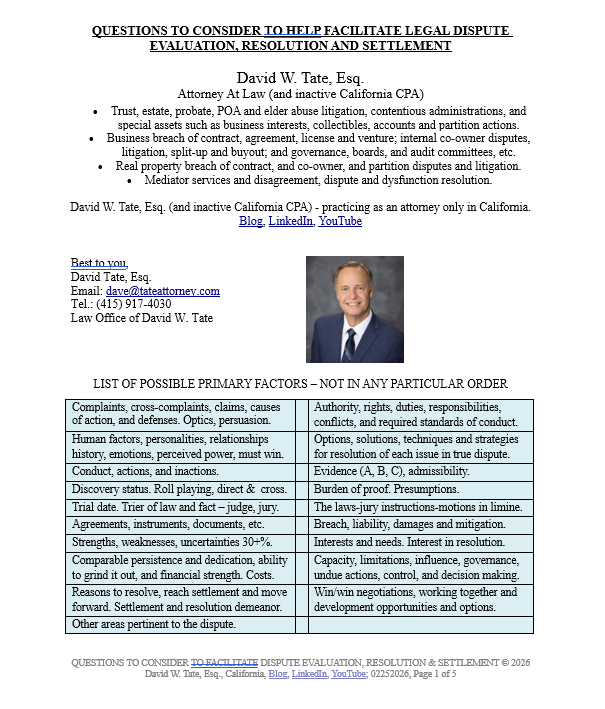
I have attached my updated Questions to Consider to Help Facilitate Legal Dispute Evaluation, Resolution and Settlement (see below the scan of the first page, and also the entire 5-page document). In particular, in the box at the bottom of the first page, you will see that multiple of the items listed, one way or another, directly or indirectly relate to human factors such as personalities, relationships, history, emotions, “must win,” and more. Since 2019 (pre-COVID), and probably even prior I have seen or been involved in more and more disputes and litigation in which personalities, relationships, and the like are not simply factors but are significant and very significant factors that influence and impact efforts to reach resolution and settlement. In addition to litigation, I provide mediator services to help parties and attorneys resolve their disputes and litigation. Be mindful that the great, great majority of cases do settle, although at least in my very contentious cases settlement often is not reached until closer to trial.
The following is a scan of the first page of my Questions to Consider paper:
The following is the entire 5-page Questions to Consider paper – please feel free to print, use, and also pass the paper to other people who may find it helpful:
Best to you, David Tate, Esq.
Please reach out on this topic or on other topics if you wish.
* * * *
Thank you for viewing and reading this discussion. Please do pass this blog and blog post and information to other people who would be interested as it is only through collaboration and sharing that great things and success are more quickly achieved. If you are interested in discussing anything that I have said in the discussion above or in either of my two blogs (see blog addresses below), or if you simply want to reach out or are seeking assistance, it is best to reach me by email at dave@tateattorney.com.
David Tate, Esq. (and inactive CPA)
Trust, estate, probate, power of attorney, fiduciary, beneficiary, conservatorship, and elder and dependent adult abuse litigation and contentious administrations, undue influence, fraud and deceit, real property partition, physical and mental health and challenging and contentious personalities and relationships.
Trust, estate and probate administrations and litigation involving special assets such as business ownership interests and operating businesses, asset co-ownership disputes, contentious governance, intellectual property assets, art and collectible assets, ongoing future contractual rights, buyouts and sales, M&A disputes, businesses divorces, real property partition, and accountings.
Businesses and third party disputes and litigation – contract, licensing, co-business, royalty and other arrangements, unfair business practices, fraud and deceit, lack of good faith and fair dealing, buyouts and sales, mergers, acquisitions, ventures, etc.
Business co-ownership and internal governance disputes and litigation, business divorces, buyouts and sales, merger and acquisition disputes, family, closely held and professional businesses, accountings, and audits, D&O, boards, audit committees and investigations. Legal authority, rights, duties, conflicts of interest, diligence, compliance, liability, BJR, legal risk management, and resolution.
Real property and financial and personal property breach of contract, and ownership and co-ownership disputes and litigation, and real property partition actions.
Trials.
Mediator and dispute and litigation resolution services.
Legal risk and uncertainty management processes – authority, rights, duties, conflicts of interest, governance, diligence, compliance, liability, and resolution.
Other and additional disputes, litigation and issues that fall within the above areas – court and trial evidence, persuasion, debate and fallacies, using AI assistance, IP, meetings, defamation, risk management processes, workplace, new laws, regulations and government actions – impact/legality, law and legal matters in the news, etc.
Remember, every case and situation is different. It is important to obtain and evaluate all of the evidence that is available, and to apply that evidence to the applicable standards and laws. You do need to consult with an attorney and other professionals about your particular situation. This post is not a solicitation for legal or other services inside of or outside of California, and, of course, this post only is a summary of information that changes from time to time, and does not apply to any particular situation or to your specific situation. So . . . you cannot rely on this post for your situation or as legal or other professional advice or representation, or as or for my opinions and views on the subject matter.
Also note – sometimes I include links to or comments about materials from other organizations or people – if I do so, it is because I believe that the materials are worthwhile reading or viewing; however, that does not mean that I do not or that I might not have a different view about some or even all of the subject matter or materials, or that I necessarily agree with, or agree with everything about or relating to, that organization or person, or those materials or the subject matter.
Please also subscribe to this blog and my other blog (see below), and connect with me on LinkedIn and Twitter.
My blogs are:
http://tateattorney.com – business, D&O, audit committee, governance, compliance, etc. – previously at http://auditcommitteeupdate.com
Prior blog: Trust, estate, conservatorship, elder and elder abuse, etc. litigation and contentious administrations http://californiaestatetrust.com
David Tate, Esq. (and inactive California CPA) – practicing only as an attorney in California.

 David Tate, Esq. - Litigation and Governance Attorney, and Mediator - California (and inactive CPA) – (1) Trust, estate, probate, elder abuse, POA, partition, etc. disputes, litigation and contentious administrations and special assets; (2) business and real property contract litigation and internal and co-owner business disputes, partition and buyout litigation, governance, boards, AC, GC, investigations and audit; (3) mediator and dispute resolution services - authority, rights, duties, conflicts of interest, governance, diligence, compliance, liability, and ADR.