What should you do if you have received a copy of a trust, a will, a deed, a power of attorney, account or other estate planning or transfer document – first consider whether it expresses the signer’s true wishes

You may have wondered what you should do when you first receive a copy of a trust or other estate planning or transfer document – well . . . as often, it depends on the specific facts and circumstances but here could be a plausible short answer – this and the following are not legal requirements, but they can be human factors and some could be possible:

  • Read the document.
  • Are its wording and provisions clear and understandable?
  • Does it cover all significant scenarios?
  • Are any of its wording or provisions contradictory?
  • Does it correctly express the signer’s true wishes?
  • Do you believe that the signer understood the wording and provisions? Do you understand the wording and provisions?
  • Is there evidence of forgery, fraud or deceit, undue influence, misrepresentation, concealment, omission, elder or dependent adult abuse, inducement by undue persuasion, dependency or reliance, or lack of legal capacity for the signer to legally and validly sign the document? You may also be required to consider legal presumptions and burdens of proof.
  • Is there evidence of a mistake in the document or that the document was signed under a circumstance of mistake or mistaken belief?

And the list is longer. You get the point that whether a document is valid, and whether select wording or provisions in the document are legally valid is determined by the facts and circumstance (the evidence), and the law including presumptions and burdens of proof. What you do in that circumstance depends on your options and on your authority, rights and duties or responsibilities. But you should consult with an attorney.

Best to you, David Tate, Esq.

Please reach out on this topic or on other topics if you wish.

* * * *

Thank you for viewing and reading this discussion. Please do pass this blog and blog post and information to other people who would be interested as it is only through collaboration and sharing that great things and success are more quickly achieved. If you are interested in discussing anything that I have said in the discussion above or in either of my two blogs (see blog addresses below), or if you simply want to reach out or are seeking assistance, it is best to reach me by email at dave@tateattorney.com.

David Tate, Esq. (and inactive CPA)

Trust, estate, probate, power of attorney, fiduciary, beneficiary, conservatorship, and elder and dependent adult abuse litigation and contentious administrations, undue influence, fraud and deceit, physical and mental health and challenging and contentious personalities and relationships.

Trust, estate and probate administrations and litigation involving special assets such as business ownership interests and operating businesses, asset co-ownership disputes, contentious governance, intellectual property assets, art and collectible assets, ongoing future contractual rights, buyouts and sales, M&A disputes, businesses divorces, and accountings.

Businesses and third party disputes and litigation – contract, licensing, co-business, royalty and other arrangements, unfair business practices, fraud and deceit, lack of good faith and fair dealing, buyouts and sales, mergers, acquisitions, ventures, etc.

Business co-ownership and internal governance disputes and litigation, business divorces, buyouts and sales, merger and acquisition disputes, family, closely held and professional businesses, accountings, and audits, D&O, boards, audit committees and investigations. Legal authority, rights, duties, conflicts of interest, diligence, compliance, liability, BJR, legal risk management, and resolution.

Real property and financial and personal property ownership and co-ownership disputes and litigation.

Trials.

Mediator and dispute and litigation resolution services.

Legal risk and uncertainty management processes – authority, rights, duties, conflicts of interest, governance, diligence, compliance, liability, and resolution.

Other and additional disputes, litigation and issues that fall within the above areas – court and trial evidence, persuasion, debate and fallacies, using AI assistance, IP, meetings, defamation, risk management processes, workplace, new laws, regulations and government actions – impact/legality, law and legal matters in the news, etc.

Remember, every case and situation is different. It is important to obtain and evaluate all of the evidence that is available, and to apply that evidence to the applicable standards and laws. You do need to consult with an attorney and other professionals about your particular situation. This post is not a solicitation for legal or other services inside of or outside of California, and, of course, this post only is a summary of information that changes from time to time, and does not apply to any particular situation or to your specific situation. So . . . you cannot rely on this post for your situation or as legal or other professional advice or representation, or as or for my opinions and views on the subject matter.

Also note – sometimes I include links to or comments about materials from other organizations or people – if I do so, it is because I believe that the materials are worthwhile reading or viewing; however, that does not mean that I do not or that I might not have a different view about some or even all of the subject matter or materials, or that I necessarily agree with, or agree with everything about or relating to, that organization or person, or those materials or the subject matter.

Please also subscribe to this blog and my other blog (see below), and connect with me on LinkedIn and Twitter.

My blogs are:

http://tateattorney.com – business, D&O, audit committee, governance, compliance, etc. – previously at http://auditcommitteeupdate.com

Prior blog: Trust, estate, conservatorship, elder and elder abuse, etc. litigation and contentious administrations http://californiaestatetrust.com

David Tate, Esq. (and inactive California CPA) – practicing only as an attorney in California.

Who gets the dog?

Who gets the dog? See the below scan of a November 12, remote/virtual program by the San Diego Bar Association. Very heated trust, estate and probate disputes often involve personal property – I have represented clients in disputes over the dog or cat and other pets, the tools, the guns, computers and software, furniture, dishes, jewelry, and a longer list of personal property. Sometimes the beneficiaries can get themselves to be somewhat organized and considerate, but sometimes it is a post-death rush to get in there first and to take, take, take, or in other cases the item was gifted prior to death. I handle disputes and litigation and contentious administrations – but you can reduce disputes and litigation by going to an estate planning attorney who will help you put your wishes into writing, and perhaps even a pet trust.

Best to you, David Tate, Esq.

Please reach out on this topic or on other topics if you wish.

* * * *

Thank you for viewing and reading this discussion. Please do pass this blog and blog post and information to other people who would be interested as it is only through collaboration and sharing that great things and success are more quickly achieved. If you are interested in discussing anything that I have said in the discussion above or in either of my two blogs (see blog addresses below), or if you simply want to reach out or are seeking assistance, it is best to reach me by email at dave@tateattorney.com.

David Tate, Esq. (and inactive CPA)

Trust, estate, probate, power of attorney, fiduciary, beneficiary, conservatorship, and elder and dependent adult abuse litigation and contentious administrations, undue influence, fraud and deceit, physical and mental health and challenging and contentious personalities and relationships.

Trust, estate and probate administrations and litigation involving special assets such as business ownership interests and operating businesses, asset co-ownership disputes, contentious governance, intellectual property assets, art and collectible assets, ongoing future contractual rights, buyouts and sales, M&A disputes, businesses divorces, and accountings.

Businesses and third party disputes and litigation – contract, licensing, co-business, royalty and other arrangements, unfair business practices, fraud and deceit, lack of good faith and fair dealing, buyouts and sales, mergers, acquisitions, ventures, etc.

Business co-ownership and internal governance disputes and litigation, business divorces, buyouts and sales, merger and acquisition disputes, family, closely held and professional businesses, accountings, and audits, D&O, boards, audit committees and investigations. Legal authority, rights, duties, conflicts of interest, diligence, compliance, liability, BJR, legal risk management, and resolution.

Real property and financial and personal property ownership and co-ownership disputes and litigation.

Trials.

Mediator and dispute and litigation resolution services.

Legal risk and uncertainty management processes – authority, rights, duties, conflicts of interest, governance, diligence, compliance, liability, and resolution.

Other and additional disputes, litigation and issues that fall within the above areas – court and trial evidence, persuasion, debate and fallacies, using AI assistance, IP, meetings, defamation, risk management processes, workplace, new laws, regulations and government actions – impact/legality, law and legal matters in the news, etc.

Remember, every case and situation is different. It is important to obtain and evaluate all of the evidence that is available, and to apply that evidence to the applicable standards and laws. You do need to consult with an attorney and other professionals about your particular situation. This post is not a solicitation for legal or other services inside of or outside of California, and, of course, this post only is a summary of information that changes from time to time, and does not apply to any particular situation or to your specific situation. So . . . you cannot rely on this post for your situation or as legal or other professional advice or representation, or as or for my opinions and views on the subject matter.

Also note – sometimes I include links to or comments about materials from other organizations or people – if I do so, it is because I believe that the materials are worthwhile reading or viewing; however, that does not mean that I do not or that I might not have a different view about some or even all of the subject matter or materials, or that I necessarily agree with, or agree with everything about or relating to, that organization or person, or those materials or the subject matter.

Please also subscribe to this blog and my other blog (see below), and connect with me on LinkedIn and Twitter.

My blogs are:

http://tateattorney.com – business, D&O, audit committee, governance, compliance, etc. – previously at http://auditcommitteeupdate.com

Prior blog: Trust, estate, conservatorship, elder and elder abuse, etc. litigation and contentious administrations http://californiaestatetrust.com

David Tate, Esq. (and inactive California CPA) – practicing only as an attorney in California.
Can a defense of a contested trust amendment trigger a no contest clause?

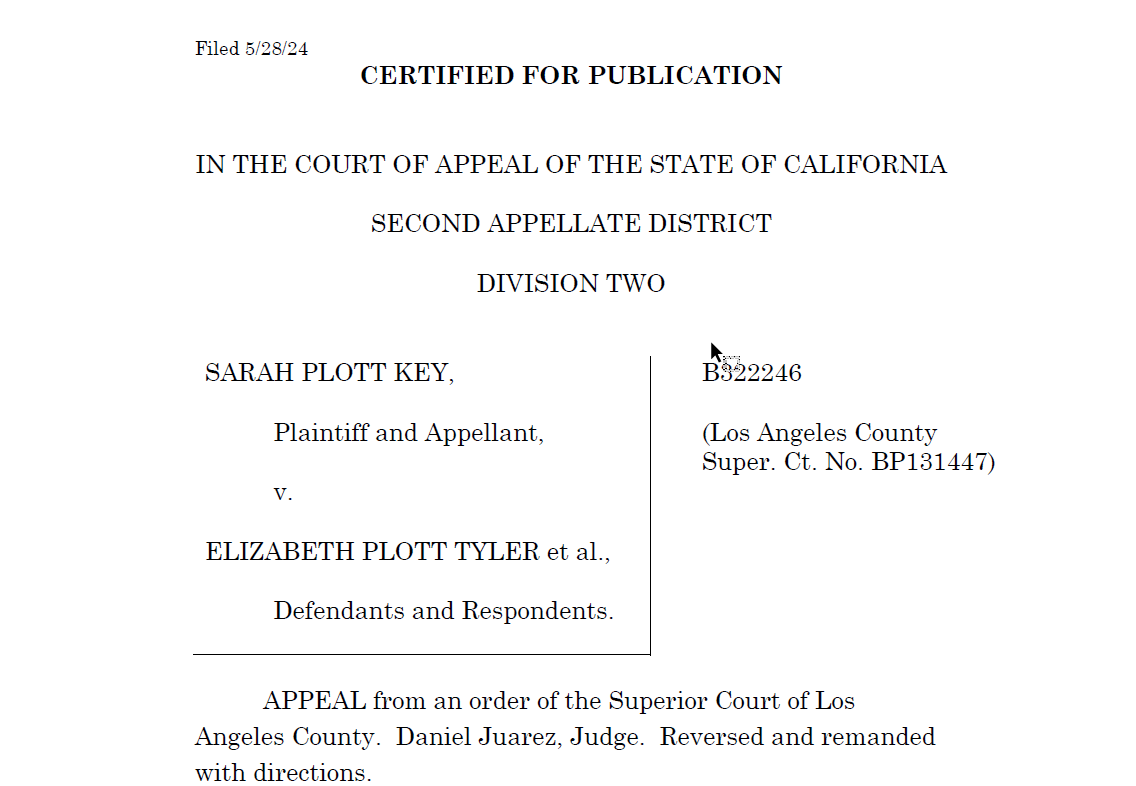
Can a defense of a contested trust amendment trigger a no contest clause? In Key v. Tyler the Court answered “yes” it may, depending on the facts and circumstances of the case (California Court of Appeal, 2nd District, Case No. B322246 (Filed 5/28/24)).

In Key v. Tyler the Trustors (Thomas and Elizabeth) executed their original Trust in 1999. The trust contained a no-contest clause which in part stated as follows:

“. . . if any devisee, legatee or beneficiary under this Trust, or any legal heir of the Trustors or person claiming under any of them directly or indirectly (a) contests either Trustor’s Will, this Trust, or any other trust created by a Trustor, or in any manner attacks or seeks to impair or invalidate any of their provisions,. . . then in that event Trustors specifically disinherit each such person, and all such legacies, bequests, devises, and interest given under this Trust to that person shall be forfeited as though he or she had predeceased the Trustors without issue, and shall augment proportionately the shares of the Trust Estate passing under this Trust to, or in trust for, such of the Trustors’ devisees, legatees and beneficiaries who have not participated in such acts or proceedings.”

The Trustors had three children: Tyler, Key, and a third sister who was not involved in the litigation.

In 2003 the Trustors subsequently executed an Amendment to the Trust – the 2003 Amendment was a one-page document that made some dispositive changes but did not restate or entirely change the provisions in the 1999 Trust – thus, the 1999 Trust remained relevant and applicable except as changed by the provisions in the one-page 2003 Amendment. The 2003 Amendment did not contain a no contest clause.

Husband Thomas subsequently died in 2003, and surviving spouse Elizabeth purportedly executed another Amendment in 2007. Pursuant to the Court “Tyler used her influence over Elizabeth to obtain the 2007 Amendment.” Beneficiary Key filed an action and successfully invalidated the 2007 Amendment on the ground that Tyler unduly influenced their mother into executing the 2007 Amendment. Against Key’s action Tyler defended the 2007 Amendments which differed from some of the provisions in the original 1999 Trust. Tyler also was a beneficiary under the 1999 Trust but would have inherited differently under the 2007 Amendment if that Amendment had not been invalidated.

Key v. Tyler is a long 20+ page Opinion which contains many relevant discussions on legal issues. However, I am writing about the Opinion here because of the discussion relating to the no contest clause in the 1999 Trust and the consequences of the litigation pertaining to the 2007 Amendment.

The Court held that Tyler’s defense of the 2007 Amendment was a contest of the 1999 Trust, and that Tyler not only did not recover under the 2007 Amendment which the Court invalidated, but also disinherited herself from what she would have recovered under the original 1999 Trust or under the 2003 Amendment pursuant to the broadly worded no contest clause that was contained in the earlier original 1999 Trust. In other words, as a result of losing on the 2007 Amendment, and there being a broadly worded no contest clause in the original 1999 Trust, Tyler lost everything and recovered nothing.

Takeaway: careful consideration needs to be given to the existence of no contest clauses contained in any and all possibly relevant trust and estate disposition instruments and documents, and to the specific wording of each possibly applicable no contest clause, as even defending a later in time subsequent instrument also may in appropriate circumstances trigger a no contest clause in an earlier instrument.

The following is a case caption scan from the Opinion in Key v. Tyler

Best to you, David Tate, Esq.

Please reach out on this topic or on other topics if you wish.

* * * *

Thank you for viewing and reading this discussion. Please do pass this blog and blog post and information to other people who would be interested as it is only through collaboration and sharing that great things and success are more quickly achieved. If you are interested in discussing anything that I have said in the discussion above or in either of my two blogs (see blog addresses below), or if you simply want to reach out or are seeking assistance, it is best to reach me by email at dave@tateattorney.com.

David Tate, Esq. (and inactive CPA)

Trust, estate, probate, power of attorney, fiduciary, beneficiary, conservatorship, and elder and dependent adult abuse litigation and contentious administrations, undue influence, fraud and deceit, physical and mental health and challenging and contentious personalities and relationships.

Trust, estate and probate administrations and litigation involving special assets such as business ownership interests and operating businesses, asset co-ownership disputes, contentious governance, intellectual property assets, art and collectible assets, ongoing future contractual rights, buyouts and sales, M&A disputes, businesses divorces, and accountings.

Businesses and third party disputes and litigation – contract, licensing, co-business, royalty and other arrangements, unfair business practices, fraud and deceit, lack of good faith and fair dealing, buyouts and sales, mergers, acquisitions, ventures, etc.

Business co-ownership and internal governance disputes and litigation, business divorces, buyouts and sales, merger and acquisition disputes, family, closely held and professional businesses, accountings, and audits, D&O, boards, audit committees and investigations. Legal authority, duties, rights, conflicts of interest, diligence, compliance, liability, BJR, legal risk management, and resolution.

Real property and co-ownership disputes and litigation.

Trials.

Mediator and dispute and litigation resolution services.

Legal risk and uncertainty management processes – authority, duties, rights, conflicts of interest, governance, diligence, compliance, liability, and resolution.

Other and additional disputes, litigation and issues that fall within the above areas – court and trial evidence, persuasion, debate and fallacies, using AI assistance, IP, meetings, defamation, risk management processes, workplace, new laws, regulations and government actions – impact/legality, law and legal matters in the news, etc.

Remember, every case and situation is different. It is important to obtain and evaluate all of the evidence that is available, and to apply that evidence to the applicable standards and laws. You do need to consult with an attorney and other professionals about your particular situation. This post is not a solicitation for legal or other services inside of or outside of California, and, of course, this post only is a summary of information that changes from time to time, and does not apply to any particular situation or to your specific situation. So . . . you cannot rely on this post for your situation or as legal or other professional advice or representation, or as or for my opinions and views on the subject matter.

Also note – sometimes I include links to or comments about materials from other organizations or people – if I do so, it is because I believe that the materials are worthwhile reading or viewing; however, that does not mean that I do not or that I might not have a different view about some or even all of the subject matter or materials, or that I necessarily agree with, or agree with everything about or relating to, that organization or person, or those materials or the subject matter.

Please also subscribe to this blog and my other blog (see below), and connect with me on LinkedIn and Twitter.

My blogs are:

http://tateattorney.com – business, D&O, audit committee, governance, compliance, etc. – previously at http://auditcommitteeupdate.com

Prior blog: Trust, estate, conservatorship, elder and elder abuse, etc. litigation and contentious administrations http://californiaestatetrust.com

David Tate, Esq. (and inactive California CPA) – practicing only as an attorney in California.

Goebner v. Superior Court – in Probate Court the timing for bringing a demurrer is determined under Probate Code provisions not under the Code of Civil Procedure

The following is a brief discussion about the recent holding in Goebner v. Superior Court (2025) 110 Cal. App. 5th 1105.

In relevant part, the Court in Goebner held that the timing for the filing of a demurrer in a probate court case is governed by the California Probate Code provisions for the bringing of a response or objection to the petition and is not governed by the California Code of Civil Procedure.

The holding is important not only to the particular case in question but also for attorneys who practice in the Probate Court. This has been an issue that I have run into in my cases many times. For example, in response to a petition a demurrer might be filed in which the respondent argues that the petition is in some manner defective or fails to state a claim. Some Judges in Probate Court are receptive to the filing of a demurrer, some Judges in Probate Court are not receptive to the filing of a demurrer, and as addressed in Goebner, in the Probate Court there can be questions whether Probate Code rules or rules of civil procedure apply.

In Goebner a demurrer was filed just two days before the hearing. Under the Probate Code a response or objection to a petition can be filed in writing at the time of the initial hearing and also can be made orally at the initial hearing. But under the rules of Civil Procedure a response or objection to the complaint is due 30 days after service of the complaint on the party.

In Goebner the Probate trial court held that the demurrer was filed too late. The Court of Appeal overruled, holding that under the Probate Code a responsive objection such as a demurrer can be brought as late as at the initial hearing. Note however, although permissible, if at all possible, I do not recommend waiting until the day of the hearing to file or bring a demurrer to the petition – instead, it is better to file a written demurrer upon available time prior to the initial hearing.

Although not the primary issue, the holding in Goebner also is relevant as it confirms that demurrer can be brought in response to and against a petition that is brought in the Probate Court, and that responses and objections in Probate Court can be made according the Probate Court procedures just prior to and even at the initial hearing (although, again, in my view, if possible it is better practice to try to not wait so long).

As the pleadings (i.e., the petition in a Probate Court case, or the complaint in a civil action) set the scope and boundaries of the relevant claims and issues to be resolved in the case, I do find it useful in appropriate circumstances to file a demurrer to try to ensure that the claims made are sufficient pleaded and are not vague or ambiguous.

The following quotes are some of the relevant discussions from the holding in Goebner:

  • Section 1000 provides, in relevant part, “Except to the extent that [the Probate Code] provides applicable rules, the rules of practice applicable to civil actions … apply to, and constitute the rules of practice” in proceedings under the Probate Code. (§ 1000, subd. (a).) This is a rule of default — that is, the Probate Code “adopts the civil practice rules only where special rules are not prescribed.”
  • Under the plain language of the Probate Code, it “does provide specially applicable rules” that address the timing for filing a response or objection to a petition. (citations omitted)
  • Within that chapter is section 1043, providing “[a]n interested person may appear and make a response or objection in writing at or before the hearing.” (§ 1043, subd. (a), italics added.) Similarly, interested persons “may appear and make a response or objection orally at the hearing.” (Id., subd. (b), italics added.) The statute underscores that oral objections may be made initially at the hearing by noting that the “court in its discretion” may “grant a continuance for the purpose of allowing a response or objection to be made in writing.” (Ibid.)
  • While the Probate Code does not expressly define “objection[s]” to include demurrers, we conclude that interpretation is appropriate. Pursuant to section 1000 we look to the Code of Civil Procedure (§ 1000, subd. (a).) The Code of Civil Procedure recognizes that a demurrer is a form of an objection to a petition or complaint. (Code Civ. Proc., §430.30, subd. (a) [a “ground for objection to a complaint, cross-complaint or answer” “may be taken by a demurrer to the pleading”]; see also id. §430.10 [party “may object, by demurrer” on enumerated grounds] . . .. (citations omitted)
  • Indeed, Code of Civil Procedure part 2, title 6, chapter 3, article 1, which includes these provisions, is titled “Objections to Pleadings.” Reading these Probate Code and Code of Civil Procedure statutes together, an interested party may file a demurrer to a petition under the Probate Code “at or before the hearing.” (citations omitted) The Probate Code further addresses concerns that a party may present a demurrer at a hearing — thus placing the petitioner at a disadvantage — by allowing a court to “continue or postpone any hearing, from time to time, in the interest of justice.”1 (§ 1045.) The deadline in the Code of Civil Procedure to respond and object within 30 days after a complaint is served is inapposite.

David W. Tate, Esq.

Please reach out on this topic or on other topics if you wish.

* * * *

Thank you for viewing and reading this discussion. Please do pass this blog and blog post and information to other people who would be interested as it is only through collaboration and sharing that great things and success are more quickly achieved. If you are interested in discussing anything that I have said in the discussion above or in either of my two blogs (see blog addresses below), or if you simply want to reach out or are seeking assistance, it is best to reach me by email at dave@tateattorney.com.

David Tate, Esq. (and inactive CPA)

Trust, estate, probate, power of attorney, fiduciary, beneficiary, conservatorship, and elder and dependent adult abuse litigation and contentious administrations, undue influence, fraud and deceit, physical and mental health and challenging and contentious personalities and relationships.

Trust, estate and probate administrations and litigation involving special assets such as business ownership interests and operating businesses, asset co-ownership disputes, contentious governance, intellectual property assets, art and collectible assets, ongoing future contractual rights, buyouts and sales, M&A disputes, businesses divorces, and accountings.

Businesses and third party disputes and litigation – contract, licensing, co-business, royalty and other arrangements, unfair business practices, fraud and deceit, lack of good faith and fair dealing, buyouts and sales, mergers, acquisitions, ventures, etc.

Business co-ownership and internal governance disputes and litigation, business divorces, buyouts and sales, merger and acquisition disputes, family, closely held and professional businesses, accountings, and audits, D&O, boards, audit committees and investigations. Legal authority, duties, rights, conflicts of interest, diligence, compliance, liability, BJR, legal risk management, and resolution.

Real property and co-ownership disputes and litigation.

Trials.

Mediator and dispute and litigation resolution services.

Other and additional disputes, litigation and issues that fall within the above areas – court and trial evidence, persuasion, debate and fallacies, using AI assistance, IP, meetings, defamation, risk management processes, workplace, new laws, regulations and government actions – impact/legality, law and legal matters in the news, etc.

Remember, every case and situation is different. It is important to obtain and evaluate all of the evidence that is available, and to apply that evidence to the applicable standards and laws. You do need to consult with an attorney and other professionals about your particular situation. This post is not a solicitation for legal or other services inside of or outside of California, and, of course, this post only is a summary of information that changes from time to time, and does not apply to any particular situation or to your specific situation. So . . . you cannot rely on this post for your situation or as legal or other professional advice or representation, or as or for my opinions and views on the subject matter.

Also note – sometimes I include links to or comments about materials from other organizations or people – if I do so, it is because I believe that the materials are worthwhile reading or viewing; however, that does not mean that I do not or that I might not have a different view about some or even all of the subject matter or materials, or that I necessarily agree with, or agree with everything about or relating to, that organization or person, or those materials or the subject matter.

Please also subscribe to this blog and my other blog (see below), and connect with me on LinkedIn and Twitter.

My blogs are:

http://tateattorney.com – business, D&O, audit committee, governance, compliance, etc. – previously at http://auditcommitteeupdate.com

Prior blog: Trust, estate, conservatorship, elder and elder abuse, etc. litigation and contentious administrations http://californiaestatetrust.com

David Tate, Esq. (and inactive California CPA) – practicing only as an attorney in California.