California Partition of Real Property Act – The Buyout Process or Partition by Sale or Partition In Kind Processes

            This post is my third post in a series discussing the California Partition of Real Property Act. This post provides a summary of the buyout process or in the alternative the partition by sale or partition in kind processes.

            The law still favors partition in kind; however, as many real properties cannot be partitioned in kind or because partition in kind may in some circumstances result in prejudice to a cotenant, in the majority of partition actions to which the Act applies the result will either be a buyout by one or more of the cotenants who did not bring the partition action, or partition by sale on the open-market or possibly sale by sealed bids or auction (see also, e.g., California Code of Civil Procedure §874.319 for the meaning of “great prejudice”). Further, if one or more of the cotenants that did not bring the partition action under the Act does not buy out all of the interests of all of the cotenants that did bring the action or claim for partition, whether the partition proceeds to partition by sale or partition in kind also depends on the remedies and actions that were requested in the claim or action for partition.

            Remember, if the Partition of Real Property Act does not apply, in the case of a partition action California’s other already-existing partition statutes and cases will apply.

            Between the partition buyout process or partition by sale or partition in kind many different scenarios are possible when the California Partition of Real Property Act applies. This discussion is a summary. You can refer for example to California Code of Civil Procedure §§874.317-874.321. It is also possible that other statutes or relevant case law could apply.

            The most simple scenario is that the real property is owned by only two cotenants in common, one of whom brings the action for partition, after which the property is appraised by the Court, and thereafter the cotenant who did not bring the action for partition timely gives notice that he or she or it will buy all of the interest of the cotenant who did bring the action for partition, at the appraised amount, and the buying cotenants also has the ability to and does fund the buyout in a timely manner.

            A second relatively simple scenario is that the real property is owned by three cotenants in common, two of whom file an action for partition, and similar to the above scenario the cotenant who did not bring the partition action timely gives notice that he or she or it will buy all of the interests of the cotenants who did bring the action for partition, at the appraised amount or amounts, and the buying cotenant also has the ability to and does fund that buyout in a timely manner.

            Similarly, if all of the interest or interests of the cotenant or cotenants in common who bring the partition action are being bought out by the cotenant or cotenants who did not bring the partition action, the scenarios tend to be less numerous or complicated. If more than one of the cotenants who did not bring the partition action are buying out all of the interest or interests of the cotenant or cotenants who did bring the partition action the general or statutory rule is that the buying cotenants buyout in accord with their ownership percentages. Question: What if the buying cotenants propose buyout percentages that are different while still buying out all of the interest or interests of the cotenant or cotenants who brought the partition action? Might it be possible that the Court would accept that type of scenario – well, it might be possible depending on the view of the specific Court in which the partition case has venue – if the Court does not allow such an alternative buyout proposal, the result might be partition by sale or possibly partition in kind.

            The Partition of Real Property Act requires that all of the interest or interests of the cotenant or cotenants who bring the action for partition be bought out by the cotenant or cotenants that did not bring the action for partition, and that if that does not occur then partition by sale or in kind (that is, the Act requires that all of the interest or interests of the cotenant or cotenants who bring the partition must all be bought out). Question: Again, what if all of the tenants in common propose something different to the Court and all of the co-owning tenants in common agree and so stipulate? Again, that would need to be determined on a case-by-case and Court-by-Court basis.

            If the property is to be sold such as on the open-market the Act provides a statutory scheme and timeline, including that the property be offered for sale by a real estate broker who is licensed in the State of California and approved by the Court (see, e.g., California Code of Civil Procedure §§874.320-874.321).

            There are many different scenarios that can occur throughout this entire process including objections that can be made, contrary evidence and requests that can be introduced, and issues that might need to be litigated and determined by the Court – there are too many different scenarios to cover in this discussion. However, the above discussion gives you an overview, and you can also read the statutes which cover many of the possible scenarios.

            I will be posting a fourth discussion in this series – in which I will discuss additional and different issues and claims that also can arise in and relate to partition actions and co-owner tenant in common disputes, such as claims and counter claims of wrongdoing, breach of duties, for damages or reimbursement, and possibly for costs or attorneys’ fees.

Best to you, David Tate, Esq.

Please reach out on this topic or on other topics if you wish.

* * * *

Thank you for viewing and reading this discussion. Please do pass this blog and blog post and information to other people who would be interested as it is only through collaboration and sharing that great things and success are more quickly achieved. If you are interested in discussing anything that I have said in the discussion above or in either of my two blogs (see blog addresses below), or if you simply want to reach out or are seeking assistance, it is best to reach me by email at dave@tateattorney.com.

David Tate, Esq. (and inactive CPA)

Trust, estate, probate, power of attorney, fiduciary, beneficiary, conservatorship, and elder and dependent adult abuse litigation and contentious administrations, undue influence, fraud and deceit, real property partition, physical and mental health and challenging and contentious personalities and relationships.

Trust, estate and probate administrations and litigation involving special assets such as business ownership interests and operating businesses, asset co-ownership disputes, contentious governance, intellectual property assets, art and collectible assets, ongoing future contractual rights, buyouts and sales, M&A disputes, businesses divorces, real property partition, and accountings.

Businesses and third party disputes and litigation – contract, licensing, co-business, royalty and other arrangements, unfair business practices, fraud and deceit, lack of good faith and fair dealing, buyouts and sales, mergers, acquisitions, ventures, etc.

Business co-ownership and internal governance disputes and litigation, business divorces, buyouts and sales, merger and acquisition disputes, family, closely held and professional businesses, accountings, and audits, D&O, boards, audit committees and investigations. Legal authority, rights, duties, conflicts of interest, diligence, compliance, liability, BJR, legal risk management, and resolution.

Real property and financial and personal property breach of contract, and ownership and co-ownership disputes and litigation, and real property partition actions.

Trials.

Mediator and dispute and litigation resolution services.

Legal risk and uncertainty management processes – authority, rights, duties, conflicts of interest, governance, diligence, compliance, liability, and resolution.

Other and additional disputes, litigation and issues that fall within the above areas – court and trial evidence, persuasion, debate and fallacies, using AI assistance, IP, meetings, defamation, risk management processes, workplace, new laws, regulations and government actions – impact/legality, law and legal matters in the news, etc.

Remember, every case and situation is different. It is important to obtain and evaluate all of the evidence that is available, and to apply that evidence to the applicable standards and laws. You do need to consult with an attorney and other professionals about your particular situation. This post is not a solicitation for legal or other services inside of or outside of California, and, of course, this post only is a summary of information that changes from time to time, and does not apply to any particular situation or to your specific situation. So . . . you cannot rely on this post for your situation or as legal or other professional advice or representation, or as or for my opinions and views on the subject matter.

Also note – sometimes I include links to or comments about materials from other organizations or people – if I do so, it is because I believe that the materials are worthwhile reading or viewing; however, that does not mean that I do not or that I might not have a different view about some or even all of the subject matter or materials, or that I necessarily agree with, or agree with everything about or relating to, that organization or person, or those materials or the subject matter.

Please also subscribe to this blog and my other blog (see below), and connect with me on LinkedIn and Twitter.

My blogs are:

http://tateattorney.com – business, D&O, audit committee, governance, compliance, etc. – previously at http://auditcommitteeupdate.com

Prior blog: Trust, estate, conservatorship, elder and elder abuse, etc. litigation and contentious administrations http://californiaestatetrust.com

David Tate, Esq. (and inactive California CPA) – practicing only as an attorney in California.
California Partition of Real Property Act – The Court’s Determination and the Process for Determination of the Property’s Fair Market Value

            If a claim or action is brought for partition of real property to which the California Partition of Real Property Act applies – e.g., if the ownership is held as tenants in common, the Court shall determine the fair market value of the property, after which the tenant in common owner or owners who did not bring the partition claim or action have the right to buy the interest of the tenant in common owner or owners who did bring the claim or action for partition.

            Obviously the Court’s determination of fair market value is a key determination in the partition case. Note however, if the property is ultimately sold on the open market, such as because the tenant in common owner or owners who is or who are entitled to purchase the interest or interests of the tenant in common owner or owners who initiated the partition action decide not to purchase, the Court can allow sale of the property for an amount or value that is greater or less than the appraised value. Thus, partition actions and the valuation and partition process present multiple strategy points for all and each tenant in common.

            In relevant part California Code of Civil Procedure §874.316 contains many of the valuation provisions.

            If the cotenants (i.e., the tenant in common owners) have agreed to the value of the property or to a method of valuation, the Court shall adopt that value or the value that is produced by the agreed upon method of valuation.

            If the Court determines that the evidentiary value of an appraisal is outweighed by the cost of the appraisal, the Court, after an evidentiary hearing, shall determine the fair market value of the property and send notice to the parties of the value.

            If the Court orders an appraisal, the Court shall appoint a disinterested real estate appraiser licensed in the State of California to determine the fair market value of the property assuming sole ownership of the fee simple estate. On completion of the appraisal, the appraiser shall file a sworn or verified appraisal with the Court. If an appraisal is conducted, not later than 10 days after the appraisal is filed, the Court shall send notice to each party with a known address, stating all of the following:

  • The appraised fair market value of the property.
  • That the appraisal is available at the Court Clerk’s office.
  • That a party may file with the Court an objection to the appraisal not later than 30 days after the notice is sent, stating the grounds for the objection.

            Continuing with the appraisal valuation process, the Court shall conduct a hearing to determine the fair market value of the property not sooner than 30 days after a copy of the notice of the appraisal is sent to each party, whether or not an objection to the appraisal is filed. Further, in addition to the Court-ordered appraisal, the Court may consider any other evidence of value offered by a party (thus, e.g., evidence of a different value). After the hearing, but before considering the merits of the partition action, the Court shall determine the fair market value of the property and send notice to the parties of the value.

Each situation and case must be carefully evaluated. And since the Partition of Real Property Act is very new, there are few guiding California legal authorities. Further, as I have said previously, at least in theory it might also be possible that a Court in California on a particular issue might follow or consider a determination from another state under the model act, the Uniform Partition of Heirs Property Act (UPHPA). Remember, if the Partition of Real Property Act does not apply, in the case of a partition action California’s other already-existing partition statutes and cases will apply. I am doing a series of posts about the Partition of Real Property Act – this post is the second post about the Act and the partition process. Next up, tenant in common buyout rights and the buyout process, and other issues and situations that arise in real property partition actions.

Best to you, David Tate, Esq.

Please reach out on this topic or on other topics if you wish.

* * * *

Thank you for viewing and reading this discussion. Please do pass this blog and blog post and information to other people who would be interested as it is only through collaboration and sharing that great things and success are more quickly achieved. If you are interested in discussing anything that I have said in the discussion above or in either of my two blogs (see blog addresses below), or if you simply want to reach out or are seeking assistance, it is best to reach me by email at dave@tateattorney.com.

David Tate, Esq. (and inactive CPA)

Trust, estate, probate, power of attorney, fiduciary, beneficiary, conservatorship, and elder and dependent adult abuse litigation and contentious administrations, undue influence, fraud and deceit, real property partition, physical and mental health and challenging and contentious personalities and relationships.

Trust, estate and probate administrations and litigation involving special assets such as business ownership interests and operating businesses, asset co-ownership disputes, contentious governance, intellectual property assets, art and collectible assets, ongoing future contractual rights, buyouts and sales, M&A disputes, businesses divorces, real property partition, and accountings.

Businesses and third party disputes and litigation – contract, licensing, co-business, royalty and other arrangements, unfair business practices, fraud and deceit, lack of good faith and fair dealing, buyouts and sales, mergers, acquisitions, ventures, etc.

Business co-ownership and internal governance disputes and litigation, business divorces, buyouts and sales, merger and acquisition disputes, family, closely held and professional businesses, accountings, and audits, D&O, boards, audit committees and investigations. Legal authority, rights, duties, conflicts of interest, diligence, compliance, liability, BJR, legal risk management, and resolution.

Real property and financial and personal property breach of contract, and ownership and co-ownership disputes and litigation, and real property partition actions.

Trials.

Mediator and dispute and litigation resolution services.

Legal risk and uncertainty management processes – authority, rights, duties, conflicts of interest, governance, diligence, compliance, liability, and resolution.

Other and additional disputes, litigation and issues that fall within the above areas – court and trial evidence, persuasion, debate and fallacies, using AI assistance, IP, meetings, defamation, risk management processes, workplace, new laws, regulations and government actions – impact/legality, law and legal matters in the news, etc.

Remember, every case and situation is different. It is important to obtain and evaluate all of the evidence that is available, and to apply that evidence to the applicable standards and laws. You do need to consult with an attorney and other professionals about your particular situation. This post is not a solicitation for legal or other services inside of or outside of California, and, of course, this post only is a summary of information that changes from time to time, and does not apply to any particular situation or to your specific situation. So . . . you cannot rely on this post for your situation or as legal or other professional advice or representation, or as or for my opinions and views on the subject matter.

Also note – sometimes I include links to or comments about materials from other organizations or people – if I do so, it is because I believe that the materials are worthwhile reading or viewing; however, that does not mean that I do not or that I might not have a different view about some or even all of the subject matter or materials, or that I necessarily agree with, or agree with everything about or relating to, that organization or person, or those materials or the subject matter.

Please also subscribe to this blog and my other blog (see below), and connect with me on LinkedIn and Twitter.

My blogs are:

http://tateattorney.com – business, D&O, audit committee, governance, compliance, etc. – previously at http://auditcommitteeupdate.com

Prior blog: Trust, estate, conservatorship, elder and elder abuse, etc. litigation and contentious administrations http://californiaestatetrust.com

David Tate, Esq. (and inactive California CPA) – practicing only as an attorney in California.

Can a defense of a contested trust amendment trigger a no contest clause?

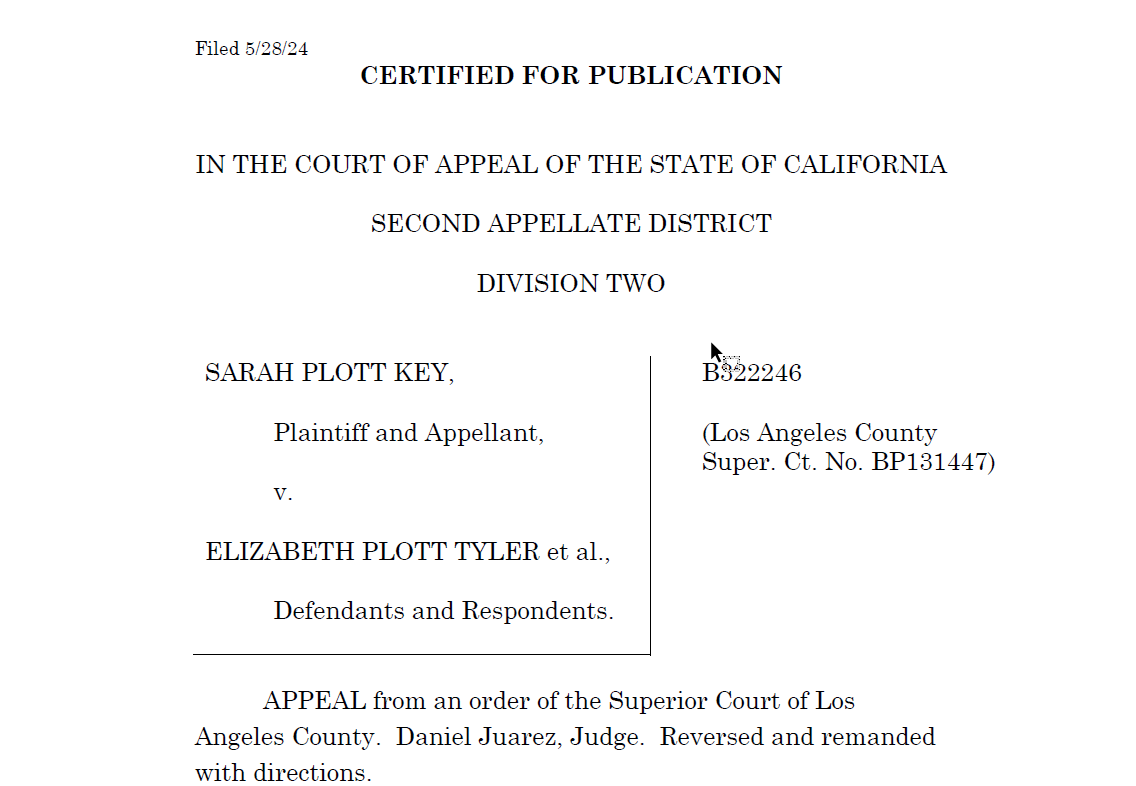
Can a defense of a contested trust amendment trigger a no contest clause? In Key v. Tyler the Court answered “yes” it may, depending on the facts and circumstances of the case (California Court of Appeal, 2nd District, Case No. B322246 (Filed 5/28/24)).

In Key v. Tyler the Trustors (Thomas and Elizabeth) executed their original Trust in 1999. The trust contained a no-contest clause which in part stated as follows:

“. . . if any devisee, legatee or beneficiary under this Trust, or any legal heir of the Trustors or person claiming under any of them directly or indirectly (a) contests either Trustor’s Will, this Trust, or any other trust created by a Trustor, or in any manner attacks or seeks to impair or invalidate any of their provisions,. . . then in that event Trustors specifically disinherit each such person, and all such legacies, bequests, devises, and interest given under this Trust to that person shall be forfeited as though he or she had predeceased the Trustors without issue, and shall augment proportionately the shares of the Trust Estate passing under this Trust to, or in trust for, such of the Trustors’ devisees, legatees and beneficiaries who have not participated in such acts or proceedings.”

The Trustors had three children: Tyler, Key, and a third sister who was not involved in the litigation.

In 2003 the Trustors subsequently executed an Amendment to the Trust – the 2003 Amendment was a one-page document that made some dispositive changes but did not restate or entirely change the provisions in the 1999 Trust – thus, the 1999 Trust remained relevant and applicable except as changed by the provisions in the one-page 2003 Amendment. The 2003 Amendment did not contain a no contest clause.

Husband Thomas subsequently died in 2003, and surviving spouse Elizabeth purportedly executed another Amendment in 2007. Pursuant to the Court “Tyler used her influence over Elizabeth to obtain the 2007 Amendment.” Beneficiary Key filed an action and successfully invalidated the 2007 Amendment on the ground that Tyler unduly influenced their mother into executing the 2007 Amendment. Against Key’s action Tyler defended the 2007 Amendments which differed from some of the provisions in the original 1999 Trust. Tyler also was a beneficiary under the 1999 Trust but would have inherited differently under the 2007 Amendment if that Amendment had not been invalidated.

Key v. Tyler is a long 20+ page Opinion which contains many relevant discussions on legal issues. However, I am writing about the Opinion here because of the discussion relating to the no contest clause in the 1999 Trust and the consequences of the litigation pertaining to the 2007 Amendment.

The Court held that Tyler’s defense of the 2007 Amendment was a contest of the 1999 Trust, and that Tyler not only did not recover under the 2007 Amendment which the Court invalidated, but also disinherited herself from what she would have recovered under the original 1999 Trust or under the 2003 Amendment pursuant to the broadly worded no contest clause that was contained in the earlier original 1999 Trust. In other words, as a result of losing on the 2007 Amendment, and there being a broadly worded no contest clause in the original 1999 Trust, Tyler lost everything and recovered nothing.

Takeaway: careful consideration needs to be given to the existence of no contest clauses contained in any and all possibly relevant trust and estate disposition instruments and documents, and to the specific wording of each possibly applicable no contest clause, as even defending a later in time subsequent instrument also may in appropriate circumstances trigger a no contest clause in an earlier instrument.

The following is a case caption scan from the Opinion in Key v. Tyler

Best to you, David Tate, Esq.

Please reach out on this topic or on other topics if you wish.

* * * *

Thank you for viewing and reading this discussion. Please do pass this blog and blog post and information to other people who would be interested as it is only through collaboration and sharing that great things and success are more quickly achieved. If you are interested in discussing anything that I have said in the discussion above or in either of my two blogs (see blog addresses below), or if you simply want to reach out or are seeking assistance, it is best to reach me by email at dave@tateattorney.com.

David Tate, Esq. (and inactive CPA)

Trust, estate, probate, power of attorney, fiduciary, beneficiary, conservatorship, and elder and dependent adult abuse litigation and contentious administrations, undue influence, fraud and deceit, physical and mental health and challenging and contentious personalities and relationships.

Trust, estate and probate administrations and litigation involving special assets such as business ownership interests and operating businesses, asset co-ownership disputes, contentious governance, intellectual property assets, art and collectible assets, ongoing future contractual rights, buyouts and sales, M&A disputes, businesses divorces, and accountings.

Businesses and third party disputes and litigation – contract, licensing, co-business, royalty and other arrangements, unfair business practices, fraud and deceit, lack of good faith and fair dealing, buyouts and sales, mergers, acquisitions, ventures, etc.

Business co-ownership and internal governance disputes and litigation, business divorces, buyouts and sales, merger and acquisition disputes, family, closely held and professional businesses, accountings, and audits, D&O, boards, audit committees and investigations. Legal authority, duties, rights, conflicts of interest, diligence, compliance, liability, BJR, legal risk management, and resolution.

Real property and co-ownership disputes and litigation.

Trials.

Mediator and dispute and litigation resolution services.

Legal risk and uncertainty management processes – authority, duties, rights, conflicts of interest, governance, diligence, compliance, liability, and resolution.

Other and additional disputes, litigation and issues that fall within the above areas – court and trial evidence, persuasion, debate and fallacies, using AI assistance, IP, meetings, defamation, risk management processes, workplace, new laws, regulations and government actions – impact/legality, law and legal matters in the news, etc.

Remember, every case and situation is different. It is important to obtain and evaluate all of the evidence that is available, and to apply that evidence to the applicable standards and laws. You do need to consult with an attorney and other professionals about your particular situation. This post is not a solicitation for legal or other services inside of or outside of California, and, of course, this post only is a summary of information that changes from time to time, and does not apply to any particular situation or to your specific situation. So . . . you cannot rely on this post for your situation or as legal or other professional advice or representation, or as or for my opinions and views on the subject matter.

Also note – sometimes I include links to or comments about materials from other organizations or people – if I do so, it is because I believe that the materials are worthwhile reading or viewing; however, that does not mean that I do not or that I might not have a different view about some or even all of the subject matter or materials, or that I necessarily agree with, or agree with everything about or relating to, that organization or person, or those materials or the subject matter.

Please also subscribe to this blog and my other blog (see below), and connect with me on LinkedIn and Twitter.

My blogs are:

http://tateattorney.com – business, D&O, audit committee, governance, compliance, etc. – previously at http://auditcommitteeupdate.com

Prior blog: Trust, estate, conservatorship, elder and elder abuse, etc. litigation and contentious administrations http://californiaestatetrust.com

David Tate, Esq. (and inactive California CPA) – practicing only as an attorney in California.

Summary of California Trustee and Beneficiary Responsibilities and Rights, and Handling Contentious Trust Administrations and Other Family Situations

Trust administrations and handling tasks and issues that arise are challenging, including responsibilities and rights, contentious administrations and other family situations, trustee duties and actions, and beneficiary conduct. Whether you are a trustee or a beneficiary, you should consult with a trust administration attorney, and in some situations also consult with a litigation attorney.

I have provided below a pdf of my presentation slides providing a summary of California trustee and beneficiary responsibilities and right, and handling contentious administrations and other family situations. Please read and use the slides and pass them to other people who would benefit. Please see also the disclaimer – these materials are only a summary, and do not apply to you, or to any person or situation, and do not create an attorney client relationship.

The following is a snap shot of the first page of the presentation slides (the slides are also provided below as a pdf):

The following is a pdf of my presentation slides:

David Tate, Esq.

Please reach out on this topic or on other topics if you wish.

* * * *

Thank you for viewing and reading this discussion. Please do pass this blog and blog post and information to other people who would be interested as it is only through collaboration and sharing that great things and success are more quickly achieved. If you are interested in discussing anything that I have said in the discussion above or in either of my two blogs (see blog addresses below), or if you simply want to reach out or are seeking assistance, it is best to reach me by email at dave@tateattorney.com.

David Tate, Esq. (and inactive CPA)

Trust, estate, probate, power of attorney, fiduciary, beneficiary, conservatorship, and elder and dependent adult abuse litigation and contentious administrations, undue influence, fraud and deceit, physical and mental health and challenging and contentious personalities and relationships.

Trust, estate and probate administrations and litigation involving special assets such as business ownership interests and operating businesses, asset co-ownership disputes, contentious governance, intellectual property assets, art and collectible assets, ongoing future contractual rights, buyouts and sales, M&A disputes, businesses divorces, and accountings.

Businesses and third party disputes and litigation – contract, licensing, co-business, royalty and other arrangements, unfair business practices, fraud and deceit, lack of good faith and fair dealing, buyouts and sales, mergers, acquisitions, ventures, etc.

Business co-ownership and internal governance disputes and litigation, business divorces, buyouts and sales, merger and acquisition disputes, family, closely held and professional businesses, accountings, and audits, D&O, boards, audit committees and investigations. Legal authority, duties, rights, conflicts of interest, diligence, compliance, liability, BJR, legal risk management, and resolution.

Real property and co-ownership disputes and litigation.

Trials.

Mediator and dispute and litigation resolution services.

Legal risk and uncertainty management processes – authority, duties, rights, conflicts of interest, governance, diligence, compliance, liability, and resolution.

Other and additional disputes, litigation and issues that fall within the above areas – court and trial evidence, persuasion, debate and fallacies, using AI assistance, IP, meetings, defamation, risk management processes, workplace, new laws, regulations and government actions – impact/legality, law and legal matters in the news, etc.

Remember, every case and situation is different. It is important to obtain and evaluate all of the evidence that is available, and to apply that evidence to the applicable standards and laws. You do need to consult with an attorney and other professionals about your particular situation. This post is not a solicitation for legal or other services inside of or outside of California, and, of course, this post only is a summary of information that changes from time to time, and does not apply to any particular situation or to your specific situation. So . . . you cannot rely on this post for your situation or as legal or other professional advice or representation, or as or for my opinions and views on the subject matter.

Also note – sometimes I include links to or comments about materials from other organizations or people – if I do so, it is because I believe that the materials are worthwhile reading or viewing; however, that does not mean that I do not or that I might not have a different view about some or even all of the subject matter or materials, or that I necessarily agree with, or agree with everything about or relating to, that organization or person, or those materials or the subject matter.

Please also subscribe to this blog and my other blog (see below), and connect with me on LinkedIn and Twitter.

My blogs are:

http://tateattorney.com – business, D&O, audit committee, governance, compliance, etc. – previously at http://auditcommitteeupdate.com

Prior blog: Trust, estate, conservatorship, elder and elder abuse, etc. litigation and contentious administrations http://californiaestatetrust.com

David Tate, Esq. (and inactive California CPA) – practicing only as an attorney in California.