Scenario – for discussion only, investigation discussion from a Form 8-K

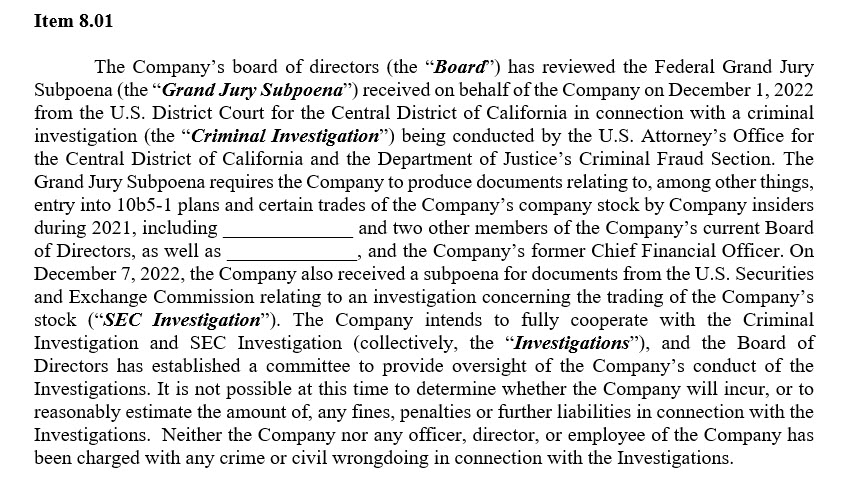
For discussion purposes only, I have attached a redacted snapshot taken from part of a recent Form 8-K that was filed with the SEC. I have no personal information about or involvement in the situation. This post is only for discussion purposes. Unfortunately news or developments today tend to be assumed or characterized to be in the negative, and often so assumed immediately and long before the facts are investigated, evaluated and made available. It takes a while to do a full investigation and to then evaluate what is known, what is not yet known, and what might not ever be known, within the context of the law and the certainty and uncertainty that exists, etc. People are innocent and presumed to be innocent and not at fault unless and until proven otherwise by admissible evidence.

Whoever is doing an investigation must be sufficiently qualified and sufficiently independent of the situation, including consideration of possible relevant personal, family, social or other outside relationships. The qualifications and independence become more elevated if the alleged situation and subject matter at issue possibly evidence greater exposure or reach into higher levels of management and authority.

Item 8.01 states “the Board of Directors has established a committee to provide oversight of the Company’s investigation” but no additional information is provided in that regard. Obviously as this situation is alleged to involve board and CxO members, the members of the committee that has been established must be carefully vetted. And consideration must also be given to optics, and to possible other high ranking or high status or visibility people from whom information might be sought and obtained during the investigation, possibly including, depending on the situation, other high-level management and board members, general counsel, internal and outside audit, and people who are members of a compliance function that is relevant to the situation. Obviously the Company’s compliance, internal controls and risk management processes relative to the issues involved also should be reviewed and evaluated and improved if necessary. Although not a legal issue, in circumstances where it becomes appropriate, possible impact on relationships and trust going forward also should be considered and worked on if necessary.

Outside, separate attorney representation also will be engaged and retained by multiple people and entities involved. Of course, possible sources of payment, reimbursement, or indemnification for the expense of legal counsel also must be evaluated and pursued.

You may know from some of my other materials that I am also interested in audit committees and governance committees, audit and auditing, internal controls and processes, auditing function and auditor communications with management, those involved in governance, and audit committees, CAMs, NOCLAR pronouncements that are becoming effective, and similar topics and matters.

That is all that I have in this post – as I said, I do not have personal information about or involvement in this situation, and, frankly, I could not talk about it if I did.

The following is the name redacted Item 8.01 from the form 8-K:
Thank you for reading. Please do pass this blog and blog post and information to other people who would be interested as it is only through collaboration and sharing that great things and success are more quickly achieved.

* * * * * * *

Best to you,

David Tate, Esq. (and inactive CPA)

  • Business litigation and disputes – business, breach of contract/commercial, co-owners, shareholders, investors, founders, workplace and employment, environmental, D&O, governance, boards and committees.
  • Trust, estate and probate court litigation and disputes – trust, estate, probate, elder and dependent abuse, conservatorship, POA, real property, mental health and care, mental capacity, undue influence, conflicts of interest, and contentious administrations.
  • Governance, boards, audit and governance committees, investigations, auditing, ESG, etc.
  • Mediator and facilitating dispute resolution:
    • Trust, estate, probate, conservatorship, elder and dependent abuse, etc.
    • Business, breach of contract/commercial, owner, shareholder, investor, etc.
    • D&O, board, audit and governance committee, accountant and CPA related.
    • Other: workplace and employment, environmental, trade secret.

Remember, every case and situation is different. It is important to obtain and evaluate all of the evidence that is available, and to apply that evidence to the applicable standards and laws. You do need to consult with an attorney and other professionals about your particular situation. This post is not a solicitation for legal or other services inside of or outside of California, and, of course, this post only is a summary of information that changes from time to time, and does not apply to any particular situation or to your specific situation. So . . . you cannot rely on this post for your situation or as legal or other professional advice or representation, or as or for my opinions and views on the subject matter.

Also note – sometimes I include links to or comments about materials from other organizations or people – if I do so, it is because I believe that the materials are worthwhile reading or viewing; however, that doesn’t mean that I don’t or might not have a different view about some or even all of the subject matter or materials, or that I necessarily agree with, or agree with everything about or relating to, that organization or person, or those materials or the subject matter.

Please also subscribe to this blog and my other blog (see below), and connect with me on LinkedIn and Twitter.

My two blogs are:

http://tateattorney.com – business, D&O, audit committee, governance, compliance, etc. – previously at http://auditcommitteeupdate.com

Trust, estate, conservatorship, elder and elder abuse, etc. litigation and contentious administrations http://californiaestatetrust.com

David Tate, Esq. (and inactive California CPA) – practicing only as an attorney in California.

Senator Warren’s letter to Tesla’s board and her requests for information and possible documents raise many legal issues

I have attached a copy of Senator Warren’s December 18, 2022, letter to Tesla’s board requesting information and possible documents pertaining to Elon Musk and whether or not the board has satisfied its duties as the letter characterizes those duties. The letter also requests a response by January 3, 2023, which in my view is an unreasonable, short time to respond, including over the holidays. A lot of time was spent preparing the letter, which is 8 pages and includes 35 footnotes to authorities and support. The specific requests for information and possible documents number 1-12, but many of which are compound, and run from pages 6 through 8.

Senator Warren’s questions pertain not only to Mr. Musk, but also to the board’s governance and oversight of Mr. Musk. Obviously the response will involve not only the board but also outside legal counsel, in-house corporate general counsel, possible board committees, and others. It has been my understanding that generally Senator Warren does not like Mr. Musk or his political views on at least some issues and subjects. I do appreciate that Senator Warren added her letter to her Senate website as this type of letter and inquiry raises many legal issues relating to the legal authority and standing of the sender, the type of private, privileged and possibly trade secret information and possible documents that are requested, and how the board should best respond. I expect that this letter and type of inquiry/investigation and appropriate responses will become the subject matter of many legal articles.

Here is Senator Warren’s letter:

Thank you for reading. Please do pass this blog and blog post and information to other people who would be interested as it is only through collaboration and sharing that great things and success are more quickly achieved.

* * * * * * *

Best to you,

David Tate, Esq. (and inactive CPA)

  • Business litigation and disputes – business, breach of contract/commercial, co-owners, shareholders, investors, founders, workplace and employment, environmental, D&O, governance, boards and committees.
  • Trust, estate and probate court litigation and disputes – trust, estate, probate, elder and dependent abuse, conservatorship, POA, real property, mental health and care, mental capacity, undue influence, conflicts of interest, and contentious administrations.
  • Governance, boards, audit and governance committees, investigations, auditing, ESG, etc.
  • Mediator and facilitating dispute resolution:
    • Trust, estate, probate, conservatorship, elder and dependent abuse, etc.
    • Business, breach of contract/commercial, owner, shareholder, investor, etc.
    • D&O, board, audit and governance committee, accountant and CPA related.
    • Other: workplace and employment, environmental, trade secret.

Remember, every case and situation is different. It is important to obtain and evaluate all of the evidence that is available, and to apply that evidence to the applicable standards and laws. You do need to consult with an attorney and other professionals about your particular situation. This post is not a solicitation for legal or other services inside of or outside of California, and, of course, this post only is a summary of information that changes from time to time, and does not apply to any particular situation or to your specific situation. So . . . you cannot rely on this post for your situation or as legal or other professional advice or representation, or as or for my opinions and views on the subject matter.

Also note – sometimes I include links to or comments about materials from other organizations or people – if I do so, it is because I believe that the materials are worthwhile reading or viewing; however, that doesn’t mean that I don’t or might not have a different view about some or even all of the subject matter or materials, or that I necessarily agree with, or agree with everything about or relating to, that organization or person, or those materials or the subject matter.

Please also subscribe to this blog and my other blog (see below), and connect with me on LinkedIn and Twitter.

My two blogs are:

http://tateattorney.com – business, D&O, audit committee, governance, compliance, etc. – previously at http://auditcommitteeupdate.com

Trust, estate, conservatorship, elder and elder abuse, etc. litigation and contentious administrations http://californiaestatetrust.com

David Tate, Esq. (and inactive California CPA) – practicing only as an attorney in California.

Fallout from FTX (and continuing)

Many financially sophisticated people and investors lost money (some a lot of money), or have otherwise been caught up in the FTX collapse and bankruptcy. Below are some of my current comments.

Just because something unexpected or negative or bad happens doesn’t by itself mean that someone is legally at fault or liable for wrongdoing or loss, or that there was related reliance and causation. We need more information to evaluate the issues.

Lawsuits have been filed (and more to follow?) – if liability is found, will there be FTX or personal money to pay? As FTX filed for bankruptcy, FTX liability might well be determined in that proceeding.

Are there possible criminal claims? It is too early to know.

There is a need for an in-depth investigation (obviously) by qualified investigators, which appears to be in progress.

Post-collapse and bankruptcy actions, representations and statements also will be evaluated, including the interviews provided (apparently without an attorney present, and perhaps without sufficient pre-interview preparation, agreed-upon questions and assurances, and post-interview review, input and oversight or authorization procedures.

The people who are or who might be caught up in this are many (but being caught up does not by itself mean legally at fault or liable for wrongdoing or loss – and there are also other limitations as FTX is a private, not public, entity, in a generally unregulated business/industry (crypto)):

  • CEO (obviously);
  • CFO (obviously);
  • Board/directors, and and possible committees (i.e., audit, governance) (obviously);
  • Possible additional internal people who directly or indirectly acted or made representations;
  • Possible people who directly or indirectly took or obtained related money or assets;
  • Possible other entities and people who were or who became directly or indirectly involved;
  • Auditors (internal and outside independent, but I do not believe that there were internal auditors) – this will be a very complicated evaluation, for example, based on what services were retained and were performed, what standards and procedures applied and/or were or perhaps should have been performed, what “opinions” or other reports were provided, what was known, what was unknown, what perhaps should have been known, who was entitled to rely, causation, etc.;    
  • General counsel – historically, generally not, but possible general counsel exposure appears to be expanding in certain circumstances;
  • Celebrity endorsers – see my prior post;
  • Insurers;
  • Regulators;
  • Investor/investment entities and/or advisors or representatives;
  • Banks and lenders, possible guarantors;
  • Investors;
  • Possible third party entities with which FTX contracted;
  • Professional licensing entities; and
  • More: possibly/probably more.

Thank you for reading. Please do pass this blog and blog post and information to other people who would be interested as it is only through collaboration and sharing that great things and success are more quickly achieved.

* * * * * * *

Best to you,

David Tate, Esq. (and inactive CPA)

  • Business litigation and disputes – business, breach of contract/commercial, co-owners, shareholders, investors, founders, workplace and employment, environmental, D&O, governance, boards and committees.
  • Trust, estate and probate court litigation and disputes – trust, estate, probate, elder and dependent abuse, conservatorship, POA, real property, mental health and care, mental capacity, undue influence, conflicts of interest, and contentious administrations.
  • Governance, boards, audit and governance committees, investigations, auditing, ESG, etc.
  • Mediator and facilitating dispute resolution:
    • Trust, estate, probate, conservatorship, elder and dependent abuse, etc.
    • Business, breach of contract/commercial, owner, shareholder, investor, etc.
    • D&O, board, audit and governance committee, accountant and CPA related.
    • Other: workplace and employment, environmental, trade secret.

Remember, every case and situation is different. It is important to obtain and evaluate all of the evidence that is available, and to apply that evidence to the applicable standards and laws. You do need to consult with an attorney and other professionals about your particular situation. This post is not a solicitation for legal or other services inside of or outside of California, and, of course, this post only is a summary of information that changes from time to time, and does not apply to any particular situation or to your specific situation. So . . . you cannot rely on this post for your situation or as legal or other professional advice or representation, or as or for my opinions and views on the subject matter.

Also note – sometimes I include links to or comments about materials from other organizations or people – if I do so, it is because I believe that the materials are worthwhile reading or viewing; however, that doesn’t mean that I don’t or might not have a different view about some or even all of the subject matter or materials, or that I necessarily agree with, or agree with everything about or relating to, that organization or person, or those materials or the subject matter.

Please also subscribe to this blog and my other blog (see below), and connect with me on LinkedIn and Twitter.

My two blogs are:

http://tateattorney.com – business, D&O, audit committee, governance, compliance, etc. – previously at http://auditcommitteeupdate.com

Trust, estate, conservatorship, elder and elder abuse, etc. litigation and contentious administrations http://californiaestatetrust.com

David Tate, Esq. (and inactive California CPA) – practicing only as an attorney in California.

Memo To Microsoft Board Re Review Of Sexual Harassment And Gender Discrimination Practices – Appreciated, And A Worthwhile Example For Others

I have provided a link below to a memo to the Microsoft Board of Directions regarding a currently ongoing review and revamp of Microsoft’s policies and practices pertaining to workplace harassment and discrimination. Microsoft provided online access to the memo. I have added some yellow highlights to a few of points. While the memo is light on detail, it does contain dates for further tasks and reports to be performed. I presume that some people might be critical of the memo for the lack of detail; however, I appreciated the fact that the memo was made available online and that it can prompt discussions. I would have to believe that other businesses and organizations, including governmental, might want to consider a possible review of their workplace harassment and discrimination policies and practices if they have not recently already done so.

A few additional comments. Probably because I also used to practice as a CPA, the use of the word “audit” without further description always gets my notice. And, although there are several references to the Board, or Board review, or reporting to the Board, a review and evaluation of how the Board handles the topic and issues might also be worthwhile. Finally, “culture” is referenced once at the end of the first paragraph – not too many years ago “culture” was regularly discussed as a Board topic but those discussions seem to have become fewer in number. It was good to see the reference to “culture” in the memo. Topics and issues such as culture, integrity, trustworthiness, and governance are important to the organization.

Here is a link to the memo with my yellow highlights on a few of the points:

Thank you for reading. Please do pass this blog and blog post and information to other people who would be interested as it is only through collaboration and sharing that great things and success are more quickly achieved.

* * * * * * *

Best to you,

David Tate, Esq. (and inactive CPA)

  • Business litigation and disputes – business, breach of contract/commercial, co-owners, shareholders, investors, founders, workplace and employment, environmental, D&O, governance, boards and committees.
  • Trust, estate and probate court litigation and disputes – trust, estate, probate, elder and dependent abuse, conservatorship, POA, real property, mental health and care, mental capacity, undue influence, conflicts of interest, and contentious administrations.
  • Governance, boards, audit and governance committees, investigations, auditing, ESG, etc.
  • Mediator and facilitating dispute resolution:
    • Trust, estate, probate, conservatorship, elder and dependent abuse, etc.
    • Business, breach of contract/commercial, owner, shareholder, investor, etc.
    • D&O, board, audit and governance committee, accountant and CPA related.
    • Other: workplace and employment, environmental, trade secret.

Remember, every case and situation is different. It is important to obtain and evaluate all of the evidence that is available, and to apply that evidence to the applicable standards and laws. You do need to consult with an attorney and other professionals about your particular situation. This post is not a solicitation for legal or other services inside of or outside of California, and, of course, this post only is a summary of information that changes from time to time, and does not apply to any particular situation or to your specific situation. So . . . you cannot rely on this post for your situation or as legal or other professional advice or representation, or as or for my opinions and views on the subject matter.

Also note – sometimes I include links to or comments about materials from other organizations or people – if I do so, it is because I believe that the materials are worthwhile reading or viewing; however, that doesn’t mean that I don’t or might not have a different view about some or even all of the subject matter or materials, or that I necessarily agree with, or agree with everything about or relating to, that organization or person, or those materials or the subject matter.

Please also subscribe to this blog and my other blog (see below), and connect with me on LinkedIn and Twitter.

My two blogs are:

http://tateattorney.com – business, D&O, audit committee, governance, compliance, etc. – previously at http://auditcommitteeupdate.com

Trust, estate, conservatorship, elder and elder abuse, etc. litigation and contentious administrations http://californiaestatetrust.com

David Tate, Esq. (and inactive California CPA) – practicing only as an attorney in California.

Golden Gate Bridge and SF Bay

Have a beautiful day!

Thank you for reading. Please do pass this blog and blog post and information to other people who would be interested as it is only through collaboration and sharing that great things and success are more quickly achieved.

* * * * * * *

Best to you,

David Tate, Esq. (and inactive CPA)

  • Business litigation and disputes – business, breach of contract/commercial, co-owners, shareholders, investors, founders, workplace and employment, environmental, D&O, governance, boards and committees.
  • Trust, estate and probate court litigation and disputes – trust, estate, probate, elder and dependent abuse, conservatorship, POA, real property, mental health and care, mental capacity, undue influence, conflicts of interest, and contentious administrations.
  • Governance, boards, audit and governance committees, investigations, auditing, ESG, etc.
  • Mediator and facilitating dispute resolution:
    • Trust, estate, probate, conservatorship, elder and dependent abuse, etc.
    • Business, breach of contract/commercial, owner, shareholder, investor, etc.
    • D&O, board, audit and governance committee, accountant and CPA related.
    • Other: workplace and employment, environmental, trade secret.

Remember, every case and situation is different. It is important to obtain and evaluate all of the evidence that is available, and to apply that evidence to the applicable standards and laws. You do need to consult with an attorney and other professionals about your particular situation. This post is not a solicitation for legal or other services inside of or outside of California, and, of course, this post only is a summary of information that changes from time to time, and does not apply to any particular situation or to your specific situation. So . . . you cannot rely on this post for your situation or as legal or other professional advice or representation, or as or for my opinions and views on the subject matter.

Also note – sometimes I include links to or comments about materials from other organizations or people – if I do so, it is because I believe that the materials are worthwhile reading or viewing; however, that doesn’t mean that I don’t or might not have a different view about some or even all of the subject matter or materials, or that I necessarily agree with, or agree with everything about or relating to, that organization or person, or those materials or the subject matter.

Please also subscribe to this blog and my other blog (see below), and connect with me on LinkedIn and Twitter.

My two blogs are:

http://tateattorney.com – business, D&O, audit committee, governance, compliance, etc. – previously at http://auditcommitteeupdate.com

Trust, estate, conservatorship, elder and elder abuse, etc. litigation and contentious administrations http://californiaestatetrust.com

David Tate, Esq. (and inactive California CPA) – practicing only as an attorney in California.

CPAs Working At Businesses – is there a NOCLAR in there (noncompliance with laws and regulations)?

NOCLAR is coming for CPAs – (NOCLAR = noncompliance with laws and regulations). NOCLARs apply to CPAs in business, and to CPAs in public practice, but with some differing provisions. This brief discussion pertains to the NOCLAR provisions that apply to CPAs in business (i.e., CPAs who work at businesses). When I was more active with CalCPA the members who worked at businesses were broadly referred to as members in the Business and Industry section. The AICPA Code of Professional Conduct contains NOCLAR provisions for members (CPAs) in business at ET 2.180.010, although under the facts and circumstances of the situation other ethics rules might well also apply. And, of course, issues of law and legal issues most likely will or may also be involved or at least relevant. ET 2.180.010 is effective June 30, 2023, but early implementation is allowed.

Previously I briefly wrote about NOCLARs here https://tateattorney.com/2022/07/01/aicpa-professional-ethics-executive-committee-and-auditing-standards-board-adopt-new-noncompliance-with-laws-and-regulations-noclar-requirements/.

Here is a new November 1, 2022, Journal of Accountancy NOCLAR article for CPAs in business https://www.journalofaccountancy.com/news/2022/nov/noclar-what-cpa-business-should-know.html.

Briefly, quoting from the Journal of Accountancy article:

“The new interpretation contributes to the fight against noncompliance in areas such as financial fraud, money laundering, asset misappropriation, bribery, data protection, tax and pension liabilities, securities trading, public health and safety, and corruption. Additionally, the interpretation further emphasizes members’ roles in serving the public interest through the enhancement of integrity in global business operations.

The Code defines NOCLAR as any “acts of omission or commission, intentional or unintentional, that are contrary to the prevailing laws or regulations and are committed by the member’s employing organization or by those charged with governance, by management, or by other individuals working for or under the direction of the employing organization.”

Accountants in business at any level could be exposed to an instance of NOCLAR, and the responsibilities of senior professional accountants in business slightly differ from the responsibilities of nonsenior professional accountants in business.”

Section .07 under the heading Scope of ET 2.180.010 states as follows:

Section .08 of ET 2.180.010 under heading Scope further states as follows:

“Examples of laws and regulations which this interpretation addresses may include those that deal with the following:

a. Fraud, corruption, and bribery

b. Money laundering

c. Securities markets and trading

d. Banking and other financial products and services

e. Data protection

f. Tax and pension liabilities and payments

g. Environmental protection

h. Public health and safety.”

Section .09 under the heading Scope of ET 2.180.010 states as follows:

Thus, scope is broadly defined as noncompliance or suspected noncompliance and is not limited to what might be considered traditional CPA financial issue areas but also includes serious adverse consequences that have a material effect on the employing organization’s financial statements in financial or nonfinancial terms and such noncompliance may include wider public interest implications in terms of substantial harm to investors, creditors, employees, or the general public. Sections .07, .08 and .09 also are not written to be all-inclusive.

The NOCLAR rules for CPAs in public practice are separately contained at AICPA Code of Professional Conduct ET 1.180.010, although under the facts of circumstances of the situation other ethics rules might well also apply. And, of course, issues of law and legal issues most likely will or may also be involved or at least relevant. ET 2.180.010 also is effective June 30, 2023, but early implementation is allowed. I will be discussing ET 1.180.00, NOCLAR rules for CPAs in public practice, in a separate blog post.

You may also like to view a few CAM-related posts (critical audit matters):

March 29, 2020 – Comments About Going Concern Uncertainties, CAMs, Etc. – Relevant In This Economic Environment, https://wordpress.com/post/auditcommitteeupdate.com/1769

February 22, 2020 – Can a CAM lead to or require an internal investigation, https://wordpress.com/post/auditcommitteeupdate.com/1571

September 22, 2019 – Takeaways from a PLI program that I recently viewed about CAMs (critical audit matters) . . . ., https://wordpress.com/post/auditcommitteeupdate.com/1248

July 17, 2019 – New July 11, 2019, PCAOB CAM Guidance for Audit Committees – Is A Matter A CAM (See Chart); And Responses To FAQs, https://wordpress.com/post/auditcommitteeupdate.com/1138

May 28, 2019 – A few Comments About Going Concern Uncertainties, CAMs, Etc., https://wordpress.com/post/auditcommitteeupdate.com/996

May 9, 2019 – PCAOB – Implementation of Critical Audit Matters Deeper Dive, https://wordpress.com/post/auditcommitteeupdate.com/957

See also PCAOB AS 3101 which contains the requirement that audit firms for public companies are required to include in their reports a discussion of “critical audit matters” (“CAMs”).

More to follow on these and other audit, auditor, audit committee and board, and governance topics.

Thank you for reading. Please do pass this blog post and information to other people who would be interested as it is only through collaboration and sharing that great things and success are more quickly achieved.

* * * * * * *

Best to you,

David Tate, Esq. (and inactive CPA)

  • Business litigation and disputes – business, breach of contract/commercial, co-owners, shareholders, investors, founders, workplace and employment, environmental, D&O, governance, boards and committees.
  • Trust, estate and probate court litigation and disputes – trust, estate, probate, elder and dependent abuse, conservatorship, POA, real property, mental health and care, mental capacity, undue influence, conflicts of interest, and contentious administrations.
  • Governance, boards, audit and governance committees, investigations, auditing, ESG, etc.
  • Mediator and facilitating dispute resolution:
    • Trust, estate, probate, conservatorship, elder and dependent abuse, etc.
    • Business, breach of contract/commercial, owner, shareholder, investor, etc.
    • D&O, board, audit and governance committee, accountant and CPA related.
    • Other: workplace and employment, environmental, trade secret.

Remember, every case and situation is different. It is important to obtain and evaluate all of the evidence that is available, and to apply that evidence to the applicable standards and laws. You do need to consult with an attorney and other professionals about your particular situation. This post is not a solicitation for legal or other services inside of or outside of California, and, of course, this post only is a summary of information that changes from time to time, and does not apply to any particular situation or to your specific situation. So . . . you cannot rely on this post for your situation or as legal or other professional advice or representation, or as or for my opinions and views on the subject matter.

Also note – sometimes I include links to or comments about materials from other organizations or people – if I do so, it is because I believe that the materials are worthwhile reading or viewing; however, that doesn’t mean that I don’t or might not have a different view about some or even all of the subject matter or materials, or that I necessarily agree with, or agree with everything about or relating to, that organization or person, or those materials or the subject matter.

Please also subscribe to this blog and my other blog (see below), and connect with me on LinkedIn and Twitter.

My two blogs are:

http://tateattorney.com – business, D&O, audit committee, governance, compliance, etc. – previously at http://auditcommitteeupdate.com

Trust, estate, conservatorship, elder and elder abuse, etc. litigation and contentious administrations http://californiaestatetrust.com

David Tate, Esq. (and inactive California CPA) – practicing only as an attorney in California.

FTX, Cryptocurrency, Celebrity Endorser Liability Exposure In The News

FTX – can a celebrity endorser have liability exposure? See the slide below with summary discussion for some consideration.

Thank you for reading. Please do pass this blog post and information to other people who would be interested as it is only through collaboration and sharing that great things and success are more quickly achieved.

* * * * * * *

Best to you,

David Tate, Esq. (and inactive CPA)

  • Business litigation and disputes – business, breach of contract/commercial, co-owners, shareholders, investors, founders, workplace and employment, environmental, D&O, governance, boards and committees.
  • Trust, estate and probate court litigation and disputes – trust, estate, probate, elder and dependent abuse, conservatorship, POA, real property, mental health and care, mental capacity, undue influence, conflicts of interest, and contentious administrations.
  • Governance, boards, audit and governance committees, investigations, auditing, ESG, etc.
  • Mediator and facilitating dispute resolution:
    • Trust, estate, probate, conservatorship, elder and dependent abuse, etc.
    • Business, breach of contract/commercial, owner, shareholder, investor, etc.
    • D&O, board, audit and governance committee, accountant and CPA related.
    • Other: workplace and employment, environmental, trade secret.

Remember, every case and situation is different. It is important to obtain and evaluate all of the evidence that is available, and to apply that evidence to the applicable standards and laws. You do need to consult with an attorney and other professionals about your particular situation. This post is not a solicitation for legal or other services inside of or outside of California, and, of course, this post only is a summary of information that changes from time to time, and does not apply to any particular situation or to your specific situation. So . . . you cannot rely on this post for your situation or as legal or other professional advice or representation, or as or for my opinions and views on the subject matter.

Also note – sometimes I include links to or comments about materials from other organizations or people – if I do so, it is because I believe that the materials are worthwhile reading or viewing; however, that doesn’t mean that I don’t or might not have a different view about some or even all of the subject matter or materials, or that I necessarily agree with, or agree with everything about or relating to, that organization or person, or those materials or the subject matter.

Please also subscribe to this blog and my other blog (see below), and connect with me on LinkedIn and Twitter.

My two blogs are:

http://tateattorney.com – business, D&O, audit committee, governance, compliance, etc. – previously at http://auditcommitteeupdate.com

Trust, estate, conservatorship, elder and elder abuse, etc. litigation and contentious administrations http://californiaestatetrust.com

David Tate, Esq. (and inactive California CPA) – practicing only as an attorney in California.

California Air Resources Board [Proposed] 2022 Scoping Plan for Achieving Carbon Neutrality – Industries, Business, D&O, Auditors, Legal, Compliance and Basically Everyone Needs to Know and Will Be Impacted

Yesterday the California Air Resources Board produced its [proposed] 2022 Scoping Plan for Achieving Carbon Neutrality November 16, 2022. Although lengthy at 297 pages, it is short on specifics. CARB refers to the plan as being proposed; however, elsewhere the plan is discussed in terms that would suggest it is a done deal. What can be said is that the eventual specifics will in some manner impact basically everyone in California, but some more and more directly than others. A section of the plan (but I wouldn’t really call it a plan but more of a paper or an overview) does focus on certain listed broad sectors, industries, activities or uses including land uses, and I find that section of the plan to be more useful. The bottom line is that all industries, businesses and business groups need to be aware and active as the proposed specifics are proposed and implemented. To be fair, the plan does talk in terms of working with business including both larger and smaller business to develop and implement specifics. Indeed, an unwise approach will negatively impact jobs of all kinds and the employment and financial wellbeing of all people throughout California. The references to “industries” and “businesses” should be read as broadly as possible as basically everyone and all legal entities in California, north and south and middle, will eventually be impacted – thus, just for example, from a legal entity perspective “industries” and “businesses” also includes entities that operate as nonprofits. One additional comment at this time – although the plan does not discuss enforcement in any detail, it does contain the following very short paragraph:

“It will take all tools at all levels of government, with robust enforcement, to ensure that vulnerable communities continue to see improvements in air quality until no disparities exist in air pollution across the state.”

The following is a link to the plan on the CARB website – scroll to near the bottom of the relatively long page and click on Scoping Plan: https://ww2.arb.ca.gov/news/california-releases-final-2022-climate-scoping-plan-proposal

Thank you for reading. Please do pass this blog post and information to other people who would be interested as it is only through collaboration and sharing that great things and success are more quickly achieved.

* * * * * * *

Best to you,

David Tate, Esq. (and inactive CPA)

  • Business litigation and disputes – business, breach of contract/commercial, co-owners, shareholders, investors, founders, workplace and employment, environmental, D&O, governance, boards and committees.
  • Trust, estate and probate court litigation and disputes – trust, estate, probate, elder and dependent abuse, conservatorship, POA, real property, mental health and care, mental capacity, undue influence, conflicts of interest, and contentious administrations.
  • Governance, boards, audit and governance committees, investigations, auditing, ESG, etc.
  • Mediator and facilitating dispute resolution:
    • Trust, estate, probate, conservatorship, elder and dependent abuse, etc.
    • Business, breach of contract/commercial, owner, shareholder, investor, etc.
    • D&O, board, audit and governance committee, accountant and CPA related.
    • Other: workplace and employment, environmental, trade secret.

Remember, every case and situation is different. It is important to obtain and evaluate all of the evidence that is available, and to apply that evidence to the applicable standards and laws. You do need to consult with an attorney and other professionals about your particular situation. This post is not a solicitation for legal or other services inside of or outside of California, and, of course, this post only is a summary of information that changes from time to time, and does not apply to any particular situation or to your specific situation. So . . . you cannot rely on this post for your situation or as legal or other professional advice or representation, or as or for my opinions and views on the subject matter.

Also note – sometimes I include links to or comments about materials from other organizations or people – if I do so, it is because I believe that the materials are worthwhile reading or viewing; however, that doesn’t mean that I don’t or might not have a different view about some or even all of the subject matter or materials, or that I necessarily agree with, or agree with everything about or relating to, that organization or person, or those materials or the subject matter.

Please also subscribe to this blog and my other blog (see below), and connect with me on LinkedIn and Twitter.

My two blogs are:

http://tateattorney.com – business, D&O, audit committee, governance, compliance, etc. – previously at http://auditcommitteeupdate.com

Trust, estate, conservatorship, elder and elder abuse, etc. litigation and contentious administrations http://californiaestatetrust.com

David Tate, Esq. (and inactive California CPA) – practicing only as an attorney in California.

SEC: 12,300 + whistleblower tips; Reminder: California Labor Code §1102.5 and §1102.6 statutory whistleblower and whistleblower retaliation protection and burden of proof

The SEC has announced its enforcement results for FY2022. Below I have provided you with a link to the announcement, and a copy of the whistleblower summary in the announcement. As indicted, the SEC received more than 12,300 whistleblower tips in fiscal year 2022. That is a lot of tips. And, presumably, also reflects a large number of internal investigations. For your information, below I have also provided copies of California Labor Code §§1102.5 and 1102.6, pertaining to California statutory whistleblower and whistleblower retaliation protection and burden of proof.

SEC Announces Enforcement Results for FY22

https://www.sec.gov/news/press-release/2022-206

Rewarding and Protecting Whistleblowers

The SEC’s Office of the Whistleblower is an integral part of the Enforcement Program. In fiscal year 2022, the SEC issued approximately $229 million in 103 awards, making it the SEC’s second highest year in terms of dollar amounts and number of awards. The Whistleblower Program also received a record high number of whistleblower tips alleging wrongdoing—more than 12,300 whistleblower tips—in fiscal year 2022.

In addition to vigorously safeguarding whistleblowers’ anonymity, the SEC protects them by pursuing individuals or entities who take steps to impede, or retaliate against them for, their whistleblowing. This was reflected in enforcement actions against the Brink’s Company, which the SEC charged and penalized for requiring certain employees to sign restrictive confidentiality agreements, and against the co-founder of a technology company, whom the SEC charged with impeding an employee from communicating with the SEC regarding potential misconduct. In another matter, the SEC’s commitment was rewarded when a court granted summary judgment to the SEC in litigation charging that the defendants had illegally conditioned the return of investor money on the investors’ signing agreements that prohibited them from reporting potential securities-law violations to law enforcement. SEC v. Collector’s Coffee, 19 Civ. 4355 (VM), 2021 U.S. Dist. LEXIS 22216,| 2021 WL 5360440 (S.D.N.Y. Nov. 17, 2021).

California Labor Code §1102.5 and §1102.6 statutory whistleblower and whistleblower retaliation protection and burden of proof

California Labor Code §1102.5

(a) An employer, or any person acting on behalf of the employer, shall not make, adopt, or enforce any rule, regulation, or policy preventing an employee from disclosing information to a government or law enforcement agency, to a person with authority over the employee, or to another employee who has authority to investigate, discover, or correct the violation or noncompliance, or from providing information to, or testifying before, any public body conducting an investigation, hearing, or inquiry, if the employee has reasonable cause to believe that the information discloses a violation of state or federal statute, or a violation of or noncompliance with a local, state, or federal rule or regulation, regardless of whether disclosing the information is part of the employee’s job duties.

(b) An employer, or any person acting on behalf of the employer, shall not retaliate against an employee for disclosing information, or because the employer believes that the employee disclosed or may disclose information, to a government or law enforcement agency, to a person with authority over the employee or another employee who has the authority to investigate, discover, or correct the violation or noncompliance, or for providing information to, or testifying before, any public body conducting an investigation, hearing, or inquiry, if the employee has reasonable cause to believe that the information discloses a violation of state or federal statute, or a violation of or noncompliance with a local, state, or federal rule or regulation, regardless of whether disclosing the information is part of the employee’s job duties.

(c) An employer, or any person acting on behalf of the employer, shall not retaliate against an employee for refusing to participate in an activity that would result in a violation of state or federal statute, or a violation of or noncompliance with a local, state, or federal rule or regulation.

(d) An employer, or any person acting on behalf of the employer, shall not retaliate against an employee for having exercised their rights under subdivision (a), (b), or (c) in any former employment.

(e) A report made by an employee of a government agency to their employer is a disclosure of information to a government or law enforcement agency pursuant to subdivisions (a) and (b).

(f) In addition to other penalties, an employer that is a corporation or limited liability company is liable for a civil penalty not exceeding ten thousand dollars ($10,000) for each violation of this section.

(g) This section does not apply to rules, regulations, or policies that implement, or to actions by employers against employees who violate, the confidentiality of the lawyer-client privilege of Article 3 (commencing with Section 950) of, or the physician-patient privilege of Article 6 (commencing with Section 990) of, Chapter 4 of Division 8 of the Evidence Code, or trade secret information.

(h) An employer, or a person acting on behalf of the employer, shall not retaliate against an employee because the employee is a family member of a person who has, or is perceived to have, engaged in any acts protected by this section.

(i) For purposes of this section, “employer” or “a person acting on behalf of the employer” includes, but is not limited to, a client employer as defined in paragraph (1) of subdivision (a) of Section 2810.3 and an employer listed in subdivision (b) of Section 6400.

(j) The court is authorized to award reasonable attorney’s fees to a plaintiff who brings a successful action for a violation of these provisions.

(Amended by Stats. 2020, Ch. 344, Sec. 2. (AB 1947) Effective January 1, 2021.)

California Labor Code §1102.6

In a civil action or administrative proceeding brought pursuant to Section 1102.5, once it has been demonstrated by a preponderance of the evidence that an activity proscribed by Section 1102.5 was a contributing factor in the alleged prohibited action against the employee, the employer shall have the burden of proof to demonstrate by clear and convincing evidence that the alleged action would have occurred for legitimate, independent reasons even if the employee had not engaged in activities protected by Section 1102.5.

(Added by Stats. 2003, Ch. 484, Sec. 3. Effective January 1, 2004.)

Thank you for reading. Please do pass this blog post and information to other people who would be interested as it is only through collaboration and sharing that great things and success are more quickly achieved.

* * * * * * *

Best to you,

David Tate, Esq. (and inactive CPA)

  • Business litigation and disputes – business, breach of contract/commercial, co-owners, shareholders, investors, founders, workplace and employment, environmental, D&O, governance, boards and committees.
  • Trust, estate and probate court litigation and disputes – trust, estate, probate, elder and dependent abuse, conservatorship, POA, real property, mental health and care, mental capacity, undue influence, conflicts of interest, and contentious administrations.
  • Governance, boards, audit and governance committees, investigations, auditing, ESG, etc.
  • Mediator and facilitating dispute resolution:
    • Trust, estate, probate, conservatorship, elder and dependent abuse, etc.
    • Business, breach of contract/commercial, owner, shareholder, investor, etc.
    • D&O, board, audit and governance committee, accountant and CPA related.
    • Other: workplace and employment, environmental, trade secret.

Remember, every case and situation is different. It is important to obtain and evaluate all of the evidence that is available, and to apply that evidence to the applicable standards and laws. You do need to consult with an attorney and other professionals about your particular situation. This post is not a solicitation for legal or other services inside of or outside of California, and, of course, this post only is a summary of information that changes from time to time, and does not apply to any particular situation or to your specific situation. So . . . you cannot rely on this post for your situation or as legal or other professional advice or representation, or as or for my opinions and views on the subject matter.

Also note – sometimes I include links to or comments about materials from other organizations or people – if I do so, it is because I believe that the materials are worthwhile reading or viewing; however, that doesn’t mean that I don’t or might not have a different view about some or even all of the subject matter or materials, or that I necessarily agree with, or agree with everything about or relating to, that organization or person, or those materials or the subject matter.

Please also subscribe to this blog and my other blog (see below), and connect with me on LinkedIn and Twitter.

My two blogs are:

http://tateattorney.com – business, D&O, audit committee, governance, compliance, etc. – previously at http://auditcommitteeupdate.com

Trust, estate, conservatorship, elder and elder abuse, etc. litigation and contentious administrations http://californiaestatetrust.com

David Tate, Esq. (and inactive California CPA) – practicing only as an attorney in California.

European Parliament adopts Corporate Sustainability Reporting Directive (CSRD), to require disclosure under the European Sustainability Reporting Standards (ESRS) (e.g., ESG, etc.); see also Biden unveils rule requiring suppliers to disclose emissions, climate targets

I am making this post because the information provided represents an ongoing march toward sustainability and/or ESG standards and disclosures; these standards will apply to some U.S. based businesses including executive officers, directors, boards, audit committees and other committees, compliance professionals, and internal and outside independent auditors; and these developments might be used by or might impact later (perhaps soon) established U.S. (or even California) standards and/or disclosures. These standards will also be used by and will impact other stakeholders in sustainability and ESG including the major accounting firms and other professionals.

The European Parliament has adopted the Corporate Sustainability Reporting Directive (CSRD), to require disclosures under the European Sustainability Reporting Standards (ESRS) (e.g., anticipated to cover a broad set of environmental, social and governance topics ranging from climate change to workers in the value chain and business conduct governance).

“The CSRD will require disclosure under a common framework of European Sustainability Reporting Standards (ESRS) which is currently under development by the European Financial Reporting Advisory Group (EFRAG). Under the new system, companies will be required to report on issues ranging from environmental sustainability and social rights to human rights and governance factors.  

With the adoption of the CSRD by the EU Parliament, the proposal will move on to the Council, which is expected to adopt the proposal later this month. The rules will begin applying from the beginning of 2024 for large public-interest companies with over 500 employees, followed by companies with more than 250 employees or €40 million in revenue in 2025, and listed SMEs in 2026.”

The following pertains to separate, prior, but recent information regarding the development of EFRAG standards:

‘The European Financial Reporting Advisory Group (EFRAG) announced the release of its initial draft of European Sustainability Reporting Standards, setting out the proposed rules and requirements for companies to report on sustainability-related impacts, opportunities and risks under the EU’s upcoming Corporate Sustainable Reporting Directive (CSRD).

EFRAG’s proposals were released as a series of exposure drafts (EDs) covering a broad set of environmental, social and governance topics ranging from climate change to workers in the value chain and business conduct governance. Companies covered by the rules would be required to provide sustainability reporting on their strategies and business models, governance and organization, materiality assessments of sustainability impacts, opportunities and risks, as well as policies, targets, action plans and performance.”


See also the following about which I expect to have additional comments at a later time: Biden Unveils Rule Requiring Federal Suppliers to Disclose Emissions, Set Climate Targets

Thank you for viewing and reading. Please pass this along to other people who would be interested as it is through collaboration and sharing that great things and success occur more quickly.

* * * * * * *

Best to you,

David Tate, Esq. (and inactive CPA)

  • Business litigation and disputes – business, breach of contract/commercial, co-owners, shareholders, investors, founders, workplace and employment, environmental, D&O, governance, boards and committees.
  • Trust, estate and probate court litigation and disputes – trust, estate, probate, elder and dependent abuse, conservatorship, POA, real property, mental health and care, mental capacity, undue influence, conflicts of interest, and contentious administrations.
  • Governance, boards, audit and governance committees, investigations, auditing, ESG, etc.
  • Mediator and facilitating dispute resolution:
    • Trust, estate, probate, conservatorship, elder and dependent abuse, etc.
    • Business, breach of contract/commercial, owner, shareholder, investor, etc.
    • D&O, board, audit and governance committee, accountant and CPA related.
    • Other: workplace and employment, environmental, trade secret.

Remember, every case and situation is different. It is important to obtain and evaluate all of the evidence that is available, and to apply that evidence to the applicable standards and laws. You do need to consult with an attorney and other professionals about your particular situation. This post is not a solicitation for legal or other services inside of or outside of California, and, of course, this post only is a summary of information that changes from time to time, and does not apply to any particular situation or to your specific situation. So . . . you cannot rely on this post for your situation or as legal or other professional advice or representation, or as or for my opinions and views on the subject matter.

Also note – sometimes I include links to or comments about materials from other organizations or people – if I do so, it is because I believe that the materials are worthwhile reading or viewing; however, that doesn’t mean that I don’t or might not have a different view about some or even all of the subject matter or materials, or that I necessarily agree with, or agree with everything about or relating to, that organization or person, or those materials or the subject matter.

Please also subscribe to this blog and my other blog (see below), and connect with me on LinkedIn and Twitter.

My two blogs are:

http://tateattorney.com – business, D&O, audit committee, governance, compliance, etc. – previously at http://auditcommitteeupdate.com

Trust, estate, conservatorship, elder and elder abuse, etc. litigation and contentious administrations http://californiaestatetrust.com

David Tate, Esq. (and inactive California CPA) – practicing only as an attorney in California.