Governance Committees – three Chat GPT 3.5 questions: what does a governance committee do; write a governance committee charter; and write a governance committee meeting agenda

You hear a lot about audit committees, but very little specifically about governance committees. So I asked Chat GPT 3.5 three questions about governance committees (and I was playing a bit with the Chat GPT): what does a governance committee do; write a governance committee charter; and write a governance committee meeting agenda.

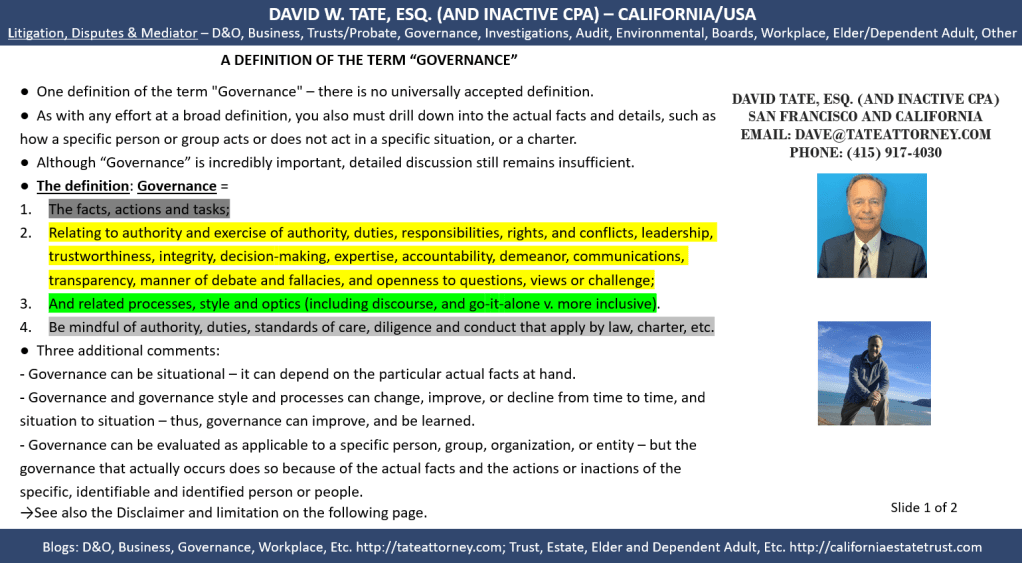
I have provided the results below. Of course, the questions were general in nature and not focused on any particular entity or industry or specific situation, issue or problem – the results cannot be relied upon for anything, but I thought the results were interesting. It is possible that some of the negative situations that you read about in the news present circumstances that might have been prevented or mitigated by a governance committee. I have also pasted below my slide for a definition of the term governance, and my simple risk management processes slide. I have also pasted below my mediator paper discussing questions to ask to help facilitate mediation and settlement.

The following is the result of my Chat GPT 3.5 question about what a governance committee does.

The following is the result of my Chat GPT 3.5 request to write a governance committee charter.

The following is the result of my Chat GPT 3.5 request to write a governance committee meeting agenda.

The following is my slide for a definition of the term governance.

The following is my simple risk management processes slide.

The following is my mediator paper discussing questions to ask to help facilitate mediation and settlement.

* * * *

Thank you for viewing this discussion. Please do pass this blog and blog post and information to other people who would be interested as it is only through collaboration and sharing that great things and success are more quickly achieved. If you are interested in discussing anything that I have said in the discussion above or in either of my two blogs (see blog addresses below), or if you simply want to reach out or are seeking assistance, it is best to reach me by email at dave@tateattorney.com.

David Tate, Esq. (and inactive CPA)

  • Business litigation and disputes – business, breach of contract/commercial, co-owners, shareholders, investors, founders, workplace and employment, environmental, D&O, governance, boards and committees.
  • Trust, estate and probate court litigation and disputes – trust, estate, probate, elder and dependent abuse, conservatorship, POA, real property, mental health and care, mental capacity, undue influence, conflicts of interest, and contentious administrations.
  • Governance, boards, audit and governance committees, investigations, auditing, ESG, etc.
  • Mediator and facilitating dispute resolution (evaluative and facilitative):
    • Trust, estate, probate, conservatorship, elder and dependent abuse, etc.
    • Business, breach of contract/commercial, owner, shareholder, investor, etc.
    • D&O, board, audit and governance committee, accountant and CPA related.
    • Other: workplace and employment, environmental, trade secret.

Remember, every case and situation is different. It is important to obtain and evaluate all of the evidence that is available, and to apply that evidence to the applicable standards and laws. You do need to consult with an attorney and other professionals about your particular situation. This post is not a solicitation for legal or other services inside of or outside of California, and, of course, this post only is a summary of information that changes from time to time, and does not apply to any particular situation or to your specific situation. So . . . you cannot rely on this post for your situation or as legal or other professional advice or representation, or as or for my opinions and views on the subject matter.

Also note – sometimes I include links to or comments about materials from other organizations or people – if I do so, it is because I believe that the materials are worthwhile reading or viewing; however, that does not mean that I do not or that I might not have a different view about some or even all of the subject matter or materials, or that I necessarily agree with, or agree with everything about or relating to, that organization or person, or those materials or the subject matter.

Please also subscribe to this blog and my other blog (see below), and connect with me on LinkedIn and Twitter.

My two blogs are:

http://tateattorney.com – business, D&O, audit committee, governance, compliance, etc. – previously at http://auditcommitteeupdate.com

Trust, estate, conservatorship, elder and elder abuse, etc. litigation and contentious administrations http://californiaestatetrust.com

David Tate, Esq. (and inactive California CPA) – practicing only as an attorney in California.
Tate Mediator Talk: In litigation mediation if you are going to settle it is not what you want and sometimes it is also not necessarily what you need – instead, it is . . . (David Tate, Esq.)

In litigation mediation if you are going to settle it is not what you want and sometimes it is also not necessarily what you need – instead, it is what you can do without to put the litigation behind you and to move forward, and are willing to, after reasonably considering and evaluating the pros, cons and options. Of course, this is not to downplay the emotions and feelings that are typically present in litigation and at mediation, and, it is also not to dismiss the possibility that in some situations emotions and feelings are at a very high level (i.e., at a level that is greater or more intense than the typical range or level for litigation in general), and that in some of those situations the emotions or feelings might present or create a need that must be addressed in the mediation.

See below page 1 of my Questions to Consider to Help Facilitate Legal Dispute Resolution and Settlement, followed by a link to the paper.

* * * *

Thank you for viewing this discussion. Please do pass this blog and blog post and information to other people who would be interested as it is only through collaboration and sharing that great things and success are more quickly achieved. If you are interested in discussing anything that I have said in the discussion above or in either of my two blogs (see blog addresses below), or if you simply want to reach out or are seeking assistance, it is best to reach me by email at dave@tateattorney.com.

David Tate, Esq. (and inactive CPA)

  • Business litigation and disputes – business, breach of contract/commercial, co-owners, shareholders, investors, founders, workplace and employment, environmental, D&O, governance, boards and committees.
  • Trust, estate and probate court litigation and disputes – trust, estate, probate, elder and dependent abuse, conservatorship, POA, real property, mental health and care, mental capacity, undue influence, conflicts of interest, and contentious administrations.
  • Governance, boards, audit and governance committees, investigations, auditing, ESG, etc.
  • Mediator and facilitating dispute resolution (evaluative and facilitative):
    • Trust, estate, probate, conservatorship, elder and dependent abuse, etc.
    • Business, breach of contract/commercial, owner, shareholder, investor, etc.
    • D&O, board, audit and governance committee, accountant and CPA related.
    • Other: workplace and employment, environmental, trade secret.

Remember, every case and situation is different. It is important to obtain and evaluate all of the evidence that is available, and to apply that evidence to the applicable standards and laws. You do need to consult with an attorney and other professionals about your particular situation. This post is not a solicitation for legal or other services inside of or outside of California, and, of course, this post only is a summary of information that changes from time to time, and does not apply to any particular situation or to your specific situation. So . . . you cannot rely on this post for your situation or as legal or other professional advice or representation, or as or for my opinions and views on the subject matter.

Also note – sometimes I include links to or comments about materials from other organizations or people – if I do so, it is because I believe that the materials are worthwhile reading or viewing; however, that does not mean that I do not or that I might not have a different view about some or even all of the subject matter or materials, or that I necessarily agree with, or agree with everything about or relating to, that organization or person, or those materials or the subject matter.

Please also subscribe to this blog and my other blog (see below), and connect with me on LinkedIn and Twitter.

My two blogs are:

http://tateattorney.com – business, D&O, audit committee, governance, compliance, etc. – previously at http://auditcommitteeupdate.com

Trust, estate, conservatorship, elder and elder abuse, etc. litigation and contentious administrations http://californiaestatetrust.com

David Tate, Esq. (and inactive California CPA) – practicing only as an attorney in California.

David Tate, Esq. – Mediator Services – Questions to Consider to Help Facilitate Legal Dispute Resolution and Settlement

I have updated my Questions to Consider to Help Facilitate Legal Dispute Resolution and Settlement. Below I have pasted an updated first page, and below the scan of the first page I have included a link to the full paper (which is only 5 pages in length). My mediation approach is evaluative and facilitative. I ask that you pass this information along to other people who would be interested, or who have a case or know of a case in which a mediator could help. Areas primarily include trust, estate, probate, conservatorship, administration, and elder-related litigation and disputes; business, contract breach, and internal co-owner, board, and governance litigation and disputes; residential real property purchase and sale litigation and disputes; professional malpractice (real estate broker and CPA); and other related areas.

* * * *

Thank you for viewing this discussion. Please do pass this blog and blog post and information to other people who would be interested as it is only through collaboration and sharing that great things and success are more quickly achieved. If you are interested in discussing anything that I have said in the discussion above or in either of my two blogs (see blog addresses below), or if you simply want to reach out or are seeking assistance, it is best to reach me by email at dave@tateattorney.com.

David Tate, Esq. (and inactive CPA)

  • Business litigation and disputes – business, breach of contract/commercial, co-owners, shareholders, investors, founders, workplace and employment, environmental, D&O, governance, boards and committees.
  • Trust, estate and probate court litigation and disputes – trust, estate, probate, elder and dependent abuse, conservatorship, POA, real property, mental health and care, mental capacity, undue influence, conflicts of interest, and contentious administrations.
  • Governance, boards, audit and governance committees, investigations, auditing, ESG, etc.
  • Mediator and facilitating dispute resolution (evaluative and facilitative):
    • Trust, estate, probate, conservatorship, elder and dependent abuse, etc.
    • Business, breach of contract/commercial, owner, shareholder, investor, etc.
    • D&O, board, audit and governance committee, accountant and CPA related.
    • Other: workplace and employment, environmental, trade secret.

Remember, every case and situation is different. It is important to obtain and evaluate all of the evidence that is available, and to apply that evidence to the applicable standards and laws. You do need to consult with an attorney and other professionals about your particular situation. This post is not a solicitation for legal or other services inside of or outside of California, and, of course, this post only is a summary of information that changes from time to time, and does not apply to any particular situation or to your specific situation. So . . . you cannot rely on this post for your situation or as legal or other professional advice or representation, or as or for my opinions and views on the subject matter.

Also note – sometimes I include links to or comments about materials from other organizations or people – if I do so, it is because I believe that the materials are worthwhile reading or viewing; however, that does not mean that I do not or that I might not have a different view about some or even all of the subject matter or materials, or that I necessarily agree with, or agree with everything about or relating to, that organization or person, or those materials or the subject matter.

Please also subscribe to this blog and my other blog (see below), and connect with me on LinkedIn and Twitter.

My two blogs are:

http://tateattorney.com – business, D&O, audit committee, governance, compliance, etc. – previously at http://auditcommitteeupdate.com

Trust, estate, conservatorship, elder and elder abuse, etc. litigation and contentious administrations http://californiaestatetrust.com

David Tate, Esq. (and inactive California CPA) – practicing only as an attorney in California.

SEC stresses the importance of comprehensive risk assessment by auditors and management, including of possible isolated and/or non-financial “risks”

I have provided below a snapshot of the first part of a discussion (sorry for the snapshot quality) by SEC Chief Accountant Paul Munter (and also below the snapshot a link to the full discussion) about the importance of management’s and auditors’ risk assessment (and possible communications about and reporting) for risks that are perceived to be isolated, or “smaller,” or are non-financial in nature. One problem is that discussing these issues or possible issues in the abstract provides no actual guidance, and second-guessing in hindsight is too easy – and it can be uncertain at what point the efforts made at assessment and actions taken are sufficient. If reasonable processes are in place, and reasonable efforts are made to follow those processes, deference should be given to those efforts. The SEC aside, risk assessment, risk management, and risk management processes are important and are topics and issues in which I have interests. I have also pasted below the most recent version and slide (June 8, 2023) of my risk management and uncertainty approach and process overview.

The following is the snapshot of the first part of Paul Munter’s discussion:

The following is the link to the full Paul Munter discussion: https://www.sec.gov/news/statement/munter-importance-risk-assessment-082523

The following is a snapshot copy of my June 8, 2023 risk management and uncertainty approach and process overview and slide, and below the snapshot I have provide a link to the slide.

* * * *

Thank you for viewing this discussion. Please do pass this blog and blog post and information to other people who would be interested as it is only through collaboration and sharing that great things and success are more quickly achieved. If you are interested in discussing anything that I have said in the discussion above or in either of my two blogs (see blog addresses below), or if you simply want to reach out or are seeking assistance, it is best to reach me by email at dave@tateattorney.com.

David Tate, Esq. (and inactive CPA)

  • Business litigation and disputes – business, breach of contract/commercial, co-owners, shareholders, investors, founders, workplace and employment, environmental, D&O, governance, boards and committees.
  • Trust, estate and probate court litigation and disputes – trust, estate, probate, elder and dependent abuse, conservatorship, POA, real property, mental health and care, mental capacity, undue influence, conflicts of interest, and contentious administrations.
  • Governance, boards, audit and governance committees, investigations, auditing, ESG, etc.
  • Mediator and facilitating dispute resolution (evaluative and facilitative):
    • Trust, estate, probate, conservatorship, elder and dependent abuse, etc.
    • Business, breach of contract/commercial, owner, shareholder, investor, etc.
    • D&O, board, audit and governance committee, accountant and CPA related.
    • Other: workplace and employment, environmental, trade secret.

Remember, every case and situation is different. It is important to obtain and evaluate all of the evidence that is available, and to apply that evidence to the applicable standards and laws. You do need to consult with an attorney and other professionals about your particular situation. This post is not a solicitation for legal or other services inside of or outside of California, and, of course, this post only is a summary of information that changes from time to time, and does not apply to any particular situation or to your specific situation. So . . . you cannot rely on this post for your situation or as legal or other professional advice or representation, or as or for my opinions and views on the subject matter.

Also note – sometimes I include links to or comments about materials from other organizations or people – if I do so, it is because I believe that the materials are worthwhile reading or viewing; however, that does not mean that I do not or that I might not have a different view about some or even all of the subject matter or materials, or that I necessarily agree with, or agree with everything about or relating to, that organization or person, or those materials or the subject matter.

Please also subscribe to this blog and my other blog (see below), and connect with me on LinkedIn and Twitter.

My two blogs are:

http://tateattorney.com – business, D&O, audit committee, governance, compliance, etc. – previously at http://auditcommitteeupdate.com

Trust, estate, conservatorship, elder and elder abuse, etc. litigation and contentious administrations http://californiaestatetrust.com

David Tate, Esq. (and inactive California CPA) – practicing only as an attorney in California.

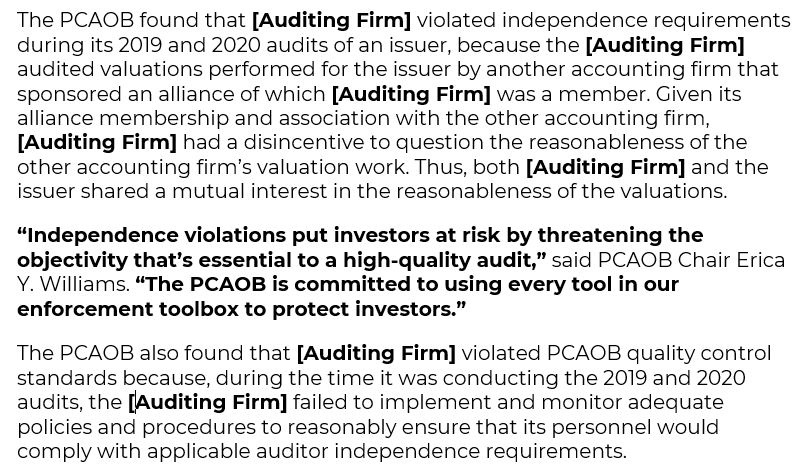
Auditor deemed not independent due to relationships (per the PCAOB), and reminder to evaluate relationships and possible conflicts of interest and independence in many various situations

I have pasted below part of a new release in which the PCAOB has found that an auditing firm lacked independence due to a relationship that the auditing firm had with another accounting firm that performed valuations for the issuer that the auditing firm was then auditing. Remember that relationships are important in many different situations where a party is required to be independent or without conflict of interest, and also in situations where there should not even be an appearance of conflict or lack of independence. Consider as possible additional examples not just in this case of an auditing firm, but often also during internal investigations, with respect to board special committees and internal audit, and in some situations, transactions or votes involving majority and minority owners, members or interests, or control.

Below is the PCAOB release – I substituted the name of the auditing firm with “Auditing Firm” as the name of the auditing firm is not important for this discussion.

* * * *

Thank you for viewing this discussion. Please do pass this blog and blog post and information to other people who would be interested as it is only through collaboration and sharing that great things and success are more quickly achieved. If you are interested in discussing anything that I have said in the discussion above or in either of my two blogs (see blog addresses below), or if you simply want to reach out or are seeking assistance, it is best to reach me by email at dave@tateattorney.com.

David Tate, Esq. (and inactive CPA)

  • Business litigation and disputes – business, breach of contract/commercial, co-owners, shareholders, investors, founders, workplace and employment, environmental, D&O, governance, boards and committees.
  • Trust, estate and probate court litigation and disputes – trust, estate, probate, elder and dependent abuse, conservatorship, POA, real property, mental health and care, mental capacity, undue influence, conflicts of interest, and contentious administrations.
  • Governance, boards, audit and governance committees, investigations, auditing, ESG, etc.
  • Mediator and facilitating dispute resolution (evaluative and facilitative):
    • Trust, estate, probate, conservatorship, elder and dependent abuse, etc.
    • Business, breach of contract/commercial, owner, shareholder, investor, etc.
    • D&O, board, audit and governance committee, accountant and CPA related.
    • Other: workplace and employment, environmental, trade secret.

Remember, every case and situation is different. It is important to obtain and evaluate all of the evidence that is available, and to apply that evidence to the applicable standards and laws. You do need to consult with an attorney and other professionals about your particular situation. This post is not a solicitation for legal or other services inside of or outside of California, and, of course, this post only is a summary of information that changes from time to time, and does not apply to any particular situation or to your specific situation. So . . . you cannot rely on this post for your situation or as legal or other professional advice or representation, or as or for my opinions and views on the subject matter.

Also note – sometimes I include links to or comments about materials from other organizations or people – if I do so, it is because I believe that the materials are worthwhile reading or viewing; however, that does not mean that I do not or that I might not have a different view about some or even all of the subject matter or materials, or that I necessarily agree with, or agree with everything about or relating to, that organization or person, or those materials or the subject matter.

Please also subscribe to this blog and my other blog (see below), and connect with me on LinkedIn and Twitter.

My two blogs are:

http://tateattorney.com – business, D&O, audit committee, governance, compliance, etc. – previously at http://auditcommitteeupdate.com

Trust, estate, conservatorship, elder and elder abuse, etc. litigation and contentious administrations http://californiaestatetrust.com

David Tate, Esq. (and inactive California CPA) – practicing only as an attorney in California.

Mediator Talk – perhaps Tuohy and Oher should get into mediation soon – as the issues or some of them might be possible to settle  

Based on news reports, perhaps Sean and Leigh Anne Tuohy and Michael Oher might benefit from getting into mediation soon – as their issues or at least some of the issues might be possible to settle. To be sure, based on what is in the news, there are legal, factual, and evidentiary issues, and also uncertainties, ambiguities, unknowns, and perplexities. And, as is true with all cases, the various outcomes on the claims and issues are unknown if the case proceeds to trial (whether adjudication is via the Court or the Jury).

Consider the following, according to the news that I have seen:

Michael was conserved in 2004 when he as 18.

It may have been a conservatorship of the person, or of the estate , or it may have been a conservatorship for everything, such as the person and the estate. I have yet to see the definitive on this.

Apparently over all of these years the conservatorship was never terminated – why not is unknown.

It appears that some reports might not have been made to or filed with the court – if reports were not filed with the court, why not is unknown.

Michael has made claims – that the conservatorship should be terminated, for an accounting, and that he is owed money from the movie The Blind Side and perhaps other remedies.

The amount of money that might be owed, or not, and the legal basis, if any, are unknown. I saw news yesterday that a producer had provided information about profits or payments that were made from The Blind Side – which, if true, I would view as probative and helpful, but certainly not determinative of anything in and by itself.

Thus, there are primary issues that might be resolved or in part resolved if the parties cooperate, such as, with the exchange of documents and an accounting, the amount owed, if any, might be agreed upon or narrowed. On the other hand, discovery of documents and information might be desired more formally or under penalty of perjury. In any event, if issues remain unresolved, the court can issue orders and make adjudications, and it certainly will if needed.

From a California perspective, the above events, actions and inactions, if true, are perplexing. In conservatorships, reports to the court are required, objections can be made, counsel can be appointed (will be appointed), conservatees can file petitions, conservatorships can be terminated, and fiduciary duties are owed, etc. I have never seen possible facts such as these in a California conservatorship.

I view “A” evidence as probative evidence that you actually already have in hand. “B” evidence is probative evidence that you strongly believe or know exists, and that you strongly believe or know how to obtain it and that you will be able to obtain it. Other evidence that does not fit “A” or “B”, is “C” – which is speculative evidence and is not reliable for any purpose. Even “B” evidence is uncertain unless and until it becomes “A.”

At this point a lot of facts and evidence are unknown and unverified; however, and although this is an early stage, the parties may agree that this might be a good time for them to mutually work for and try to mediate a resolution.

* * * *

Thank you for viewing this discussion. Please do pass this blog and blog post and information to other people who would be interested as it is only through collaboration and sharing that great things and success are more quickly achieved. If you are interested in discussing anything that I have said in the discussion above or in either of my two blogs (see blog addresses below), or if you simply want to reach out or are seeking assistance, it is best to reach me by email at dave@tateattorney.com.

David Tate, Esq. (and inactive CPA)

  • Business litigation and disputes – business, breach of contract/commercial, co-owners, shareholders, investors, founders, workplace and employment, environmental, D&O, governance, boards and committees.
  • Trust, estate and probate court litigation and disputes – trust, estate, probate, elder and dependent abuse, conservatorship, POA, real property, mental health and care, mental capacity, undue influence, conflicts of interest, and contentious administrations.
  • Governance, boards, audit and governance committees, investigations, auditing, ESG, etc.
  • Mediator and facilitating dispute resolution (evaluative and facilitative):
    • Trust, estate, probate, conservatorship, elder and dependent abuse, etc.
    • Business, breach of contract/commercial, owner, shareholder, investor, etc.
    • D&O, board, audit and governance committee, accountant and CPA related.
    • Other: workplace and employment, environmental, trade secret.

Remember, every case and situation is different. It is important to obtain and evaluate all of the evidence that is available, and to apply that evidence to the applicable standards and laws. You do need to consult with an attorney and other professionals about your particular situation. This post is not a solicitation for legal or other services inside of or outside of California, and, of course, this post only is a summary of information that changes from time to time, and does not apply to any particular situation or to your specific situation. So . . . you cannot rely on this post for your situation or as legal or other professional advice or representation, or as or for my opinions and views on the subject matter.

Also note – sometimes I include links to or comments about materials from other organizations or people – if I do so, it is because I believe that the materials are worthwhile reading or viewing; however, that does not mean that I do not or that I might not have a different view about some or even all of the subject matter or materials, or that I necessarily agree with, or agree with everything about or relating to, that organization or person, or those materials or the subject matter.

Please also subscribe to this blog and my other blog (see below), and connect with me on LinkedIn and Twitter.

My two blogs are:

http://tateattorney.com – business, D&O, audit committee, governance, compliance, etc. – previously at http://auditcommitteeupdate.com

Trust, estate, conservatorship, elder and elder abuse, etc. litigation and contentious administrations http://californiaestatetrust.com

David Tate, Esq. (and inactive California CPA) – practicing only as an attorney in California.


Internal audit – focus on auditing, controls, compliance with laws and regulations, and investigations that are significantly helpful to your primary stakeholders

If I was internal audit I would focus on auditing, controls, compliance with laws and regulations, and investigations that are significantly helpful to your primary stakeholders including executive officers, the board and its committees, and possibly outside audit. Depending on your entity and situation, primary executive officers might include the CFO (and possibly the CEO), chief legal officer, chief compliance officer, possibly the chief operations officer, possibly the chief human resources officer, and possibly others. The board also includes the audit committee, possibly the governance committee, and possibly others. Also possibly the outside auditors if you provide assistance to them.  

Of course to do this you need to have good relationships and regular communications with and be respected as a resource by your primary stakeholders – so that you know from them the issues, services, tasks and products/reports that internal audit can provide that would be significantly helpful to them. And your primary stakeholders also need to know from you what significant issues, service, tasks and products/reports internal audit can address and provide to them. Effective communications, qualifications, and output or products/reports. Do you know who your primary stakeholders are and communicate with them regularly about issues, services, tasks, and products/reports that they need and want and that would be significantly helpful to them?

Taking ESG as an example, because I see a lot of talk about ESG, but it is still uncertain or might be uncertain the extent to which ESG will become a significant area for internal audit within your organization. I would approach ESG in the same manner as I indicated above – that is, get to know and focus on specific areas in ESG and the auditing, controls, compliance with laws and regulations, and investigations within those specific ESG areas that are significantly helpful (if any such areas exist) to your primary stakeholders. Again, that requires effective communications with internal audit’s stakeholders (do you know how to talk and communicate with them?), internal audit’s qualifications, and an understanding about the output and products/reports that the stakeholders need and want from internal audit.     

* * * * *

Thank you for viewing this discussion. Please do pass this blog and blog post and information to other people who would be interested as it is only through collaboration and sharing that great things and success are more quickly achieved. If you are interested in discussing anything that I have said in the discussion above or in either of my two blogs (see blog addresses below), or if you simply want to reach out or are seeking assistance, it is best to reach me by email at dave@tateattorney.com.

David Tate, Esq. (and inactive CPA)

  • Business litigation and disputes – business, breach of contract/commercial, co-owners, shareholders, investors, founders, workplace and employment, environmental, D&O, governance, boards and committees.
  • Trust, estate and probate court litigation and disputes – trust, estate, probate, elder and dependent abuse, conservatorship, POA, real property, mental health and care, mental capacity, undue influence, conflicts of interest, and contentious administrations.
  • Governance, boards, audit and governance committees, investigations, auditing, ESG, etc.
  • Mediator and facilitating dispute resolution (evaluative and facilitative):
    • Trust, estate, probate, conservatorship, elder and dependent abuse, etc.
    • Business, breach of contract/commercial, owner, shareholder, investor, etc.
    • D&O, board, audit and governance committee, accountant and CPA related.
    • Other: workplace and employment, environmental, trade secret.

Remember, every case and situation is different. It is important to obtain and evaluate all of the evidence that is available, and to apply that evidence to the applicable standards and laws. You do need to consult with an attorney and other professionals about your particular situation. This post is not a solicitation for legal or other services inside of or outside of California, and, of course, this post only is a summary of information that changes from time to time, and does not apply to any particular situation or to your specific situation. So . . . you cannot rely on this post for your situation or as legal or other professional advice or representation, or as or for my opinions and views on the subject matter.

Also note – sometimes I include links to or comments about materials from other organizations or people – if I do so, it is because I believe that the materials are worthwhile reading or viewing; however, that does not mean that I do not or that I might not have a different view about some or even all of the subject matter or materials, or that I necessarily agree with, or agree with everything about or relating to, that organization or person, or those materials or the subject matter.

Please also subscribe to this blog and my other blog (see below), and connect with me on LinkedIn and Twitter.

My two blogs are:

http://tateattorney.com – business, D&O, audit committee, governance, compliance, etc. – previously at http://auditcommitteeupdate.com

Trust, estate, conservatorship, elder and elder abuse, etc. litigation and contentious administrations http://californiaestatetrust.com

David Tate, Esq. (and inactive California CPA) – practicing only as an attorney in California.
Outside auditor communications with audit committees – PCAOB sanctions audit firms for their communications

I am providing a link (see below) to a PCAOB release reporting that the PCAOB has sanctioned five audit firms for their audit committee communications. I have also provided below a partial snapshot of the PCAOB release. The sanction amounts are relatively small. And there is a fix – I am sure that remedies are already in place. Auditor independence is an important disclosure and an important requirement as the outside auditor must be “independent” as described in the PCAOB rules and standards, and AICPA auditing pronouncements.

Of course there are also other additional more detailed audit-related communications that the auditor is required to have with the audit committee and/or other people who are in charge of governance. When I was an audit committee chair I would also ask the audit partner if there are any other items that the auditor is aware of that they believe the audit committee members should know? See also, for example, PCAOB AS 1301: Communications with Audit Committees and PCAOB AS 1305: Communications About Control Deficiencies in an Audit of Financial Statements.

Please see also my prior posts discussing CAMs, NOCLARs, and the proposed new PCAOB standard relating to auditing standards and communications pertaining to possible or actual noncompliance with laws and regulations, in addition to other auditing standards and pronouncements that might present challenging situations and from which additional or different auditor/audit committee communications might arise, such as the following: PCAOB AS 2401: Consideration of Fraud in a Financial Statement Audit; PCAOB AS 2405: Illegal Acts by Clients; PCAOB AS 2410: Related Parties; PCAOB AS 2415: Consideration of an Entity’s Ability to Continue as a Going Concern; PCAOB AS 2501: Auditing Accounting Estimates, Including Fair Value Measurements; PCAOB AS 2505: Inquiry of a Client’s Lawyer Concerning Litigation, Claims, and Assessments; PCAOB AS 2510: Auditing Inventories; PCAOB AS 2605: Consideration of the Internal Audit Function; and PCAOB AS 2710: Other Information in Documents Containing Audited Financial Statements.

Below is a partial snapshot of the PCAOB release, and here is the link to the release: https://pcaobus.org/news-events/news-releases/news-release-detail/following-sweep-pcaob-sanctions-five-firms-for-violating-pcaob-rules-and-standards-related-to-audit-committee-communications

* * * * *

Thank you for viewing this discussion. Please do pass this blog and blog post and information to other people who would be interested as it is only through collaboration and sharing that great things and success are more quickly achieved. If you are interested in discussing anything that I have said in the discussion above or in either of my two blogs (see blog addresses below), or if you simply want to reach out or are seeking assistance, it is best to reach me by email at dave@tateattorney.com.

David Tate, Esq. (and inactive CPA)

  • Business litigation and disputes – business, breach of contract/commercial, co-owners, shareholders, investors, founders, workplace and employment, environmental, D&O, governance, boards and committees.
  • Trust, estate and probate court litigation and disputes – trust, estate, probate, elder and dependent abuse, conservatorship, POA, real property, mental health and care, mental capacity, undue influence, conflicts of interest, and contentious administrations.
  • Governance, boards, audit and governance committees, investigations, auditing, ESG, etc.
  • Mediator and facilitating dispute resolution (evaluative and facilitative):
    • Trust, estate, probate, conservatorship, elder and dependent abuse, etc.
    • Business, breach of contract/commercial, owner, shareholder, investor, etc.
    • D&O, board, audit and governance committee, accountant and CPA related.
    • Other: workplace and employment, environmental, trade secret.

Remember, every case and situation is different. It is important to obtain and evaluate all of the evidence that is available, and to apply that evidence to the applicable standards and laws. You do need to consult with an attorney and other professionals about your particular situation. This post is not a solicitation for legal or other services inside of or outside of California, and, of course, this post only is a summary of information that changes from time to time, and does not apply to any particular situation or to your specific situation. So . . . you cannot rely on this post for your situation or as legal or other professional advice or representation, or as or for my opinions and views on the subject matter.

Also note – sometimes I include links to or comments about materials from other organizations or people – if I do so, it is because I believe that the materials are worthwhile reading or viewing; however, that does not mean that I do not or that I might not have a different view about some or even all of the subject matter or materials, or that I necessarily agree with, or agree with everything about or relating to, that organization or person, or those materials or the subject matter.

Please also subscribe to this blog and my other blog (see below), and connect with me on LinkedIn and Twitter.

My two blogs are:

http://tateattorney.com – business, D&O, audit committee, governance, compliance, etc. – previously at http://auditcommitteeupdate.com

Trust, estate, conservatorship, elder and elder abuse, etc. litigation and contentious administrations http://californiaestatetrust.com

David Tate, Esq. (and inactive California CPA) – practicing only as an attorney in California.

WH release re voluntary commitments from AI companies to manage risks posed by AI

I have provided below a copy of the White House July 21, 2023 release re the voluntary commitments from several large AI companies to manage risks posed by AI, and also a copy of the Ensuring Safe, Secure, and Trustworthy AI document. I took the liberty of circling some of the provisions that appear to be vague or overbroad, or that arguably might create duties depending on what responsibilities, if any, a “voluntary commitment” creates. In any event, more formal executive orders, laws and regulations will be forthcoming and ongoing, creating duties and opportunities for a lot of people who wear different hats.

Here is the copy of the July 21, 2023 release and the Ensuring Safe, Secure, and Trustworthy AI document, with my circles which are all over the documents.

* * *

Thank you for viewing this discussion. Please do pass this blog and blog post and information to other people who would be interested as it is only through collaboration and sharing that great things and success are more quickly achieved. If you are interested in discussing anything that I have said in the discussion above or in either of my two blogs (see blog addresses below), or if you simply want to reach out or are seeking assistance, it is best to reach me by email at dave@tateattorney.com.

David Tate, Esq. (and inactive CPA)

  • Business litigation and disputes – business, breach of contract/commercial, co-owners, shareholders, investors, founders, workplace and employment, environmental, D&O, governance, boards and committees.
  • Trust, estate and probate court litigation and disputes – trust, estate, probate, elder and dependent abuse, conservatorship, POA, real property, mental health and care, mental capacity, undue influence, conflicts of interest, and contentious administrations.
  • Governance, boards, audit and governance committees, investigations, auditing, ESG, etc.
  • Mediator and facilitating dispute resolution (evaluative and facilitative):
    • Trust, estate, probate, conservatorship, elder and dependent abuse, etc.
    • Business, breach of contract/commercial, owner, shareholder, investor, etc.
    • D&O, board, audit and governance committee, accountant and CPA related.
    • Other: workplace and employment, environmental, trade secret.

Remember, every case and situation is different. It is important to obtain and evaluate all of the evidence that is available, and to apply that evidence to the applicable standards and laws. You do need to consult with an attorney and other professionals about your particular situation. This post is not a solicitation for legal or other services inside of or outside of California, and, of course, this post only is a summary of information that changes from time to time, and does not apply to any particular situation or to your specific situation. So . . . you cannot rely on this post for your situation or as legal or other professional advice or representation, or as or for my opinions and views on the subject matter.

Also note – sometimes I include links to or comments about materials from other organizations or people – if I do so, it is because I believe that the materials are worthwhile reading or viewing; however, that does not mean that I do not or that I might not have a different view about some or even all of the subject matter or materials, or that I necessarily agree with, or agree with everything about or relating to, that organization or person, or those materials or the subject matter.

Please also subscribe to this blog and my other blog (see below), and connect with me on LinkedIn and Twitter.

My two blogs are:

http://tateattorney.com – business, D&O, audit committee, governance, compliance, etc. – previously at http://auditcommitteeupdate.com

Trust, estate, conservatorship, elder and elder abuse, etc. litigation and contentious administrations http://californiaestatetrust.com

David Tate, Esq. (and inactive California CPA) – practicing only as an attorney in California.

Risk management and uncertainty processes – the one, better solution for addressing business, nonprofit, government, organization, community, and political issues and problems

There is one, better solution for addressing business, nonprofit, government, organization, community, and political issues and problems – and that is to design, implement and use prudent risk management and uncertainty processes, which will also help reduce or eliminate some or all of the ineffective personal opinion. argument (i.e., unsupported argument), and lack of effective discussion guidelines and structure. In addition, consider governance, communication and debate practices, fallacies and demeanor, compliance with laws and regulations, investigations and internal audit, conflicts of interest, and following the business judgment rule.

You might wonder why I have been calling it “risk management and uncertainty processes” instead of “risk and uncertainty management processes” – I prefer the later description; however, the term “risk management” is widely accepted, whereas the “uncertainty” part is not so widely recognized – thus, “risk management and uncertainty processes” for perhaps more accepted recognition.

Below I have pasted (1) my slide for risk management and uncertainty processes, and (2) my slide for a definition of the term “governance.”

* * * *

Thank you for viewing this discussion. Please do pass this blog and blog post and information to other people who would be interested as it is only through collaboration and sharing that great things and success are more quickly achieved. If you are interested in discussing anything that I have said in the discussion above or in either of my two blogs (see blog addresses below), or if you simply want to reach out or are seeking assistance, it is best to reach me by email at dave@tateattorney.com.

David Tate, Esq. (and inactive CPA)

  • Business litigation and disputes – business, breach of contract/commercial, co-owners, shareholders, investors, founders, workplace and employment, environmental, D&O, governance, boards and committees.
  • Trust, estate and probate court litigation and disputes – trust, estate, probate, elder and dependent abuse, conservatorship, POA, real property, mental health and care, mental capacity, undue influence, conflicts of interest, and contentious administrations.
  • Governance, boards, audit and governance committees, investigations, auditing, ESG, etc.
  • Mediator and facilitating dispute resolution (evaluative and facilitative):
    • Trust, estate, probate, conservatorship, elder and dependent abuse, etc.
    • Business, breach of contract/commercial, owner, shareholder, investor, etc.
    • D&O, board, audit and governance committee, accountant and CPA related.
    • Other: workplace and employment, environmental, trade secret.

Remember, every case and situation is different. It is important to obtain and evaluate all of the evidence that is available, and to apply that evidence to the applicable standards and laws. You do need to consult with an attorney and other professionals about your particular situation. This post is not a solicitation for legal or other services inside of or outside of California, and, of course, this post only is a summary of information that changes from time to time, and does not apply to any particular situation or to your specific situation. So . . . you cannot rely on this post for your situation or as legal or other professional advice or representation, or as or for my opinions and views on the subject matter.

Also note – sometimes I include links to or comments about materials from other organizations or people – if I do so, it is because I believe that the materials are worthwhile reading or viewing; however, that does not mean that I do not or that I might not have a different view about some or even all of the subject matter or materials, or that I necessarily agree with, or agree with everything about or relating to, that organization or person, or those materials or the subject matter.

Please also subscribe to this blog and my other blog (see below), and connect with me on LinkedIn and Twitter.

My two blogs are:

http://tateattorney.com – business, D&O, audit committee, governance, compliance, etc. – previously at http://auditcommitteeupdate.com

Trust, estate, conservatorship, elder and elder abuse, etc. litigation and contentious administrations http://californiaestatetrust.com

David Tate, Esq. (and inactive California CPA) – practicing only as an attorney in California.